
Safe Pilates Exercise for Hip Replacements
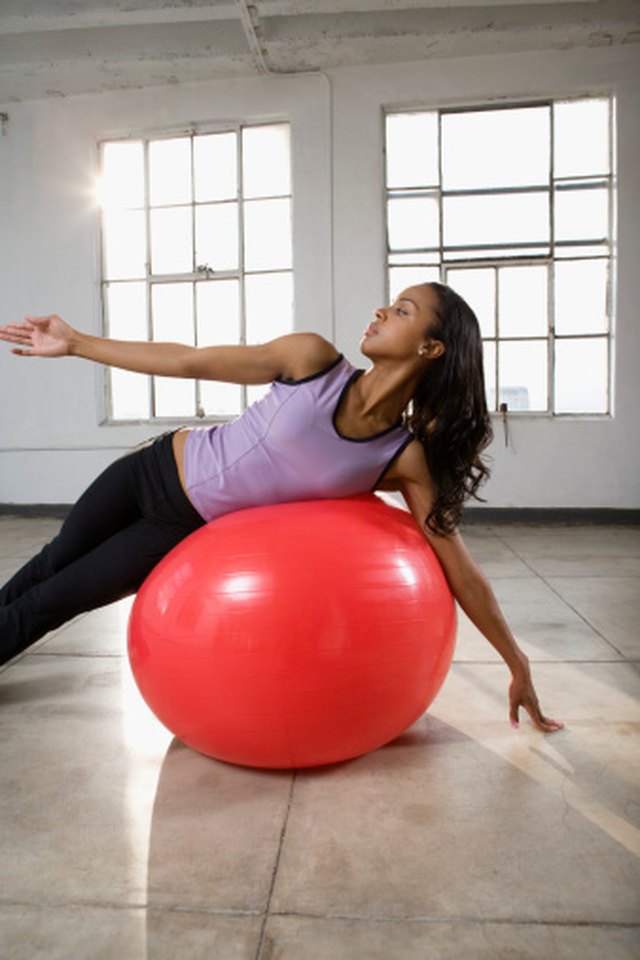
According to the Journal of Clinical Orthopedics and Related Research, the New York University Hospital for Joint Diseases has been developing a Pilates program for hip replacement patients. While Pilates appears to be safe for these patients, the authors of the study stress that more research on this subject is needed. Meanwhile, understanding the postoperative contraindicated movements can help the patient choose the appropriate Pilates exercises.
History of Pilates Rehabilitation
Joseph Pilates developed his technique as a means of overcoming his physical disabilities and limitations. As a German living in England during World War I, he was placed in a British internment camp, where he fine-tuned his rehabilitation methods.
Pilates arrived in New York in 1926, and opened a studio that was popular with dancers and athletes. Although Pilates was less popular during the reign of the "no pain, no gain" philosophy of fitness in the 1970s and 1980s, it experienced a rebirth in the 1990s.
Physical therapist Brent Anderson of Polestar Pilates began using Pilates exercise for dancers who had hip replacement surgery. Anderson and physical therapist Elizabeth Larkham then developed Polestar's pre- and post-rehabilitation instructor-training programs, and other organizations now have similar programs.
Rehabilitaion Benefits of Pilates
According to Dr. Nicholas DiNubile, who coined the word "boomeritis," baby boomers who subjected their bodies to hard-core exercise may be susceptible to hip and other types of injuries, which may eventually require hip replacement surgery.
One can speculate that it was not the intensity, but the mindlessness of these exercises that caused the injuries.
In contrast, Pilates originally gave his technique the name Contrology, which implies controlled, mindful movements.
Since hip replacement post-operative exercise has a number of contraindications, the controlled movements of Pilates exercise are often helpful.
Considerations
Many Pilates exercises require modification in order to adhere to post-operative guidelines. Since the hip should not be flexed past 90 degrees, exercises like "rolling like a ball" are contraindicated. The operated leg should not be adducted past the midline of the body. Avoid internal rotation of the hip joint. When seated, the hip should be higher than the knees. Thus, if you use a stability ball, select a larger one to raise your hips above knee level. Kneeling exercises are discouraged.
Pilates Modifications
During side-lying exercises, place a towel between the inner legs, so that the operated leg does not pass the mid-line of the body. Avoid internal leg rotation during side-lying leg circles by creating a backwards letter "D" with the leg. The Hundred exercise should be performed with the knees bent and the feet on the floor. When performing foot work on the reformer, work from a parallel position, without cables or springs. Simply work the foot against the foot bar.
Warnings
According to Peak Pilates master trainer Clare Dunphy, there are two types of hip replacement operations. While posterior approach surgeries are more common, some people have an anterior approach surgery, which has different guidelines. After anterior approach surgeries, you will need to avoid hip extension and external rotation. Pilates exercises should begin within six to eight weeks after surgery.
Pilates as Prevention
Chronic postural misalignment can make you susceptible to the types of hip injuries that require surgery. The hip joints are surrounded by a synovial membrane that secretes a synovial fluid, a substance that enables fluidity of movement. However, excessive joint friction causes excess fluid secretion, which results in joint inflammation. Joint friction is often caused by postural misalignment, which can be corrected through Pilates exercise.
References
- Byrnes K, Wu PJ, Whillier S. Is Pilates an effective rehabilitation tool? A systematic review. Journal of Bodywork and Movement Therapies. 2018 Jan.;22(1):192-202. doi:10.1016/j.jbmt.2017.04.008
- Wells C, Kolt GS, Marshall P, Hill B, Bialocerkowski A. The effectiveness of Pilates exercise in people with chronic low back pain: a systematic review. PLoS One. 2014;9(7):e100402. doi:10.1371/journal.pone.0100402
- Tudor I-D, Grigore V, Tudor M, Burcea C-C. Pilates Principles - Psychological Resources for Efficiency Increase of Fitness Programs for Adults. Procedia - Social and Behavioral Sciences. 2013;84(9):658-662. doi:10.1016/j.sbspro.2013.06.621
- Huxel Bliven KC, Anderson BE. Core stability training for injury prevention. Sports Health. 2013;5(6):514–522. doi:10.1177/1941738113481200
- Roller M, Kachingwe A, Beling J, Ickes DM, Cabot A, Shrier G. Pilates Reformer exercises for fall risk reduction in older adults: A randomized controlled trial. J Bodyw Mov Ther. 2018;22(4):983-998. doi:10.1016/j.jbmt.2017.09.004
- Kloubec J. Pilates: how does it work and who needs it?. Muscles Ligaments Tendons J. 2011;1(2):61–66.
Resources
Writer Bio
In 1999, Lisa Mercer’s fitness, travel and skiing expertise inspired a writing career. Her books include "Open Your Heart with Winter Fitness" and "101 Women's Fitness Tips." Her articles have appeared in "Aspen Magazine," "HerSports," "32 Degrees," "Pregnancy Magazine" and "Wired." Mercer has a Bachelor of Arts in psychology from the City College of New York.