
How to Teach Yourself Kickboxing
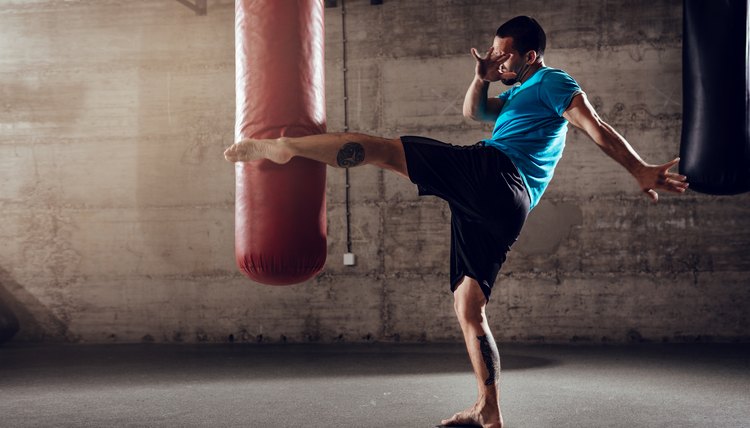
Whether you want to be able to defend yourself against an attack or you just want to get in great shape, learning the art of kickboxing will get you there. An experienced instructor can help demonstrate technique and provide feedback, as well as provide a sparring partner—but that doesn't mean you can't go it alone. There are plenty of print and online resources you can use to build a strong foundation.
Find a Space
You can learn the basics of kickboxing right in your living room, as long as you have enough room to throw some punches and kicks. Depending on the amount of equipment you decide to invest in, you may need a larger dedicated space, such as a basement, rec room or garage.
If you are going to hang a heavy bag, for example, choose a space with plenty of clearance, with ceilings that are high enough and sturdy enough to support the weight. If you plan to use videos to learn techniques, set up a TV or laptop in an area that is visible but not in danger of being damaged by errant kicks or jabs.
Equip Yourself
You can learn the basics of kickboxing without any equipment. Shadowboxing is an effective way to practice punches, kicks and footwork. However, having some equipment will help you take your training to the next level.
For basic training, you need athletic clothing that provides support while allowing you to move freely. You need a cross-training shoe that provides stability but has a light and flexible sole that enables you to be quick and agile.
If you plan to spar with a partner or punch a bag, you'll need hand wraps and/or kickboxing gloves. Hand wraps provide support and light protection for your hands and wrists, while kickboxing gloves provide stronger protection. Other safety items for sparring include shin guards, head guards and mouth guards.
A heavy bag is a major investment but it will really help you develop speed, power and hand-eye coordination. You can also spar with a partner using focus mitts and strike shields which your partner holds for protection.
Learn the Basic Moves
There are a few foundational punches and kicks that are essential to know from the get-go. Learn these, then spend some time practicing your technique before moving on to more advanced combinations.
Fighting Stance
Your fighting stance is the foundation for all your kicks and punches. A strong fighting stance provides stability and power. Stand with your feet staggered, one in front, one behind. Bend your knees slightly and lift the heel of your back foot. Bring your arms up with your elbows next to your ribs and your fists near your chin, palms facing in. Close your fists and curl the fingers in tightly. Place your thumb over your first two fingers.
This is the form you'll start from when executing the following moves. You also want to keep your core muscles contracted by pulling your navel in toward your spine.
Basic Punches
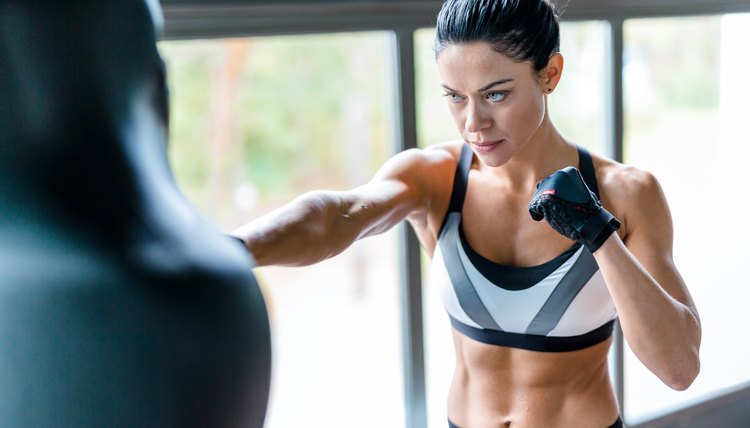
Throwing a powerful punch is crucial for beating an opponent or fending off an attack. From a fitness perspective, throwing punches works the muscles of your upper body and core and, when done for an extended period of time, provides an effective cardio workout.
Jab: Stand with your right foot forward. Rotate your right hip forward and extend your right arm as you twist your forearm so your palm faces the ground. To throw a jab with your left hand, start with the left foot forward.
Cross: Stand with your right foot forward. Rotate your left foot, knee, hip and shoulder as you extend your left arm out, twisting the forearm faces down. Cross with your right arm by starting with the left foot forward.
Hook: Stand with your left foot forward and bring the heel of the right foot to the floor. Pivot on the ball of the left foot, rotating your knee, hip and shoulder to the right. Extend your arm across your body, keep your elbow bent and your forearm parallel with the floor. Start with your right foot forward to throw a hook with your left arm.
Upper cut: With your left foot forward, drop your right arm slightly and rotate your hips to the left. Punch your right fist up, with your palm facing you.
Basic Kicks
The large muscles of your lower body generate a great deal of power. Harnessing that power to throw sharp kicks and sweeping roundhouses makes you a force to be reckoned with. Executing these moves also takes a lot of strength and stamina, so you'll burn fat and build muscle.
Front kick: Stand in fighting stance with your left foot forward. Transfer the weight into your right foot and pull the left knee up to your chest. Pull the left heel in toward your glute and flex the foot. Kick straight out, keeping the foot flexed.
Side kick: Stand with your left foot forward. Rotate your hips to the right and point your right toes out slightly. Keep the left foot flexed as you bend the knee and bring it in toward your chest. Kick the left leg forcefully out to the left, leaning your weight to the right to balance.
Roundhouse: Stand with your right foot forward. Bend the right knee and bring it in toward your glute. Pivoting on the left foot, rotate your hips left as you strike with the right leg in an arc from right to left. Extend the kick from the knee with your toes pointed.
Get Conditioned
Knowing the moves is only part of becoming an accomplished kickboxer. You also need strength, speed and stamina. Building cardiovascular fitness with jogging, bike riding or any other activity you enjoy will help you go the distance in the ring without pooping out.
Build strength and muscular endurance with a regimen of resistance training with or without weights. Do exercises for all your major muscle groups two to three times a week. If you don't have weights at home, simply doing a routine of push-ups, pull-ups, squats, lunges and core work will make you a stronger, better kickboxer.
Read more: Basics of Kickboxing
References
Writer Bio
Jody Braverman is a professional writer and editor based in Atlanta. She studied creative writing at the American University of Paris and received a Bachelor of Arts in English from the University of Maryland. She also received personal trainer certification from NASM and her 200-hour yoga teacher certification from YogaWorks.