
What does fact checked mean?
At SportsRec, we strive to deliver objective content that is accurate and up-to-date. Our team periodically reviews articles in order to ensure content quality. The sources cited below consist of evidence from peer-reviewed journals, prominent medical organizations, academic associations, and government data.
The information contained on this site is for informational purposes only, and should not be used as a substitute for the advice of a professional health care provider. Please check with the appropriate physician regarding health questions and concerns. Although we strive to deliver accurate and up-to-date information, no guarantee to that effect is made.
What Muscles Are Used in Weight Training Exercises?
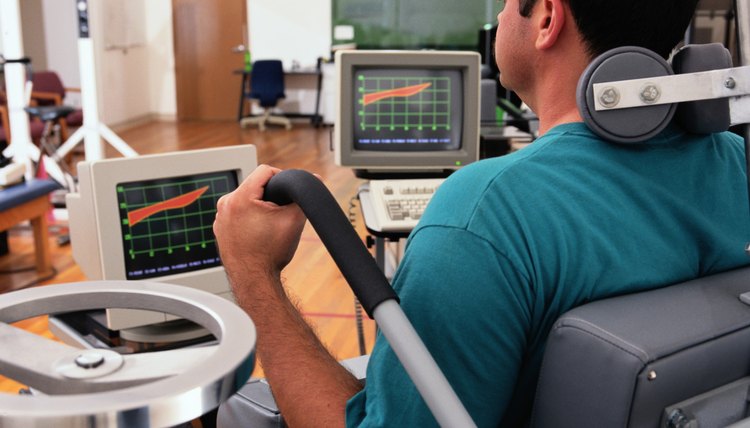
If you are new to working out, it is a good idea to understand a little bit about what muscles are used during weight training. This will ensure that you are targeting your desired muscle and using proper form. Considering that there are more than 600 muscles in the human body, there's no one exercise to hit all of your muscles at once; but the kettlebell Turkish getup or the clean and jerk come pretty close.
Shoulders
The shoulders contain two muscles known as the trapezius and deltoids. The traps are found on the upper part of the shoulders and the delts are located on the sides of your shoulders. Both muscles get worked with a seated front press. Perform this exercise by lifting two dumbbells or a barbell straight above your head.
Triceps
The triceps consist of three-part muscles located on the backs of the upper arms. Responsible for extending the elbow, they can be worked with triceps pushdowns. Perform these are by pushing a straight bar on a cable machine down toward your thighs with your upper arms still.
Biceps
The biceps contain two parts: the biceps brachii and brachioradialis. You can work both regions with a barbell curl. Perform this exercise from a standing position. While holding the bar in front of your thighs with an underhand, shoulder-width grip, lift it up toward your chest and then back down by bending your elbows. This is a movement known as flexion.
Chest
The chest, or pectoral muscles, have two parts. A bench press works both the pectoralis major -- the larger muscle -- and the pec minor -- the smaller. Press a barbell to and from your chest while lying face-up on a workout bench.
Abs
The abs consist of a large muscle that runs from the lower chest to the pelvis called the rectus abdominus and muscles on the sides of the rib cage called the obliques. You can work this entire area with a bicycle crunch and ankle weights attached to your lower legs. Perform this exercise from a face-up position on the floor with your legs and head elevated. From this position you alternate bringing your opposite elbow to your opposite knee while extending one leg out straight.
Back
The back consists of the latissimus dorsi, rhomboids and erector spinae. The lats are the fan-shaped muscles that give your back a V shape. The rhomboids major and minor are located between your shoulder blades. The erector spinae run down the spine and form your lower back musculature. Pullups are exercises that work the lats and rhomboids, and back extensions work your erector spinae.
Glutes and Thighs
The largest muscles in your body, the glutes, are in your butt. The thighs have two main muscles. The quadriceps are located on the front and the hamstrings are located on the back. All of these muscles can be worked with a barbell squat. Hold a barbell behind your neck, lower your body down by bending your knees and stand back up.
Calves
The calf muscles have two parts: the gastrocnemius, which is the upper portion, and the soleus, or the lower portion. Both parts can be worked with a calf raise on a step. Hold dumbbells in your hands, place your toes on the step and alternate between standing on your tiptoes and lowering your heels toward the floor.
References
Writer Bio
I am very genuine and magnetic on camera, and have made numerous videos on my own for clients and other organizations that I'm affiliated with. I also have a degree in Sport Management, and multiple certifications to back up my validity. I've also been featured in three different exercise infomercials and had a speaking role in a National Lampoons movie.