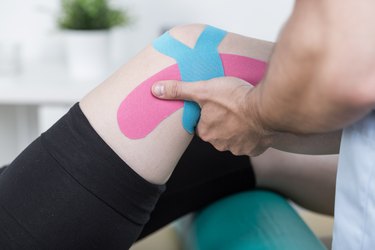
Knee sprains can occur during sports activities or may result from trauma such as a fall. Sprains affect the ligaments that hold your bones together. The cartilage that provides padding between the bones in your knee is also sometimes injured.
Knee sprain rehab includes treatments to decrease pain, manual therapy, range-of-motion exercises and strengthening. Follow the specific instructions from your physical therapist or doctor if you have a knee sprain.
Video of the Day
Video of the Day
Read more: Swelling of the Knee After Exercise
Initial Knee Sprain Rehab
Initial treatment during rehab for a knee sprain focuses on decreasing pain and inflammation while improving blood flow to promote healing. Ice is often used to decrease swelling, pain and muscle spasms. Once your swelling has resolved, heat may be applied to your knee prior to exercise to increase blood flow and decrease stiffness.
Ultrasound and electrical stimulation treatments also decrease pain and increase blood flow to your knee. In addition, neuromuscular electrical stimulation — electrical current that is strong enough to cause a muscle contraction — may be used in conjunction with exercise to help strengthen your thigh muscles as part of knee sprain rehab.
Physical Therapy: Manual Techniques
Manual therapy — hands-on treatment — is an important component of physical therapy for a sprained knee. Your therapist may bend and straighten your knee and move your kneecap to decrease stiffness and improve flexibility. Different types of massage may also be used.
Retrograde massage — strokes directed from your lower leg to your thigh — can be used to decrease knee swelling. Muscle spasms and tightness may be treated with deep tissue massage, or firm pressure applied with strokes in multiple directions.
Cross-friction massage may be performed directly on an injured ligament to increase blood flow to the area. Firm pressure is applied to the ligament, then massaged with a side-to-side motion.
Range-of-Motion Exercises
Range-of-motion exercises often start in your first rehab session to reduce stiffness after your knee sprain.The goal is to improve bending and straightening. Full range of motion is expected within two to four weeks after injury.
At first, you might have difficulty moving the knee without assistance. To improve knee bending, sit with your legs straight out in front of you. Wrap a towel around the ball of your foot. As you attempt to bend your knee, pull the towel toward you to assist with the movement.
Use gravity as one of your stretches for a knee sprain. Lie on your stomach with your lower legs hanging over the edge of the table. Straighten your knee as far as possible, then relax, allowing gravity to gently stretch your knee further.
Build Your Strength
Strengthening exercises typically begin once you have full pain-free movement in your knee. Initially, you might perform these exercises while seated or lying down to reduce pressure on your leg. Ankle weights can be worn during these exercises to increase resistance as you become stronger.
Stationary cycling and use of an elliptical trainer may be incorporated to increase your endurance. Balance activities such as standing on one foot and sports-specific training activities may also be incorporated in rehab, typically six to eight weeks after injury.
Is this an emergency? If you are experiencing serious medical symptoms, please see the National Library of Medicine’s list of signs you need emergency medical attention or call 911.