
A Comparison of Martial Arts Styles
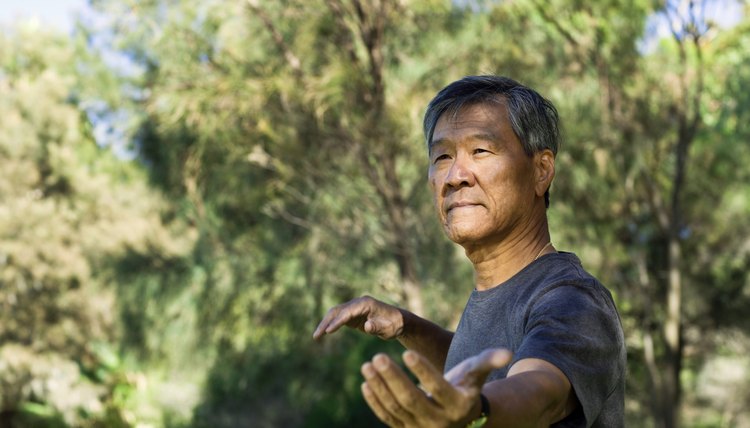
When comparing martial arts styles, it is important to understand the different ranges that can occur in an actual fight. These ranges refer to the distance between you and your opponent. The ranges are kicking, striking, trapping and grappling. While most martial arts styles typically give you some training at each of these distances, usually one range is emphasized over the others.
Get a Kick With Taekwondo
Taekwondo is one of the most popular martial arts in the world. This fighting style, which originated in Korea, focuses on kicking and is most effective at this range. In addition to basic front and side kicks, you also learn flashy spinning and jumping kicks in a taekwondo class. This martial art's kicks are often deceptive, and they can quickly stop an opponent in his tracks. A strong, well-placed kick can prevent you from having to fight an opponent at a closer range. You can see some of the world's top taekwondo competitors spar at the Summer Olympics every four years. Taekwondo became an official Olympic sport in 2000.
The Flurry Fury of American Kenpo Karate
American Kenpo Karate is a particularly effective martial art at striking range. Although this style does teach kicks, American Kenpo Karate is well-known for its devastating flurry of strikes that can hit multiple targets within seconds. According to Dragon's Den Kenpo Karate Studio, every block is a strike and every strike is a block in this martial arts system. American Kenpo Karate was founded by Grandmaster Edmund Parker Sr. in the 1950s. Parker blended the circular movements of Chinese martial arts and the linear movements of Japanese karate styles. This fighting system teaches a series of 154 self-defense techniques that can be used against assailants.
Everybody Wing Chun Tonight
At trapping range, you are close enough to an opponent to control his arms and legs. Wing Chun teaches students how to efficiently fight at this range. This Chinese style was founded by a Buddhist nun about 300 years ago and named after one of her top students. Wing Chun students spend much of their time practicing an exercise called “chi sao,” translated as “sticky hands.” During this exercise, your arms are consistently touching your training partner's arms as you perform techniques. This drill develops your sensitivity and reflexes. In addition, chi sao increases your awareness of weaknesses in your opponent's defense. Wing Chun was popularized by Bruce Lee, who studied this martial art under legendary Grandmaster Ip Man.
The Grace of Brazilian Jiu-Jitsu
If you are involved in an altercation that goes to the ground, then you are in grappling range. Brazilian Jiu-Jitsu teaches numerous arm locks, leg locks and chokes that can be executed at grappling range. This style also teaches you how to use leverage to your advantage. This is particularly helpful against larger opponents. Brazilian Jiu-Jitsu was developed by the Gracie family in Brazil in the 1920s, but it has roots in Japanese jujitsu and judo. Brazilian Jiu-Jitsu increased in popularity in the 1990s when Royce Grace used the fighting style to achieve several victories in the early Ultimate Fighting Championship competitions.
References
Writer Bio
Kelsey Casselbury has a Bachelor of Arts in journalism from Penn State-University Park. She has a long career in print and web media, including serving as a managing editor for a monthly nutrition magazine and food editor for a Maryland lifestyle publication. She also owns an Etsy shop selling custom invitations and prints.