As anyone who's ever watched a swim competition or the Summer Olympics knows, there's more than one way to move across a pool, lake or ocean — and all swimming styles demand something different in terms of technique and effort.
Some strokes, like the freestyle, come relatively naturally, making them ideal swimming strokes for beginners. Others, such as the butterfly, take a while to perfect. Wonder which ones experts think are the simplest — and the toughest?
Video of the Day
Video of the Day
Here's how swim coaches rate the types of swimming strokes from the easiest swimming stroke to hardest. Try adding a few to your next your swim workout to keep you on your fins.
Related Reading
1. Front Crawl or Freestyle
"Swimmers tend to gravitate to freestyle as it's the fastest," Jenny McCuiston, co-founder of Goldfish Swim School, tells LIVESTRONG.com. "And at the introductory level, it's the easiest swimming stroke."
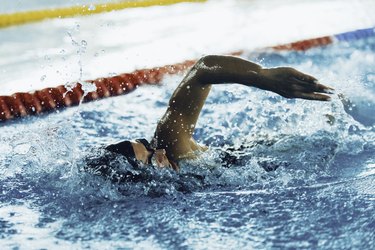
Haven't perfected the stroke just yet? Start facedown, body stretched long and tall. Begin the freestyle arm movement by circling your arms in a continuous cycle (as one arm pulls from above your head to your hip underwater, the other sweeps forward above the water to extend over your head again).
The quick, forceful flutter kick uses most of the big, powerful muscles in your legs — your quads, especially — will feel the burn of the effort, Samantha Caballero, CEO of Swim With Sam in Miami, tells LIVESTRONG.com.
The biggest challenge is learning to breathe while turning your head to the side, Stacy Caprio, a certified Red Cross water safety instructor, coach and former competitive swimmer, tells LIVESTRONG.com.
But once you learn the swimming techniques, freestyle uses the least amount of energy to cover a given distance. That means you can move more quickly, making front crawl the favored stroke for speed — you'll spot many triathlon swimmers using it.
Related Reading
2. Sidestroke
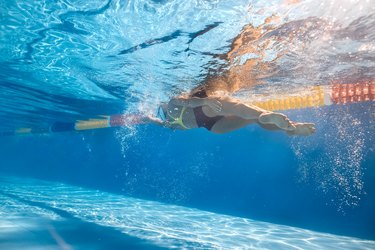
Though many people in the military — including the Navy Seals — practice this stroke, it isn't used in competitive swimming, Caprio says. But lifeguards might use it to rescue people from the deep end, as it's easier to drag someone along with you.
To perform this stroke, lie on one side, with your head, back and legs in the swimming pool in a straight line. Your arms will move at the same time, but asymmetrically. Reach the arm deepest in the water (your leading arm) forward, then sweep down and backward in a semicircular motion, pushing water back with your palm.
The other arm, called your trailing arm, starts at your side, then bends and slides forward until your palms nearly meet, then pushes back to the starting swimming position. Your leg movements, meanwhile, power you forward using a scissor kick.
Sidestroke requires little energy and is accessible for most people, especially because you don't need to submerge your head. But it's far less efficient than freestyle, Mike Lucero, head swim coach and president at Golden Road Aquatics, tells LIVESTRONG.com. For that reason, he ranks it as slightly more difficult.
3. Backstroke
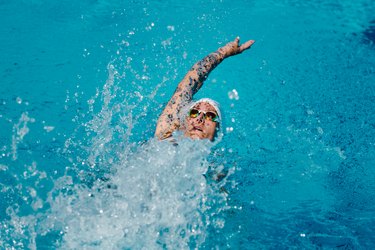
In some ways, backstroke represents the opposite of freestyle, Caballero says. You'll make similar windmill-like reaching and pulling motions with your arms, while your leg movements should be the same powerful flutter kicks.
But because you're doing it all lying on your back instead of your stomach, the stroke requires more coordination. Reaching back, instead of forward, can fatigue your shoulders and triceps, Caballero says. Kicking on your back requires an added focus on form, including pointing your feet and relaxing your ankles.
Because your face stays above the water, breathing is easier, though many swimmers still time their inhalations and exhalations to their strokes. Beginners often find it challenging to keep their heads in the water and arch their neck upward, Lucero says. Instead, relax your neck and stare at the sky as you cycle your arms.
4. Breaststroke
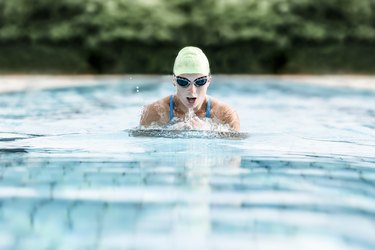
Breaststroke more advanced swimming techniques than many of the other strokes, with more pressing and squeezing, McCuiston says. Getting it right is all about timing, Lucero notes: "It's pull, breathe, kick, swim — and you've got to work on the glide."
Your arms move similarly to treading water. You'll start with palms together, pushing your arms forward. Then comes the pull, where you turn your palms out and bring your arms back in a semi-circular motion before extending them back in front of you again. All this should represent one fluid motion. And as your arms start to come together, you'll lift your head for a breath.
Meanwhile, your legs do a whip kick. Start with your legs in the swimming pool extended behind you, then bend your knees and bring your feet toward your butt. Then, kick out and back forcefully, moving your knees away from each other to the sides and rotating your feet out, a movement often compared to that of a frog.
It's possible to do this stroke while keeping your head above water: Breathing comes easier, you can see where you're headed and you might not need to use goggles. But more competitive swimmers increase their efficiency by dipping their head in to exhale with each stroke.
5. Butterfly
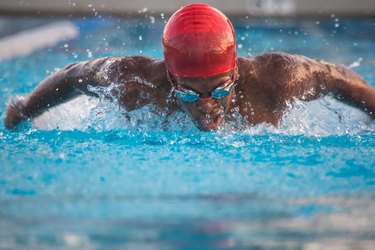
The combination of strength and coordination required to pull off the butterfly make it the hardest swimming stroke. Some people, including many triathletes, never learn it, Lucero says. Other swimmers spend a lifetime trying to perfect it.
Done correctly, your arm movements are symmetrical, and your body whips like a wave and your legs move together in a dolphin kick. Timing is critical: There are two dolphin kicks for each strong pull of the arms, and they must occur at just the right time to maintain forward momentum.
Meanwhile, you'll engage your abs with every stroke and summon significant strength from your shoulders to lift both arms out of the water simultaneously. If that sounds exhausting, it is. The butterfly requires significant physical and mental effort.
"It takes a lot out of you to swim more than one lap," Caballero says. But there's a reason to try: "The accomplishment you feel after is incomparable."
Related Reading