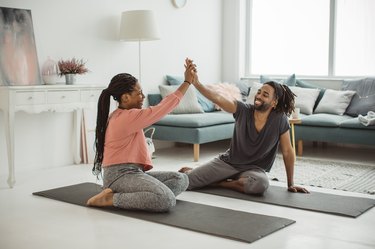
If you've decided to get in shape after being sedentary, you've already taken the first — very important — step in your fitness journey.
So what should you do next? If the thought of going for a jog or picking up a weight after you haven't in a long time (or ever) is intimidating and even scary, know that you're not alone. But also know that getting in shape doesn't have to equal intense or grueling work.
Video of the Day
Video of the Day
First, let's get something straight: There's no one ultimate definition of "in shape." The phrase means something different to everyone, explains Andy Speer, CSCS, a certified strength and conditioning specialist and Peloton Tread and Strength instructor. We're all starting from a different place and have our own unique goals.
"If you've been very sedentary, getting up and going for a five-minute walk and then a 10-minute walk and then a 20-minute walk are huge accomplishments," Speer says.
Are you a long-time exerciser trying to figure out how to get back in shape after some time off? Maybe you go for a light mile-long jog and see how it feels. "It really varies from person to person," he says.
And don't feel like that five- or 10-minute walk isn't worthwhile. Even adding a small amount of activity into your life can make a big difference in your health and mood, says Bianca Vesco, CPT, a certified personal trainer and WW Digital 360 coach.
Of course, exercising can help you reach performance and aesthetic goals, but more importantly, it has so many health benefits. It's good for your heart and lungs, bone strength, mental health and more.
It also just feels good when your muscles are loose and your body doesn't ache every time you bend down to pick something up. Sometimes, it's the little things.
Want to make it happen. Here, experts share exactly how to get in shape — and stay there for life.
Figure Out Your 'Why'
Why do you want to get fit? Establishing your "why" gives you focus and purpose — and something to keep coming back to on days you want to quit.
"Think about what you want out of life," Vesco says. "Is it to be able to chase your kids around without getting out of breath? Is it carrying all your groceries in one trip? Is it going on a run without lower back pain?"
Consider these deep-down reasons your fire. While it's totally normal and OK to have some aesthetic goals in mind, quality-of-life ones have more staying power. (They also just tend to feel better, right?)
Related Reading
Set Realistic Mini-Goals
Once you establish your "why," you can set some small goals to work toward your large, overall goal.
"When you figure out what you want to get out of exercise, that's going to allow you to determine what you need to put into it," Speer says. The key here is to make goals SMART: specific, measurable, achievable, realistic and time-bound.
"It doesn't have to be a five-year plan, it can be a one-month plan," Speer says. "Keep it to short-term goals."
For example, if your overall goal is to run a 5K, maybe your first-month goal is to walk for 30 minutes three times per week to get your body comfortable with moving consistently. Maybe you also throw in a goal of stretching for 10 minutes after each walk.
Meeting these action-based goals gets you closer to your ultimate goal while giving you plenty of accomplishments to celebrate along the way.
Do What Feels Good
This should be obvious but, unfortunately, a lot of people think pain and gain actually go together. No! You should actually enjoy your workouts.
That doesn't mean they shouldn't be challenging, but it does mean ditching activities that make you miserable and feel like you're not making any progress. It makes sense — no one feels inspired to keep doing something they hate.
That might mean skipping burpees and finding an alternative to do whenever they pop up in a workout, or taking dance cardio classes because you love to dance. But it can also mean creatively marrying movement with other hobbies.
"Think about things you're genuinely interested in and how you can incorporate movement into that activity, even if it's not activity-based," says Janeil Mason, CPT, a certified personal trainer and creator of Fit and Lit.
Take, for example, cooking. "You can incorporate a love of cooking into movement by listening to a podcast about cooking while you're going for a walk," he says. "Or maybe when you're watching your favorite cooking show, walk around your living area or do 10 squats during the commercial breaks."
Practice Patience
How long does it take to get in shape? It depends on what "in shape" means to you, your starting place and what your new fitness routine entails.
That said, getting in shape is not a race. If you feel like things are moving slowly, that's normal. Slow is good. It means you're making realistic changes that you can stick with over the long haul. Be patient with yourself and the process, Speer says.
"[Progress happens] a little bit each day, and some days may not go as well as others," he says. "But what matters is that you are intentional and purposefully continuing forward. Know that some days you're going to feel really good about what you did, and some days you're just going to do it even if it doesn't feel like you accomplished much."
Even on those less-than-stellar days, remember to appreciate yourself for what you did accomplish. Progress over perfection.
"Patience is a virtue and for some people, it's hard to come by. I am one of those people, so I try to take it one day at a time," Vesco says. "One day, one step, one workout at a time."
Start With Stretching
Before you take up jogging or lifting, cement a regular stretching habit.
"Flexibility work is a great gateway exercise because it doesn't involve anything high-impact and can improve your range of motion," Vesco says. It's also a great way to get familiar with your body and how it moves before jumping into anything more intense.
Consider adding a few five-minute stretch sessions into your weekly routine to get in the habit of moving consistently and improving your flexibility.
Ease Into Strength Training and Cardio
Strength training works your muscles and increases strength; cardio works your most important muscle, your heart, and helps increase your endurance. Both burn calories and both are necessary in some amount for overall health and fitness. The best way to get in shape is to do some mix of both.
For example, in one 2019 PLOS One study of 69 sedentary adults, doing both resistance training and cardio was they key to improving their cardiovascular health. Doing just one or the other really didn't cut it.
According to the Physical Activity Guidelines for Americans, for overall health, adults should do at least 150 minutes per week of moderate-intensity or 75 minutes a week of vigorous-intensity aerobic activity, preferably spread throughout the week. They should also do moderate- to high-intensity muscle-strengthening moves two or more days per week.
The perfect breakdown of each, though, depends on your goals, Vesco says.
"If you're not sure where to start with this, try alternating days. One day strength, one day cardio," she suggests. "See how your body responds and what you do and don't like and create a game plan from there."
When you're just starting your fitness journey, this can be as simple as walking for cardio and doing a few bodyweight exercises for strength.
Use Other Healthy Habits as Support
"How you live your life dictates how you show up for your workouts," Vesco adds. "Bringing awareness to the foods you eat and the small steps you can take every day to set yourself up for long-term success is crucial to your journey." Some examples of small steps worth taking: good sleep, plenty of hydration and healthy stress management.
Same thing goes for your mindset and the way you speak to yourself. "You don't want to have that negative inner monologue, you want to speak positively to yourself so that you get through what you're doing, even if it's hard," Mason says.
Think about what your trainer or fitness instructor would say to you: "You can do it." Or remind yourself why you started your get-in-shape routine in the first place. "That's positive self talk and that helps with exercise," she says.
Know That Any Movement Counts
The path to getting in shape after being sedentary doesn't have to be paved with high-intensity workouts. In fact, if you're starting slow and steady (like you should), physical activity may not be what you think of as a "workout," at least not in the beginning. It may just be more general "movement."
"Sneaky exercise is my favorite way to exercise," Vesco says. "Daily activities like, cleaning, dancing or playing with kids can absolutely count toward movement."
Just because you're not in a gym or holding onto weights doesn't mean you're not going good things for your body. Any movement counts as exercise and is an important part of your journey to getting in shape.
Was this article helpful?
150 Characters Max
0/150
Thank you for sharing!
Thank you for your feedback!