
What does fact checked mean?
At SportsRec, we strive to deliver objective content that is accurate and up-to-date. Our team periodically reviews articles in order to ensure content quality. The sources cited below consist of evidence from peer-reviewed journals, prominent medical organizations, academic associations, and government data.
- European Journal of Applied Physiology: Effect of Body Tilt Angle on Fatigue and EMG Activities in Lower Limbs During Cycling.
- European Journal of Applied Physiology: Effect of Body Tilt Angle on Fatigue and EMG Activities in Lower Limbs During Cycling.
The information contained on this site is for informational purposes only, and should not be used as a substitute for the advice of a professional health care provider. Please check with the appropriate physician regarding health questions and concerns. Although we strive to deliver accurate and up-to-date information, no guarantee to that effect is made.
Resistance Vs. Electric Exercise Bikes
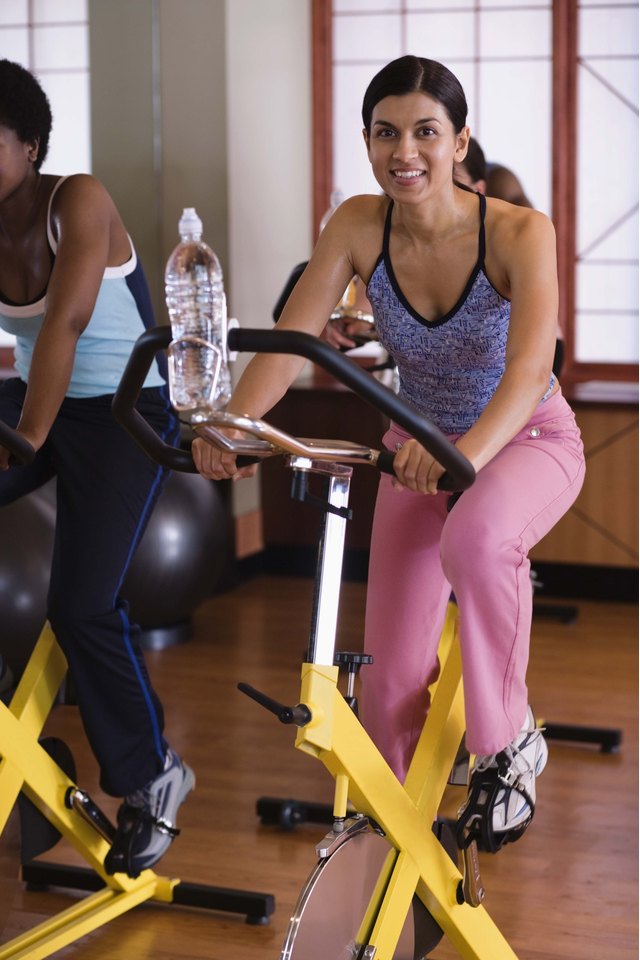
Nearly every health club and gym now offers indoor classes that re-create the road racing conditions experienced by elite cyclists. Working out on a resistance bike differs from an electric bike in both form and exertion. Choosing between a resistance bike or an electric bike depends on your preferred type of cycling workout and how engaged you want to be while exercising.
Automated Course
An electric exercise bike allows you to set a predetermined course at the beginning of your workout. Choosing your own course lets you select the duration and intensity of your workout. Courses simulate series of steep hills, gently rolling hills or flat terrain. Such bikes create each hill and valley by automatically increasing or reducing the resistance for a specific length of time. In contrast, the only way to change the speed or resistance on a nonelectric stationary bike is by moving your legs faster and turning a manual knob. Both types of exercise bikes offer challenging workouts, but the electric bike lets you "zone out" after setting the initial difficulty level, which may or may not appeal to you.
Progress Tracking
If you're exercising on a resistance bike alone, you must rely on yourself to push yourself by speeding up or adding resistance. If you're in a class or exercising with a DVD, the instructor tells you when to work harder. But an electric exercise bike tracks everything from the distance you've gone to the number of calories you've burned. These numbers can be found on the computer screen mounted on the front of the bike. Those who enjoy monitoring their workout details, such as the average number of revolutions per minute or the distance they've covered in the past 20 minutes, can find a nonelectric cycling bike disorienting and frustrating. Conversely, seasoned cyclists who gauge their workout intensity by heart rate or perceived exertion can find tracking a computer screen distracting.
Position Variety
While electric exercise bikes come in recumbent and upright models, all resistance exercise bikes are upright. This upright position creates a natural flow of energy from your torso down through your legs. By contrast, a recumbent exercise bike bisects your upper and lower body, making pedaling less ergonomic and more tiring. According to a 2010 study published in the European Journal of Applied Physiology, subjects riding a reclined exercise bike tired earlier and ultimately exerted less energy than those riding upright bicycles.
Real-Life Simulation
Riding a nonelectric stationary bike mirrors the experience of road racing more closely than riding an electric exercise bike. Like the bike you'd ride outdoors on the pavement, a nonelectric indoor bike requires you to adjust your exertion level instead of waiting for a computerized course to change the resistance level. While exact models vary, the electronic gear adjusters can also make pedaling an electric bike feel choppy and less natural than riding on a resistance indoor cycle.
References
- European Journal of Applied Physiology: Effect of Body Tilt Angle on Fatigue and EMG Activities in Lower Limbs During Cycling.
- Ho SS, Dhaliwal SS, Hills AP, Pal S. The effect of 12 weeks of aerobic, resistance or combination exercise training on cardiovascular risk factors in the overweight and obese in a randomized trial. BMC Public Health. 2012;12:704. doi:10.1186/1471-2458-12-704
Writer Bio
Christina Bednarz Schnell began writing full-time in 2010. Her areas of expertise include child development and behavior, medical conditions and pet health. She holds a Bachelor of Arts in international relations.