
Losing weight in your 40s isn't the same as when you were in your 20s and 30s. Unfortunately, a few changes make it slightly more challenging.
For one, sarcopenia (the natural loss of muscle tissue with age) starts to rear its head. And remember, muscle burns more calories than fat does, so losing muscle mass means a slower metabolism.
Video of the Day
Video of the Day
The second hurdle — for those assigned female at birth — is the transition through menopause, called perimenopause. It's common for people in this stage of life to gain weight, gain fat (especially around their mid-section) and start to have higher blood sugar levels, according to a November 2018 study in Maturitas.
So how can you make weight loss — or even just weight maintenance — easier in your 40s? Here are five expert-backed tips.
1. Figure Out How Many Calories You Actually Need
To lose weight, you need to eat less than you burn, which comes down to simply subtracting calories. But how many calories is that, exactly?
Keep in mind that calorie needs change as we age, so you may need fewer calories than you did in your 20s or 30s to maintain your current weight.
Here's a general look at calorie needs by age and activity level (the lower number in each range is for people assigned female at birth, and the higher number is for those assigned male at birth):
Calorie Needs by Age and Activity Level
Age | Sedentary | Moderately Active | Active |
|---|---|---|---|
36-40 | 1,800-2,400 | 2,000-2,600 | 2,200-2,800 |
41-45 | 1,800-2,200 | 2,000-2,600 | 2,200-2,800 |
46-50 | 1,800-2,200 | 2,000-2,400 | 2,200-2,800 |
Moderately active means you walk between 1.5 and 3 miles per day (or do equivalent exercise), while active is anything beyond that.
In order to lose weight, you'll want to subtract about 500 to 750 calories from your weight-maintenance number, per the 2020-2025 Dietary Guidelines for Americans. This should help you lose 1 to 1.5 pounds each week, which is considered safe and maintainable in the long run, according to the National Institutes of Health.
Keep in mind, though, that you shouldn't fall below 1,500 daily calories for those assigned male at birth or 1,200 for people assigned female at birth, per the Dietary Guidelines, because this puts you at risk for nutrient deficiencies and other unhealthy side effects.
2. Prioritize Protein
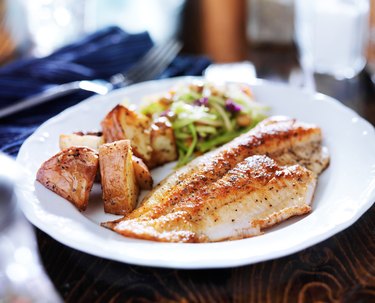
When you're trying to lose weight, eating protein-rich foods is key — partly because protein is quite filling (more so than carbs or fat, actually, per a February 2015 study in the Nutrition Journal). Also, eating protein may help you eat less later in the day, according to the same study.
In fact, a May 2015 study in the Journal of Nutrition, Health, & Aging found that people in menopause who ate higher amounts of protein weighed less and had less body fat than those who ate less protein.
The high-protein-eaters ate 0.8 grams of protein per kilogram of body weight or more each day. That translates to about 55 grams of protein each day for a 150-pound person.
So, what should you be eating? Lean, protein-rich foods include all types of seafood, meat, poultry and eggs; plant-based proteins like nuts and seeds and "butters" made from them; soy products; and peas, lentils and beans, per the USDA.
Here are some common protein-rich foods that make healthy additions to a diet:
- 3 ounces of lean beef, chicken, turkey, pork or fish: 21 grams of protein
- 3 ounces of seafood: 18 grams of protein
- 5 ounces of Greek yogurt: 12 to 18 grams of protein
- 3 ounces of tofu: 9 grams of protein
- Half-cup of kidney, black or cannellini beans: 8 grams of protein
- 2 tablespoons of peanut butter: 7 grams of protein
- 1 egg: 6 grams of protein
3. Pare Down Your Carbs
Based on how your hormones change in your 40s as you enter perimenopause, following a lower-carb diet could help prevent weight gain or make weight loss easier.
"You want all of your hormones in balance — your sex hormones like estrogen, progesterone and testosterone, as well as insulin," Carolyn Williams, PhD, RD, author of Meals That Heal, tells LIVESTRONG.com.
That balance is key for a couple reasons. First, your sex hormones work with insulin to control your blood sugar.
"When your sex hormones become unbalanced, you're at higher risk of developing insulin resistance, which can make perimenopause symptoms worse," Williams says. "And also, decreased estrogen levels have been linked to insulin resistance."
This is why experts believe post-menopausal people gain weight, especially in the abdominal area, and also find it harder to lose weight.
Williams suggests cutting back on carbs to help fight that insulin resistance that can encourage weight gain or prevent weight loss.
"I have found that alternating low- and lower-to-moderate carb days can be beneficial for this age group. And by this I mean days where you have 50 grams of net carbs and then days where you have 100 grams of net carbs," Williams says.
Net carbs is an easy calculation: It's total carbohydrate grams minus grams of fiber.
To get a better grasp on what 50 grams of net carbs a day looks like in food servings, here's how many carbs and net carbs are in a serving of some common carbohydrate-heavy foods, per the USDA:
- 1 cup oatmeal: 32 grams total carbs, 27 grams net carbs
- 1 slice whole-wheat bread: 15 grams total carbs, 13 grams net carbs
- 1 cup grapes: 27 grams total carbs, 26 grams net carbs
- 1 cup raspberries: 18 grams total carbs, 8 grams net carbs
- 1 cup green beans: 7 grams total carbs, 3 grams net carbs
4. Keep Your Stress in Check

"In your 40s, the sheer number of demands — career, being sandwiched between raising kids and aging parents — can raise your stress," Kara Mohr, PhD, FACSM, of MohrResults.com, tells LIVESTRONG.com.
If you can keep your stress level dialed down, though, that can help you keep weight gain at bay and potentially make losing weight a little easier.
Here's why: When you're stressed, your cortisol levels are elevated, and that can raise your blood sugar and also encourage weight gain, especially around your midsection, according to the True Health Initiative.
Also, keeping stress in check might make it easier to eat a healthier diet. We're more likely to overeat and choose less-healthy foods when we're stressed, according to a December 2018 study in the Journal of Molecular Biochemistry.
"To manage stress, first start by identifying which stressors are within your control versus not," Mohr says.
Things like the weather, illness, loss and economic uncertainty are all not in your control. But you can control your thoughts and beliefs, and how you act.
"Set reminders on your phone to take 1 to 2 minutes a few times each day to check in and notice what you're feeling," Mohr suggests. "Are you worrying about things outside of your control? Are you 'future tripping' — finding yourself planning, focusing or worrying about a future state — rather than staying in the present moment?"
Use that time to focus on your breath, clear your mind and connect to what is in the present moment.



5. Re-Assess Your Exercise Routine
In your 40s, exercise is about more than just vanity. For a few reasons, exercise becomes that much more valuable at this age.
"One is a decrease in muscle mass and bone density that can occur with aging,"Mohr says. "The second is a shift in hormones that leads to increased abdominal adiposity — aka belly fat — and a third is the increased demands on time and stressors for this age group."
Fortunately, the type of activity you choose has the potential to bolster your results.
Weight-bearing exercises, such as strength training and yoga, can offset losses in bone density and maintain, or even increase, your muscle mass.
When it comes to belly fat: "Research has shown that abdominal fat responds better to higher-intensity exercise, but that type of exercise is an additional physical stress," says Mohr.
Her advice is to use exercise in complement with the overall stress in your life as well as your current activity level. So, for instance, if you are currently under high demands, choose weight-bearing exercises that don't create as much physical stress on your body or that have other relaxing qualities, such as yoga.
"If your overall stress is in check and you want to offset some changes in your body composition, consider adding some high-intensity intervals a few times a week," Mohr says.



- Maturitas: "A qualitative assessment of health behaviors and experiences during menopause: a cross-sectional, observational study"
- Harvard Health Publishing: "Calorie counting made easy"
- Nutrition Journal: "A randomized, controlled, crossover trial to assess the acute appetitive and metabolic effects of sausage and egg-based convenience breakfast meals in overweight premenopausal women"
- True Health Initiative: "Cortisol “The Stress Hormone” Makes You Fat"
- Journal of Molecular Biochemistry: "Impact of a stress management program on weight loss, mental health and lifestyle in adults with obesity: a randomized controlled trial"
- U.S. Department of Health and Human Services: "2015-2020 Dietary Guidelines for Americans"
- National Institutes of Health: "Key Recommendations"
- Journal of Nutrition, Aging, & Health: "Adequate dietary protein is associated with better physical performance among post-menopausal women 60–90 years"
- USDA: "Protein Foods"
- 2020-2025 Dietary Guidelines for Americans
- U.S. Food & Drug Administration: "Do You Know How Many Calories You Need?"