How to Cover Missing Teeth in Your Mouth
Having a gaping hole in your mouth where a tooth or teeth should be isn’t pleasant. Missing teeth can seriously affect how you look, often for the worse 1. Any missing teeth you have affect how your teeth slot together when you bite down on food 1. Missing teeth can cause food to get trapped in the spaces, which can lead to tooth decay and gum disease 1. From a cosmetic angle, there are several ways you can compensate for missing teeth, ranging from crowns to partial dentures or a full set of dentures 1.
Put in a fixed partial denture, which is commonly known as a bridge. A bridge covers up the gap in your mouth left by one or more teeth by creating a "bridge" between the existing teeth. This type of bridge is glued into the mouth with dental cement, while a removable bridge can be removed by the wearer.
Types of False Teeth
Learn More
Insert a cap or a crown. Caps are the best option for covering gaps in your teeth when part of the tooth is missing, because they can be fitted onto the partial remains of a tooth 1. They are also useful for propping up an existing filling when the tooth surrounding the filling is almost gone.
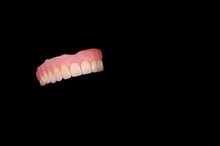
Wear a set of dentures. This is the best solution if you are missing many teeth and wish to cover the resulting gap 1. There are partial and full dentures. Partial dentures are mounted onto a plastic or metal plate or a framework that is inserted inside the mouth and is held in place with clasps. Full dentures are worn when no teeth remain in either your upper or lower jaw. Upper full dentures suction onto your palate to stay in place. If you do wear dentures, be sure to clean them after each meal, using soap or a denture cleaner and a soft toothbrush.
Warnings
Lower fuller dentures are harder to keep in because of the movement of your jaw, so make sure you go to a reputable dentist.
Related Articles

Types of False Teeth
Learn More

What Is the Difference Between Dental Bonding & Veneers?
Learn More
How to Make Your Own Tooth Caps
Learn More
How to Cement a Dental Crown Without the Dentist
Learn More

Disadvantages of Ceramic Braces
Learn More

How to Remove Tooth Tartar at Home
Learn More
How to Hold Dentures in Without an Adhesive
Learn More
How to Remove Gum Line Stains
Learn More
How to Glue Broken Dentures
Learn More
How to Set Up for a Dental Composite Procedure
Learn More
References
- “Bupa”; Replacing missing teeth
- “Health Leader; Missing a Tooth? “Bridge” the Gap
- The American College of Prosthodontists "Who is a Prosthodontist?"
- The American Dental Association. "Dentures FAQ"
- The National Denturist Association. "What Denturists Do."
Writer Bio
Based in Leeds, United Kingdom, Nicola Gordon-Thaxter has been writing sales articles since 1995. Her articles have appeared in the "Milton Keynes Citizen" and on the ePolitix website. Gordon-Thaxter holds a Bachelor of Arts in English literature from the University of the West Indies and is completing a Master of Arts in writing from the University of Leeds.