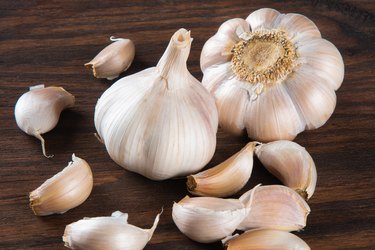
If you love garlic and you have ulcerative colitis, you may be wondering if eating garlic is good (or bad) for you — and if it could heal or prevent an ulcerative colitis flare-up. Could garlic be used to help heal ulcerative colitis, or should it be avoided?
At this point, it's unclear whether garlic is good or bad for people with ulcerative colitis (UC), and it may take trying it out in small amounts and monitoring your symptoms to know what works for you.
Video of the Day
Video of the Day
"At this point, dietary management of ulcerative colitis is highly individualized, and there has not been convincing data to support any broad recommendations for patients," says Boston-based Andrew T. Chan, MD, MPH, vice chair of Gastroenterology at Massachusetts General Hospital and professor of medicine at Harvard Medical School. Nor is there "any concrete data that eating garlic might either be beneficial or harmful for people with ulcerative colitis," he says.
"Garlic does not treat colitis, and is not a recommended food for it either," adds David T. Rubin, MD, section chief of Gastroenterology, Hepatology & Nutrition at the University of Chicago Medicine.
Ulcerative colitis is an inflammatory bowel disease, marked by inflammation and ulcers in the large intestine, causing symptoms such as diarrhea, cramping and urgent bowel movements, according to the National Institute of Diabetes and Digestive and Kidney Diseases (NIDDK).
Garlic’s Potential for Ulcerative Colitis
To date, research on garlic's potential for helping ulcerative colitis has largely been tested on animals — which doesn't always translate to people.
When it comes to overall health, a large October–December 2014 review in the Journal of Traditional and Complementary Medicine (JTCM) notes garlic is highly regarded around the globe for its medicinal properties as an antibacterial, antiviral and antifungal.
However, more human studies are needed to confirm or deny putting garlic in your arsenal for UC.
The Potential Downside of Garlic for Ulcerative Colitis
While some animal studies have shown promise for garlic and UC, experts warn that for humans with ulcerative colitis, garlic may not be your friend.
The Crohn's & Colitis Foundation (CCF) does not endorse any single dietary intervention. But among various nutritional options, it does highlight the low-FODMAP diet, which advocates avoiding specific groups of sugars in certain foods that may pose absorption difficulties for people with ulcerative colitis.
One such group is "fructans," found in leeks, artichokes, wheat — and, yes, garlic. This diet is one that people with certain GI conditions can try temporarily to see if it reduces symptoms.
Ulcerative Colitis Food Dos and Don’ts
According to the NIDDK, treatment for ulcerative colitis largely centers around medications designed to reduce inflammation in the large intestine.
That said, the CCF offers broad meal guidance for ulcerative colitis patients:
- Eat four to six small meals per day.
- Stay well-hydrated.
- Drink slowly.
- Avoid straws (to reduce air ingestion).
- Use simple cooking methods (boiling, poaching, grilling, steaming).
Trigger foods best avoided, per the CCF, include:
- High-fat foods
- Insoluble fiber
- Lactose
- Sugary foods
- Alcohol and caffeinated drinks
- Spicy foods
Instead, the CCF advises sticking to easier-to-digest foods such as:
- Low-fiber fruits (melon, cantaloupe)
- Lean proteins (fish, white meat, soy)
- Refined grains
- Fully cooked seedless, skinless noncruciferous vegetables (cucumbers, potatoes, squash, asparagus tips)
- Andrew T. Chan, MD, MPH, vice chair of Gastroenterology, and chief of Clinical and Translational Epidemiology Unit, Massachusetts General Hospital; professor of medicine, Harvard Medical School, Boston
- David T. Rubin, MD, section chief of Gastroenterology, Hepatology & Nutrition and codirector, Digestive Diseases Center, University of Chicago Medicine, Chicago, Illinois
- Journal of Traditional and Complementary Medicine: “Dietary Agents and Phytochemicals in the Prevention and Treatment of Experimental Ulcerative Colitis”
- Crohn’s & Colitis Foundation: “Special IBD Diets”
- NIDDK: “Ulcerative Colitis”
- NIDDK: "Eating, Diet, & Nutrition for Ulcerative Colitis"
Is this an emergency? If you are experiencing serious medical symptoms, please see the National Library of Medicine’s list of signs you need emergency medical attention or call 911.