
Pre-K Games to Play in Gym
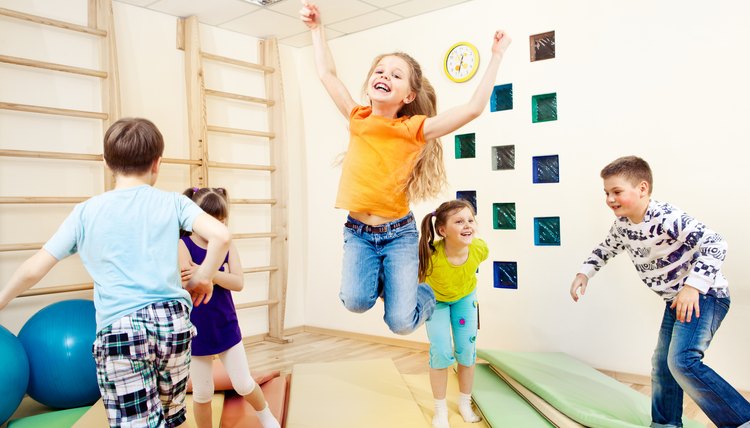
Preschool students typically love physical activity. Gym is likely one of their favorite classes at school because they get to move freely and release energy. Physical Education teachers should take advantage of this excitement by designing fun and engaging movement games for their preschool students. Such games will help preschoolers stay healthy and practice basic age-appropriate skills such as body awareness, motor skills and rhythm.
Copy Cat
The copy cat game introduces preschool students to a variety of movements and teaches them body and space awareness. Have the students spread out throughout the gym. Tell them that you are the “cat” and they are the “copy cats.” Emphasize that they need to stay in their own area. Perform various movements—arm circles, jogging in place, jumping up and down, toe touches and more—for about 10 seconds each. Tell the students to copy your movements as best they can as you switch from skill to skill. Provide encouragement and verbal feedback to the students during the activity. After about a minute of activity, allow the students to rest briefly and then assign a student to be the cat. Continue until all the students have played the cat once.
Follow the Leader
Follow the leader teaches preschoolers to follow directions and gets them moving as soon as they enter the gym. Make the students line up outside the gym and explain that they are to follow you into and around the gym. Walk at various speeds and change directions often. Use your arms to pretend to fly like an airplane or flap wings like a bird.
Jump the River
PECentral.org recommends “jump the river” to improve preschoolers’ jumping ability. Prepare for the game by scattering jump ropes throughout the gym. Before starting the activity, teach kids how to properly jump off both feet and land on both feet. Tell the students they will be walking around the gym and will need to “jump the river” each time they come to a jump rope; demonstrate this several times for the students before having them engage in the activity. Have them perform the activity for 3 to 5 minutes at a time. Play music to indicate when they should be moving.
Shadow Tag
Physical Education teacher Carol Totsky Hammett, a contributor to PECentral.org, suggests playing shadow tag to help preschool students work on chasing and fleeing. This game also improves preschoolers’ cardiovascular endurance. It must be played outdoors on a sunny day. Assign partners and have one be the “walker” and the other the “tagger.” On your signal, the walker walks around randomly and the tagger chases the walker and tries to step on her shadow. Once the tagger successfully steps on the walker’s shadow, the partners switch roles. Emphasize that the walkers must stay far away from other groups to avoid collisions.
References
Writer Bio
Matthew Schirm has worked in the sports-performance field since 1998. He has professional experience as a college baseball coach and weight-training instructor. He earned a Master of Science in human movement from A.T. Still University in 2009.