What does fact checked mean?
At Healthfully, we strive to deliver objective content that is accurate and up-to-date. Our team periodically reviews articles in order to ensure content quality. The sources cited below consist of evidence from peer-reviewed journals, prominent medical organizations, academic associations, and government data.
The information contained on this site is for informational purposes only, and should not be used as a substitute for the advice of a professional health care provider. Please check with the appropriate physician regarding health questions and concerns. Although we strive to deliver accurate and up-to-date information, no guarantee to that effect is made.
Tooth Pain After Eating
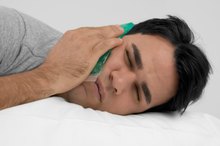
Pain in the teeth can affect everything—including the way you eat, interact with others and even smile. Although tooth pain after eating can be the sign of tooth injury or decay, it may also signal a temporary condition that can be remedied from home. Therefore, it is important to understand what causes tooth pain and how it can be treated.
Symptoms
“The Doctors Book of Home Remedies” notes that pain in the tooth can occur after eating, drinking, smiling, frowning, clenching the jaw or moving the head in different directions 1. Sometimes breathing can even cause tooth pain as warm or cold air moves into the mouth over a sensitive tooth. In addition, tooth pain can also be accompanied by redness, gum and facial swelling and peeling inside of the mouth.
Causes
Can You Drink Beer With Abscessed Tooth?
Learn More
According to the Mayo Clinic, tooth decay is typically the cause of tooth pain. This decay occurs when bacteria clings to the plaque on the teeth and begins to create a hole called a cavity. Left untreated, this cavity can grow deeper and deeper, eventually exposing the nerve of the tooth. In addition to decay, tooth pain after eating can also be the sign of an infection or even just a little bit of food caught in between two of the teeth.
- According to the Mayo Clinic, tooth decay is typically the cause of tooth pain.
- Left untreated, this cavity can grow deeper and deeper, eventually exposing the nerve of the tooth.
Relief
Rinse the mouth and teeth out with warm water and floss to loosen any pieces of food trapped between the teeth. In addition, antiseptics such as eugenol or benzocaine can be dabbed directly onto the tooth to help reduce irritation and pain. Orally, traditional pain reliever medications, such as ibuprofen, can relieve aches and swelling. In the case of a cavity, a dentist must be seen to remove the decayed sections of tooth and replace them with a filling.
- Rinse the mouth and teeth out with warm water and floss to loosen any pieces of food trapped between the teeth.
- In the case of a cavity, a dentist must be seen to remove the decayed sections of tooth and replace them with a filling.
Prevention
Relief From Wisdom Tooth Pain
Learn More
To prevent tooth pain and decay, KidsHealth recommends brushing the teeth with a toothpaste containing fluoride at least two times a day—but preferably after every meal 4. Make sure you brush the gums as well as the teeth. To remove food and plaque, floss every night at bed time. Stay away from sugary foods and drinks, which can encourage cavities and decay. Go to the dentist two times a year for cleanings and regular checkups.
- To prevent tooth pain and decay, KidsHealth recommends brushing the teeth with a toothpaste containing fluoride at least two times a day—but preferably after every meal 4.
Tips
Before your dentist appointment, “The Doctors Book of Home Remedies” suggests avoiding the painful tooth while eating 1. Food can become trapped in cavities or further irritate sore teeth and gums. Consider sucking on an ice cube or applying an ice pack to the cheek in 15-minute increments approximately four times a day. Because cold air can increase the sensation of tooth pain, consider keeping your mouth closed as much as possible.
- Before your dentist appointment, “The Doctors Book of Home Remedies” suggests avoiding the painful tooth while eating 1.
- Because cold air can increase the sensation of tooth pain, consider keeping your mouth closed as much as possible.
Related Articles

Can You Drink Beer With Abscessed Tooth?
Learn More

Relief From Wisdom Tooth Pain
Learn More
Relief of Tooth Pain From Eating Warm Food
Learn More
How to Clean Germs Below the Gumline
Learn More

How to Eat With a Tongue Ring
Learn More
Dental Bridge Complications
Learn More

How to Remove Tooth Tartar at Home
Learn More

Tooth Pain and Sweets
Learn More
Tooth Pain & Nausea
Learn More
Toothaches and High Altitudes
Learn More
References
- "The Doctors Book of Home Remedies"; Prevention Magazine Editors; 2003
- MayoClinic: Toothache
- FamilyDoctor.org: Tooth Problems
- KidsHealth: What's a Cavity?
- Renton T. Dental (Odontogenic) Pain. Rev Pain. 2011;5(1):2-7. doi:10.1177/204946371100500102
- Kumarswamy A. Multimodal management of dental pain with focus on alternative medicine: A novel herbal dental gel. Contemp Clin Dent. 2016;7(2):131-9. doi:10.4103/0976-237X.183066
- Cavities/tooth decay. Mayo Clinic.
- Sensitive Teeth. American Dental Association.
Writer Bio
Rose Erickson has been a professional writer since 2010. She specializes in fitness, parenting, beauty, health, nutrition and saving money, and writes for several online publications including The Krazy Coupon Lady. She is also a novelist and a mother of three.