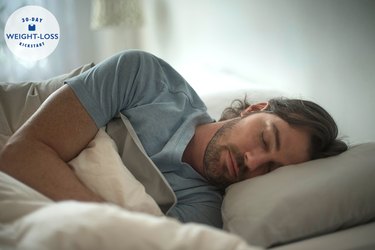
You know what it feels like to not get enough sleep, and that groggy feeling is no picnic. But lack of shut-eye affects much more than your mood. Snoozing for less than seven hours each night can lead to serious health problems, from hypertension to heart disease and stroke, according to a 2015 study published in the journal Sleep.
And more recently, a 2019 study published in Diabetes Care found that people with poor sleep patterns are more likely to have obesity and develop other serious metabolic disorders. Unfortunately, more than a third of Americans aren't hitting the magic number on a regular basis, according to the Centers for Disease Control and Prevention.
Video of the Day
Video of the Day
Natalie Dautovich, an environmental scholar with the National Sleep Foundation, stresses that deep, quality sleep is important for cognitive, physical and social functioning. Here, she weighs in on 10 habits that might be ruining your Zzzs and offers some tips for getting a better night's sleep tonight.
1. Working Too Much
The Problem: According to a 2014 study published in Sleep, work was the primary culprit that kept people from getting enough sleep. Unsurprisingly, this was often tied to early start times and long commutes.
Another study in a 2017 issue of Nature Reviews Neuroscience found that getting too little sleep negatively affects memory. And in a 2015 book titled Sleep and Affect: Assessment, Theory and Clinical Implications, University of Arkansas researchers note that lack of sleep might make someone more likely to react emotionally when facing stress. So ironically, foregoing sleep because of work may result in poorer work performance.
The Fix: Try negotiating for a later start time at work: The 2014 Sleep study found that starting one hour later in the morning increased sleep time by about 20 minutes.
Read more: 15 Secrets to Better Work-Life Balance
2. Using Electronics Too Close to Lights-Out
The Problem: You've probably heard that it's not recommended to use your smartphone in bed. Reading on your cell phone, laptop or e-reader or watching TV before bed can mess with your circadian rhythms, making it harder to fall asleep and stay asleep. Plus, it may even contribute to weight gain, according to a 2019 study published in JAMA Internal Medicine.
The Fix: Disconnect from your devices well before bedtime. If you like to read before you hit the sheets, opt for a hardcover book rather than an e-reader. And if you can, take the TV out of the bedroom altogether so you're not tempted to fall asleep with it on.
Ready to Lose Weight?
Set yourself up for success with more from our 30-Day Weight-Loss Kickstart.
3. Not Nixing Nicotine or Alcohol Before Bed
The Problem: You've likely felt sleepy after a glass of wine. But while alcohol initially acts as a sedative, it actually diminishes your overall quality of sleep.
Indeed, an April 2013 article in Alcoholism: Clinical and Experimental Research found that large amounts of alcohol not only interfere with sleep quality, but also impede the restorative functions of sleep. Researchers said this is especially true for regular heavy-drinkers.
What's more: When you have that glass (or two) of wine can affect your sleep quality, too. An August 2019 study in Sleep found that consuming alcohol within four hours of bedtime resulted in fragmented zzzs among African American adults. The researchers also discovered that nicotine use had a similar disruptive effect on sleep continuity when used in the same timeframe.
The Fix: The solution to this one is easy: Decrease the amount and frequency of your alcohol and nicotine consumption, especially in the hours leading up to bedtime.
4. Playing Catch-Up on Weekends
The Problem: It's tempting to "borrow from your future self" by skipping sleep during the week, then making up for it on weekends. But even 30 minutes of lost sleep a day can add up to long-term consequences for your body weight and metabolism.
In a 2016 study published in the Journal of Clinical Sleep Medicine, researchers from Weill Cornell Medical College and other institutions found that people with a weekday sleep deficit were 72 percent more likely to have obesity and were also more likely to be insulin resistant, meaning sleep debt could contribute to developing Type 2 diabetes.
The Fix: Researchers also found that a 30-minute nap can reverse the impact of a night of poor sleep, which might be a good technique for night and shift workers.
Read more: 12 Foods That Help You Fall (and Stay) Asleep
5. Waking Up Often
The Problem: Even if you're in bed for eight hours, if you're often woken up, you might feel as if you haven't gotten any rest at all. Even small amounts of light and noise can be a barrier to obtaining deeper, restorative sleep, says Dautovich.
Research from 2014 conducted by Tel Aviv University's School of Psychological Sciences found that interrupted sleep has the same effect on your body as four or fewer consecutive hours of sleep. No surprise here: This type of sleep was linked to difficulties thinking, a shorter attention span and a bad mood.
The Fix: Even if the interruptions are just five minutes, they can have serious consequences. To limit disruptions, set your phone to automatically revert to "sleep" mode at bedtime.
And although sleep masks and ear plugs can help, a 2015 paper in Critical Care found that in a bright, noisy environment, taking one milligram of fast-release oral melatonin could help you get more (and better) sleep.
6. Skipping Your Workouts
The Problem: Although you may feel too tired to fit in a workout, regular exercise has been shown to improve your sleep quality and reduce feelings of sleepiness during the day. In fact, a 2017 review published in Advances in Preventive Medicine, concluded that exercise promoted increased sleep efficiency and duration regardless of the mode and intensity of activity, especially for middle-aged and elderly individuals, and those who with diseases.
The Fix: Consider upping your exercise to get a better night's sleep. The National Sleep Foundation's 2013 Sleep in America poll found that, regardless of exercise level, one-half of respondents reported that their sleep quality improved on days they exercised.
7. Stressing Out
The Problem: High stress and poor sleep might be a "chicken or egg" scenario, because feeling tired adds to feelings of stress and makes high-stress situations harder to handle.
According to the 2017 Stress in America survey by the American Psychological Association, 45 percent of respondents said that stress had caused them to lie awake at night in the past month, and those with lower stress levels reportedly got more hours of sleep each night than those with higher stress levels.
The Fix: Try meditating. According to a 2015 article published by JAMA Internal Medicine, mindfulness meditation improved sleep quality for older adults who experience sleep disturbances.
8. Consuming Too Much Caffeine
The Problem: Although caffeine can help with alertness during the day, it stays in your body for hours after consumption, meaning it might make it harder to fall and stay asleep, according to the National Sleep Foundation.
But it's not all bad news for coffee lovers. The August 2019 study in Sleep didn't find a connection between caffeine consumption within four hours of bedtime and disrupted sleep. But maybe don't fire up the Keurig just yet. The researchers didn't study all the factors that may link caffeine and sleep disturbance.
For one, they didn't measure the caffeine content of beverages. Since the amount of caffeine in drinks can vary quite a bit, it's quite possible that higher doses may result in sleep issues. They also didn't ask participants how much caffeine they had before bed. Plus, they didn't assess individuals' caffeine sensitivity, which may also play a role in whether you'll experience problems with sleep after sipping a cup of joe.
The Fix: Drinking less coffee, especially in the hours before bed, could ultimately help reduce daytime sleepiness by improving your sleep quality.
9. Burning the Midnight Oil
The Problem: We have electricity to thank for allowing us to work or socialize long after the sun has gone down, but research published in a 2011 issue of the Journal of Clinical Endocrinology and Metabolism found that this disrupts the body's perception of how long the night is.
According to the research, exposure to electrical lighting after the sun has gone down suppresses melatonin levels and its functions, like sleepiness, body temperature, blood pressure and blood sugar levels.
The Fix: If you're up way past sunset, dim the lights while you work and consider taking melatonin if you have trouble falling asleep.
10. Double-Timing Your Bedroom
The Problem: Don't feel tired when you head to bed? Using the bedroom environment for tasks other than sleeping can create feelings of wakefulness rather than sleepiness when you are in the room, says Dautovich. Activities she warns against include watching TV, doing work or having discussions.
The Fix: Do these activities in a different room. "Ideally," she says, "the bedroom should be 60 to 69 degrees, dark, quiet and comfortable." Still not sleeping well? Dautovich recommends keeping a sleep diary and noting how factors such as the length of sleep time, bedtime and wake time are associated with next-day performance. "Critically evaluating daytime activities, the evening routine and the bedroom environment can be useful for identifying sleep-interfering behaviors."
Read more: 10 Surprising Steps to a Good Night's Sleep
- Sleep: "Recommended Amount of Sleep for a Healthy Adult: A Joint Consensus Statement of the American Academy of Sleep Medicine and Sleep Research Society"
- Centers for Disease Control and Prevention: "1 in 3 Adults Don't Get Enough Sleep"
- Diabetes Care: "Cross-sectional and Prospective Associations of Actigraphy-Assessed Sleep Regularity With Metabolic Abnormalities: The Multi-Ethnic Study of Atherosclerosis"
- Sleep: "Sociodemographic characteristics and waking activities and their role in the timing and duration of sleep."
- Nature Reviews Neuroscience: "The sleep-deprived human brain"
- University of Arkansas News: "Sleep Loss Tied to Emotional Reactions"
- National Sleep Foundation: "2014 Sleep in the Modern Family"
- Alcoholism, Clinical and Experimental Research: "Alcohol and sleep I: effects on normal sleep."
- Journal of Clinical Sleep Medicine: "The Impact of Sleep Debt on Excess Adiposity and Insulin Sensitivity in Patients with Early Type 2 Diabetes Mellitus."
- Tel Aviv University: "TAU Study on Interrupted Sleep"
- Critical Care: "Effect of oral melatonin and wearing earplugs and eye masks on nocturnal sleep in healthy subjects in a simulated intensive care unit environment: which might be a more promising strategy for ICU sleep deprivation?"
- Advances in Preventive Medicine: "Interrelationship between Sleep and Exercise: A Systematic Review"
- National Sleep Foundation: "2013 Exercise and Sleep"
- American Psychological Association: "By the numbers: Our stressed-out nation"
- JAMA Internal Medicine: "Mindfulness Meditation and Improvement in Sleep Quality and Daytime Impairment Among Older Adults With Sleep Disturbances"
- National Sleep Foundation: "Caffeine and Sleep"
- Journal of Clinical Endocrinology and Metabolism: "Exposure to Room Light before Bedtime Suppresses Melatonin Onset and Shortens Melatonin Duration in Humans"
Is this an emergency? If you are experiencing serious medical symptoms, please see the National Library of Medicine’s list of signs you need emergency medical attention or call 911.