What does fact checked mean?
At Healthfully, we strive to deliver objective content that is accurate and up-to-date. Our team periodically reviews articles in order to ensure content quality. The sources cited below consist of evidence from peer-reviewed journals, prominent medical organizations, academic associations, and government data.
- MayoClinic.com; Dietary Fiber: Essential for a Healthy Diet; November 2009
- MedlinePlus: Vitamin C
- Linus Pauling Institute Micronutrient Information Center; Potassium; Jane Higdon, Ph.D.; February 2004
- Linus Pauling Institute; The Possible Health Benefits of Anthocyanin Pigments and Polyphenolics; Ronald E. Wrolstad, Ph.D.; May 2001
The information contained on this site is for informational purposes only, and should not be used as a substitute for the advice of a professional health care provider. Please check with the appropriate physician regarding health questions and concerns. Although we strive to deliver accurate and up-to-date information, no guarantee to that effect is made.
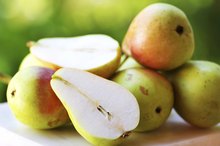
Most fruit stands carry a variety of red pears including Bartlett, Anjou, Red Crimson and Comice. Like their green counterparts, red pears are a low-fat, cholesterol-free food. What differentiates the two is the antioxidant compounds found in the skin of red pears. Red pears have a high concentration of the phytonutrient anthocyanin. Anthocyanin has anti-aging properties, promotes heart health and protects against cancer. Red pears are also an excellent source of fiber, vitamin C, potassium and copper 2.
Fiber
In addition to maintaining bowel health, fiber helps lower cholesterol, control blood sugar levels and protect against certain cancers. According to the Institute of Medicine, men age 50 and under should consume 38 grams of fiber daily. Women in the same age group should consume 25 grams. One medium pear has 5.5 grams of dietary fiber, or just over 20 percent of the suggested recommendation for women.
- In addition to maintaining bowel health, fiber helps lower cholesterol, control blood sugar levels and protect against certain cancers.
- According to the Institute of Medicine, men age 50 and under should consume 38 grams of fiber daily.
Vitamin C
How Many Calories Does a Pear Have?
Learn More
Like most fruits, pears are an excellent source of vitamin C. Vitamin C is necessary to tissue growth, repair and healing 2. In addition, vitamin C is an antioxidant that helps neutralize the free radicals that may be responsible for cancer, heart disease, arthritis and aging 2. The recommended dietary allowance for vitamin C is 75 milligrams for women and 90 milligrams for men 2. One medium pear has 7.5 milligrams of vitamin C, which equals 10 percent of a woman’s daily requirement 2.
Potassium
Potassium is an essential dietary mineral that helps prevent stroke, osteoporosis and hypertension. Although not as nutrient-dense as a banana, one medium pear has 212 milligrams of potassium. Enjoying a pear in your salad, as a snack or for dessert are all ways of reaching the 4,700 milligrams of potassium the Food and Nutrition Board of the Institute of Medicine recommends for adults age 19 and over.
Copper
What Are the Health Benefits of Gooseberries?
Learn More
Copper, a mineral found throughout the body, is necessary to the production of hemoglobin, collagen and elastin. It also helps keep the nerves, bones and immune system healthy. According to the U.S. Department of Health and Human Services Dietary Guidelines for Americans, adults age 19 and over should consume 900 micrograms of copper daily. One medium pear has .146 milligrams of copper, nearly 10 percent of this recommendation.
- Copper, a mineral found throughout the body, is necessary to the production of hemoglobin, collagen and elastin.
- According to the U.S. Department of Health and Human Services Dietary Guidelines for Americans, adults age 19 and over should consume 900 micrograms of copper daily.
Related Articles
How Many Calories Does a Pear Have?
Learn More
What Are the Health Benefits of Gooseberries?
Learn More
Red Cherries & Potassium
Learn More
What Are the Health Benefits of Red Potatoes?
Learn More

What Are the Benefits of Apples, Oranges & Grapes?
Learn More
10 Healthiest Red Foods
Learn More
Is Ruby Red Grapefruit Juice Good for You?
Learn More
Fruit with Beta-Carotene
Learn More
How Many Calories in Carrot Sticks?
Learn More
Nutritional Content of Melons
Learn More
References
- MayoClinic.com; Dietary Fiber: Essential for a Healthy Diet; November 2009
- MedlinePlus: Vitamin C
- Linus Pauling Institute Micronutrient Information Center; Potassium; Jane Higdon, Ph.D.; February 2004
- Linus Pauling Institute; The Possible Health Benefits of Anthocyanin Pigments and Polyphenolics; Ronald E. Wrolstad, Ph.D.; May 2001
- Reiland H, Slavin J. Systematic review of pears and health. Nutr Today. 2015;50(6):301-305. doi:10.1097/NT.0000000000000112
- Pears, raw. FoodData Central. U.S. Department of Agriculture. Published April 1, 2019.
- Soliman GA. Dietary fiber, atherosclerosis, and cardiovascular disease. Nutrients. 2019;11(5):1155. doi:10.3390/nu11051155
- Atkinson FS, Foster-Powell K, Brand-Miller JC. International Tables of Glycemic Index and Glycemic Load Values: 2008. Diabetes Care. 2008;31(12):2281-2283. doi:10.2337/dc08-1239.
- Dietary Reference Intakes (DRIs): Recommended Dietary Allowances and Adequate Intakes, Elements. National Institutes of Health, Food and Nutrition Board. Updated 2011.
- Desai V, Kaler SG. Role of copper in human neurological disorders. Am J Clin Nutr. 2008;88(3):855S-8S. doi:10.1093/ajcn/88.3.855S
- Stone MS, Martyn L, Weaver CM. Potassium intake, bioavailability, hypertension, and glucose control. Nutrients. 2016;8(7):444. doi:10.3390/nu8070444
- Carr AC, Maggini S. Vitamin C and immune function. Nutrients. 2017;9(11):1211. doi:10.3390/nu9111211
- Wedick NM, Pan A, Cassidy A et al. Dietary flavonoid intakes and risk of type 2 diabetes in US men and women. Am J Clin Nutr. 2012;95(4):925-33. doi:10.3945/ajcn.111.028894
- Larsson SC, Virtamo J, Wolk A. Total and specific fruit and vegetable consumption and risk of stroke: A prospective study. Atherosclerosis. 2013;227(1):147-52. doi:10.1016/j.atherosclerosis.2012.12.022
- Hu D, Huang J, Wang Y, Zhang D, Qu Y. Fruits and vegetables consumption and risk of stroke: A meta-analysis of prospective cohort studies. Stroke. 2014;45(6):1613-9. doi:10.1161/strokeaha.114.004836
- Anderson JW, Baird P, Davis RH, et al. Health benefits of dietary fiber. Nutr Rev. 2009;67(4):188-205. doi:10.1111/j.1753-4887.2009.00189.x
- Lee HS, Isse T, Kawamoto T, Baik HW, Park JY, Yang M. Effect of Korean pear (Pyruspyrifolia cv. Shingo) juice on hangover severity following alcohol consumption. Food Chem Toxicol. 2013;58:101-6. doi:10.1016/j.fct.2013.04.007
- Oral Allergy Syndrome (OAS) or Pollen Fruit Syndrome (PFS). American Academy of Allergy Asthma & Immunology.
- Dirty Dozen: EWG's 2019 Shopper's Guide to Pesticides in Produce. Environmental Working Group. Updated 2019.
- Pears, asian, raw. FoodData Central. U.S. Department of Agriculture. Published April 1, 2019.
Writer Bio
Karen Gardner is an award-winning writer and editor. She studied advertising and journalism at Virginia Commonwealth University and since that time has written for a wide variety of local, regional, national and online publications. In addition to her writing career, Gardner is also owns an event planning and private party staffing business.