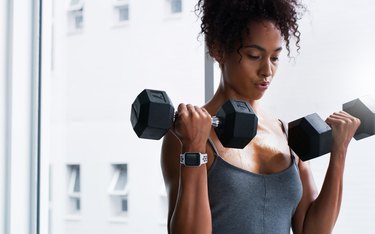
You have many options for gaining lean muscle, from lifting weights to running road races and playing sports. Other strategies include interval training, circuit training and even yoga. Learning about these activities will help you find the best way to build and keep your lean muscle.
Video of the Day
Video of the Day
Understand Lean Muscle
You might want to lift weights to build lean muscle. Experts call this process a hypertrophic response. A complex set of mechanisms help you build muscle tissue, according to a September 2013 review in the FEBS Journal. Researchers believe that a biological cascade triggers the protein synthesis necessary to build mass. In sum, you need to consume more protein than you tear down to see hypertrophy.
In addition to eating a balanced diet, consider adding a protein supplement to your daily menu. Many protein bars give you the nutrients needed to encourage hypertrophy, but you should combine these snacks with muscle-building exercises for the best results.
A December 2013 paper in the Journal of the International Society of Sports Nutrition shows that the total amount of protein ingested has greater importance than its timing. According to a June 2019 article from Harvard Health Publishing, the recommended daily amount of 0.8 grams of protein per kilogram of body weight may not be sufficient.
Try Lifting Weights
Many people think that weightlifting is the best way to increase lean muscle and that free weights have an added benefit over exercise machines. Yet, both methods have advantages, according to an October 2017 report from Harvard Health Publishing.
Free weights engage a broader range of muscles. This can prevent injury, but it also means slower progress. In contrast, you can use exercise machines to isolate specific areas.
A 2014 article in the Journal of Aging Research and Clinical Practice illustrates the superiority of weightlifting for building lean muscle. Researchers tracked 16 athletes for five years. Half of the men tested lifted weights, and the other half played sports. Each group exercised on most days of the week.
Compared to those who played sports, weightlifters gained more muscle mass. Interestingly, weightlifting didn't benefit lower leg muscles like the soleus.
Play Team Sports
Just because lifting weights produces greater hypertrophy than other activities doesn't mean you can't use the camaraderie and fun of team sports to gain mass. In fact, sports offer many health benefits.
The authors of a May 2013 study published in the journal Health tested 30 younger adults and found that soccer players of both genders consistently showed greater muscle mass than nonathletes. These findings indicate that team sports can be an effective means to stimulate hypertrophy.
A September 2014 meta-analysis in Sports Medicine highlights the many benefits of sports participation. Researchers state that keeping your muscles fit by playing sports will likely decrease body fat levels as well as the risk for heart disease and diabetes.
Sports also seem to improve bone health and self-esteem. Interestingly, playing sports when you are young might have long-term, beneficial effects on your health.
Do Aerobic Exercise
Contrary to popular belief, cardio or aerobic exercise can increase lean muscle too. In a November 2012 study published in the Journal of Applied Physiology, 13 men trained on an exercise bike for 12 weeks. By the end of the study, aerobic exercise increased their thigh muscle size.
The researchers dispelled another myth as well. When separated into groups, younger and older men showed a nearly identical increase in lean muscle. Thus, people of all ages can similarly benefit from doing aerobic exercise.
Scientists have found similar results in women. The authors of a June 2012 article in Diabetes and Metabolism Journal tested 28 women with diabetes and showed that 12 weeks of aerobic exercise increased muscle mass. Both moderate intensity and vigorous intensity exercise produced significant improvements in body composition.
Interestingly, moderate intensity exercise didn't have any effects on muscle mass but decreased visceral fat. In contrast, vigorous intensity exercise increased thigh muscle density and insulin sensitivity but was less effective at burning fat.
Read more: What Effect Does Aerobic Exercise Have on Muscles?
Combine Activities for Better Effects
A June 2015 review in Metabolites suggests that combining resistance exercises like weightlifting with aerobic activities like running might be the best way to build lean muscle as you age. Coaches call this combination concurrent training. For a long time, it was believed that the two interventions would interfere with each other and hinder the hypertrophic response. New research, however, shows that carefully combining activities can enhance your results.
The authors of a September 2014 report in Medicine and Science in Sports and Exercise conducted a study showing the benefits of combining aerobic exercise and strength training. Some subjects did aerobic exercise and then strength training, while others did strength training and then aerobic exercise.
Researchers had 34 younger men exercise two to three times a week for 24 weeks. Concurrent training led to an increase in both physical fitness and muscle mass. Interestingly, exercise order didn't alter training adaptations.
Try Electrical Stimulation
Doctors use electrical myostimulation, or EMS, to help bed-ridden patients keep their muscle mass. It can easily mimic the effects of exercise, according to a January 2013 paper in Clinical Nephrology. As the scientists note, EMS can increase muscle oxidation capacity, glucose removal and insulin sensitivity. It has proven effective for fighting age-related muscle wasting — or sarcopenia.
In fact, you can get similar results at home with a transcutaneous electrical nerve stimulation device. Better known as TENS, this unit offers an effective and safe way to stimulate hypertrophy using electrical stimulation.
Few people realize how quickly they can lose your lean muscle when they don't use it. The authors of a March 2014 article in Acta Physiologica tested 24 younger men and showed that leg immobilization triggered a significant loss of quadriceps muscle tissue within five days.
Another research team reversed such losses using electrical stimulation, according to another March 2014 article in Acta Physiologica. Interestingly, electrical stimulation didn't help the subjects preserve muscle strength even though they kept their muscle mass.
- Journal of the International Society of Sports Nutrition: "Effect of Protein Timing on Muscle Strength and Hypertrophy"
- Harvard Health Publishing: "Lift Weights to Boost Muscle"
- Journal of Aging Research and Clinical Practice: "Influence of Strength Training on Distribution of Trunk and Appendicular Muscle Mass"
- Health: "Differences in Body Components and Electrical Characteristics Between Youth Soccer Players and Non-athletes"
- Journal of Applied Physiology: "Aerobic Exercise Training Induces Skeletal Muscle Hypertrophy and Age-Dependent Adaptations in Myofiber Function in Young and Older Men"
- Diabetes and Metabolism Journal: "Effects of Aerobic Exercise Intensity on Abdominal and Thigh Adipose Tissue and Skeletal Muscle Attenuation in Overweight Women With Type 2 Diabetes Mellitus"
- Metabolites: "Role of Myofibrillar Protein Catabolism in Development of Glucocorticoid Myopathy"
- Medicine and Science in Sports and Exercise: "Fitness and Lean Mass Increases During Combined Training Independent of Loading Order"
- Clinical Nephrology: "Neuromuscular Electrostimulation Techniques"
- Acta Physiologica: "Substantial Skeletal Muscle Loss Occurs During Only 5 Days of Disuse"
- Acta Physiologica: "Neuromuscular Electrical Stimulation Prevents Muscle Disuse Atrophy During Leg Immobilization in Humans"
- FEBS Journal: "Mechanisms Regulating Skeletal Muscle Growth and Atrophy"
- Harvard Health Publishing: "How Much Protein Do You Need Every Day?"
- Sports Medicine: "Health Benefits of Muscular Fitness for Children and Adolescents"