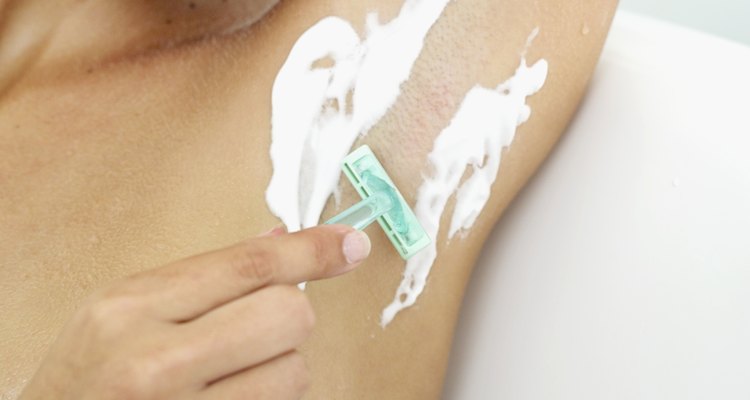
Whether you're waltzing across the dance floor in a sleeveless evening gown, jumping around in a vigorous game of beach volleyball or simply wearing a tank top on a hot summer's day, you probably want to avoid flashing hairy, stubbly or razor-burned armpits. It can be difficult to achieve a smooth shave under your arms -- the hair tends to grow in different directions and you need to accommodate the natural curves of your anatomy. Wield your razor skillfully at the right moment in your bathing routine and you'll soon have smooth, hairless underarms.
Step 1
Shave your armpits at the end of your shower or bath as this allows the hair to soften and the pores of the skin to open, making hair removal easier.
Step 2
Clean your armpits with a soapy washcloth, or clean and exfoliate with a pouf to remove dead skin cells, deodorant and sweat.
Step 3
Lift your arm straight up over your head and spread a thick coating of shaving cream or gel over the area of your armpit that you want to shave. Keep your arm lifted so that the armpit skin is taut.
Step 4
Stroke your razor down through the center of the shaving cream. Rinse your razor to remove the loose hair. Repeat, moving the razor from top to bottom over the entire armpit area until all the shaving cream is gone. Then reapply shaving cream and stroke the razor from side to side to get the closest shave. Repeat this process on your other armpit.
Step 5
Rinse both armpits to remove any shaving-cream residue and pat dry with a clean towel.
Related Articles

How to Get a Smooth, Bald Look

How to Make Your Armpits Smooth

How to Prevent Underarm Bumps

How to Shave Legs With an Electric ...

How to Open & Clean a Norelco 1050CC ...
How to Get Rid of Underarm Shadow

How to Use a Brow Shaver
How to Shave With an Electric Razor

How to Clear Up Red Bikini Line Bumps
How to Clean a Philips Norelco Shaver

Proper Way to Use a Foil Shaver
Proper Way to Shave a Mustache
How to Take Care of Painful Ingrown Hair

How to Stop Hair From Growing at the ...
How to Stop Facial Redness From Shaving

Proper Sanitizing of Electric Razors
How to Shave Pubic Hair on Men
How to Unclump Eyelashes
How to Not Get Stubble When Shaving ...

How to Keep From Getting Ingrown Armpit ...
References
Tips
- Wait half an hour or more before applying deodorant. If possible, shave your underarms at night and wait until morning to apply your deodorant as this gives tiny skin abrasions time to seal, sparing you stinging or further irritation.
- Replace your blade frequently. With an old blade you won't get a close shave and are likelier to nick yourself.
- Run the razor no more than twice over each area of your underarm. Repeated passes can irritate the skin or cause nicks.
- Use shaving cream or gel -- not soap -- for a silky smooth shave.
- If you prefer an electric razor, you will need to shave more frequently, as these shavers don't give the close results of manual razors.
Warnings
- Do not shave your underarms if the skin is irritated or broken.
Writer Bio
Living in California, Michelle Ullman is a professional writer with particular expertise in home, garden and pet/nature topics. Her work is published on many websites. She loves crafts and has a deep interest in design and DIY projects.
Photo Credits
Stockbyte/Stockbyte/Getty Images