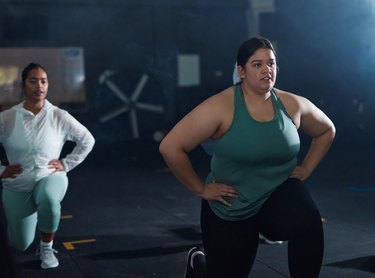
The gym is a perplexing place for many people, especially beginners. What exercises should you do? How many sets and reps? How much weight should you lift? And what type and how much cardio do you need to lose weight?
But it doesn't need to be confusing. Any type of gym workout will help you lose weight, and the best routine is one you enjoy doing. That being said, when it comes to how to lose weight at the gym, there are a few types of gym workouts that stand out among the rest.
Video of the Day
How to Lose Weight at the Gym
The first thing to note is that the best exercise to lose weight is one that challenges you. But sprinting right out the gate (literally and figuratively) can leave you burned out, discouraged, and worse, injured.
To start seeing results as soon (and sustainably) as possible, you need a balanced strength-training and cardio routine, according to Carolina Araujo, CPT, a California-based strength coach. From there, incorporate a little progressive overload by increasing your workout intensity, weight, sets or reps little by little each week.
"A weekly resistance routine with some cardio on the side is the key to weight loss in the gym," Araujo says.
Start your workouts with dynamic stretches to loosen up your connective tissues. Perform side bends, heel lifts, arm crossovers, shoulder circles, forward leg swings, reverse lunges and alternating toe touches to target your whole body.
You can also perform these kind of gentle movements on their own. Remember, when you feel less stressed, you may find it easier to stick with healthy eating and exercise. Consider yoga or stretching on your days off from cardio and weight training. These practices improve your flexibility and mobility and give your muscles time to recover.
Resistance Training for Weight Loss
Resistance training builds muscle mass, which not only strengthens your body, but increases your metabolism. Muscle is responsible for up to 20 percent of your daily calorie burn, while fat accounts for less than 5 percent, according to the University of New Mexico. In other words, the more muscle you have, the more calories you burn doing day-to-day activities.
There are many different types of resistance-training programs for a variety of goals, whether it's building muscle size, strength or endurance. And any one of these programs is beneficial for fat loss, as long as you're increasing the challenge over time.
Beginners can start their weight-loss resistance plan with just their body weight, according to Araujo. Compound exercises (like squats or deadlifts) are the best place to begin, because they work multiple muscles at once. Perform 10 to 12 reps and 3 to 4 sets of each move. Keeping your rest to 60 seconds or less can help keep your heart rate up.
As you grow more comfortable with your workouts, you can start to add resistance bands, dumbbells or kettlebells to your routine.
"Start with 4 to 5 days of gym strength training per week," Araujo says. "To promote weight loss, make sure you're progressively overloading week after week and try to hit your minimum cardio requirements, too [more on that below]."
Resistance Training for Beginners
This beginner-friendly routine is a great place to start. As you advance, you can increase the weight or reps of each exercise.
Calories Burned While Resistance Training
Your calorie burn depends on a lot of factors, including your weight, age and fitness level. But after 30 minutes of circuit training, you can expect to burn about 240 calories or more, according to Harvard Health Publishing.
1. Incline Push-Up
- Place your palms on a step, exercise bench or seat of a chair.
- Walk your feet back until you're on your toes.
- Come into a high plank with your core and glutes engaged. Your shoulders should be over your wrists and your hips should be in line with your head and heels.
- Bend your elbows at about a 45-degree angle from your torso and lower your body toward the bench.
- On the way down, squeeze your shoulder blades together.
- When your chest hovers just above the bench (or however far down you can go), press into the ground and push back up to the starting position.
2. Air Squat
- Stand tall with your feet hip-width apart and brace your core. Focus on keeping your feet rooted into the ground and your core tight the entire time.
- Extend your arms out in front of you and slowly bend your knees as you push your hips back to lower toward the floor. Focus on lowering your body as if you were going to sit on a chair.
- Lower down until your thighs are parallel with the floor (or as far as is comfortable).
- Pause for a moment at the bottom of your squat.
- On an exhale, reverse the motion by pressing through your heels to return to standing. As you stand, lower your arms back to your sides.
Related Reading
3. Forearm Plank
- Lie face down on the floor, with your forearms on the ground, elbows directly beneath your shoulders.
- Extend your legs straight behind you, toes tucked.
- With your core braced, press into your toes and forearms and lift your body off the ground.
- Keep your back flat and your body in a straight line from head to hips to heels.
- Hold here for 15 to 30 seconds. Try working up to 60 seconds over time.
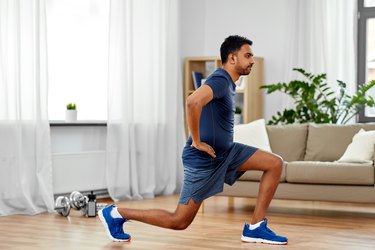
4. Reverse Lunge
- Stand with your feet about hip-width apart, arms at your sides. Hold a pair of light dumbbells in each hand.
- Step with your right leg 3 feet behind you and bend both knees until they form 90-degree angles. Your back knee should hover an inch above the ground and your front thigh should be parallel to the ground.
- Keep most of your weight in the front leg as you press into your left heel and straighten your left leg.
- Bring the right leg back to the starting position and stand up.
- Repeat the motion with the opposite leg.
Tip
If reverse lunges feel too challenging with weights, drop the dumbbells, Araujo recommends. Focus on your form above all else.
5. Bent-Over Dumbbell Row
- Stand with your feet hip-width apart, holding a dumbbell in each hand at your sides, palms facing each other.
- Push your hips back and soften your knees to lean your torso forward until it's nearly parallel with the ground and your weight is centered in your heels. Let the weights hang straight down in front of your knees.
- Brace your core and focus on keeping your back flat.
- Leading with your upper back, squeeze your shoulder blades together and pull through your arms to raise the dumbbells up toward your ribcage.
- Pause at the top of the movement.
- Keep your core and spine stable as you reverse the motion, extending your arms to lower the dumbbells so they hang by your knees.
Tip
"Start with a light pair of weights as you perfect your bent-over row form," Araujo says. "You can even record yourself on your phone to make sure your back stays in a flat line as you do the move."
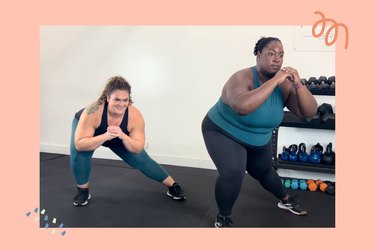
6. Sumo Squat
- Stand with your feet slightly wider than hip-width apart, toes pointed out at a 45-degree angle. (If the position feels uncomfortable, move your feet in a little closer).
- Clasp your hands together at your chest.
- Keeping your back straight, push your hips back and bend your knees out over your toes to squat down. Thinking about sliding down a wall, keeping your back as straight as possible and avoiding leaning forward or sticking your butt out.
- Lower until your your thighs are parallel to the floor (or as low as you can comfortably go).
- Activate your core, glutes and quads to propel your body back upright, driving your weight through your feet to return to a standing position.
- Squeeze your glutes at the top of the movement and repeat.
7. Seated Dumbbell Shoulder Press
- Sit on a bench with your feet rooted to the floor.
- Hold a dumbbell in each hand at shoulder height with your forearms vertical, hands in a neutral grip with fingers toward your face. Your arms shoulder be just slightly in front of your body. Brace your core.
- On an exhale, press both dumbbells up and in toward each other.
- Lower the weights back to the starting position with control.
Related Reading

Cardio Training for Weight Loss
Alongside a strength-training routine, cardio can boost your total calorie burn, Araujo says. For general heart health, the Centers for Disease Control and Prevention recommend you get at least 150 minutes of moderate cardio per week, like walking, jogging or using the elliptical.
Pick the cardio machine you like best. Perform a cardiovascular workout about 4 days a week to meet the minimum requirement. Step onto your machine and begin exercising at a light pace for 5 minutes to slowly raise your heart rate and core body temperature. Increase your speed to a point at which you're breaking a sweat and stay there for the rest of your workout.
You can also opt for 75 minutes of vigorous cardio each week, which includes high intensity interval training (HIIT). HIIT kicks up your heart rate and incorporates muscle-building exercises like burpees and jump squats.
Interval training not only saves time, but it's also more effective for fat loss than steady-state training. Interval training can help you burn almost 30-percent more total fat mass than moderate-intensity, steady-state cardio, according to an April 2019 review in the British Journal of Sports Medicine.
Researchers noted that fat loss isn't just about the number of calories you burn during a workout, but also about how your body reacts to training afterward. Because HIIT is so challenging, your body needs more energy to repair and recover. So, you continue burning calories at a higher rate after a HIIT workout than after a steady-state workout, according to the American Council on Exercise.
As its name implies, HIIT is intense. If you're just starting out, don't feel like you need to go from 0 to 100, Araujo says. A mix of walking and running might be just your speed. But do increase the intensity week after week. And don't do HIIT every day — your body needs time to recover after tough workouts, so it's best to space these workouts a couple of days apart.
Cardio Exercises for Beginners
Here's a sample treadmill HIIT workout you can try:
- Warm up at an easy pace for 5 minutes.
- Increase your pace to an all-out effort for 30 to 60 seconds minute.
- Return to an easy pace (4 mph on the treadmill) for 2 minutes.
- Repeat both intervals 5 more times, trying to work a little harder during each sprint interval.
- Cool down at an easy pace for 5 minutes.
You can also structure your HIIT workouts in a circuit, according to the ACE. Circuit training involves doing several different exercises back-to-back with no rest in between sets. You do a certain number of reps for one exercise, then immediately move to the next. At the end of one round, you'll rest for 1 to 2 minutes, then repeat the round as many times as you'd like. You can rotate between almost any gym machine or exercise.
Tabata training is another type of structure you can try for your HIIT cardio workouts, according to the ACE. For Tabata, you do an exercise for 20 seconds, rest for 10 seconds, then repeat that for 8 rounds. After 8 rounds (which is 4 minutes), switch to your next exercise. Just like with interval sprints, the idea is to really work for that 20 seconds, then enjoy the following 10-second rest.



- British Journal of Sports Medicine: "Is Interval Training the Magic Bullet for Fat Loss? A Systematic Review and Meta-Analysis Comparing Moderate-Intensity Continuous Training With High-Intensity Interval Training (HIIt) Free"
- American Council on Exercise: "7 Things to Know About Excess Post-Exercise Oxygen Consumption (EPOC)"
- University of New Mexico: "Controversies in Metabolism"
- Centers for Disease Control and Prevention: "How Much Physical Activity Do Adults Need?"
- Harvard Health Publishing: "Calories Burned in 30 Minutes for People of Three Different Weights"