LIVESTRONG.COM Blog: CSA 101: Guest blogger Rachel Pinsky talks community supported agriculture

Pickleball Strategy

Text size: A  A  |  Post a comment  |  Print  |  Send To Friend
Pickleball Strategy

Pickleball Strategy

Overview

Pickleball is a simple paddle sport that the whole family can enjoy together, but that doesn't mean it doesn't take strategy to win. While pickleball borrows aspects from badminton, tennis and other paddle sports, its wooden paddles and Wiffle ball give it a unique dynamic that requires its own strategy.

General Strategy

Its more important to be precise than powerful in pickleball. Aim for an area from which your opponent will have difficulty returning, such as at his feet or bouncing right beside him. Step toward your target when hitting. Point your front shoulder in the target's direction, following though toward the target. Position yourself just as the ball contacts your opponent's paddle; you should never be moving when this happens. Keep your paddle in front of your body, your feet at shoulder width and moving side to side on your toes. Notice which player on your opponent's team is the weakest and where he has the most difficulty shooting from, and exploit it by aiming for this area. Anticipate your opponent's out balls.

Gripping The Paddle

In the the continental grip, put the space between your thumb and index finger on top of the handle when the face of the paddle is to the side rather than facing up or down. You execute the volley, serve overhead and ground strokes using the continental grip. You can use wristbands and tennis overgrips for your paddle handle to keep your grip dry during warm days.

Serving

As with other shots, you should not hit serves too hard at the expense of precision. When in doubt, attempt the deep serve, which is more difficult to return. Serving toward your opponent's backhand also increases the difficulty of a quality return. After you complete your serve, take a step behind the baseline so that the ball will have to land in front of you and not at your feet. This also gives you a better perspective on whether the return is going out.

Returning

Return deep, slowly and low to the opponent's backhand when possible. Most importantly, avoid hitting the ball out of bounds or at the net, surrendering points. Try to position yourself at the net when returning, which will help you make easier shots. Don't return short when near the net, though, which could leave you open to a dink or power shot.

The Volley

When hitting a volley, keep your head and eyes behind the ball at ball height. Keep your elbow in tight in front of your hip with the paddle head above your wrist. Don't drop the head of the paddle during low shots. Instead, bend your knees to get low while keeping your eyes on the ball.

Photo Credit

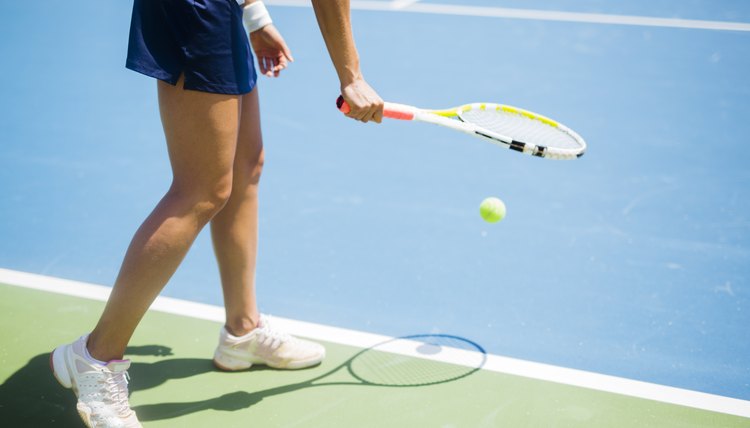
tennis net image by jimcox40 from Fotolia.com
Kip Doyle

About this Author

Kip Doyle, the managing editor at a weekly newspaper in Western New York, has over 12 years of experience researching and participating in sports and physical fitness. Doyle, who also writes about technology, music and pop culture, has been published by several newspapers, as well as websites like Punknews.org.

Article reviewed by Alison Gaynor

Last updated on: 07/26/10

Member Comments

Be the first to post a comment.

Advertise Here
advertisement

Related Topics

Sports & Recreation Tools

Loops

BMI Calculator

Target Heart Rate

Body Fat Calculator

Fitness Tracker

Write for LIVESTRONG.COM

Health and fitness professionals
are urged to apply

Learn More