Exercises for SPD After Birth
Pelvic girdle pain, including symphysis pubis dysfunction (SPD), is common during pregnancy. Luckily, SPD pain after birth is rare.
Laxity in the joint between your pubic bones is a good thing during childbirth — the cartilage loosens up to allow your pelvis to expand as your baby is delivered. However, in some cases, the joint remains lax after childbirth, causing SPD to continue.
Read more: Exercises That Relieve SPD in Pregnancy
SPD After Pregnancy
See your doctor for an accurate diagnosis if you suspect you have SPD. According to a case study published in the September 2015 issue of the Journal of Clinical & Diagnostic Research_,_ other conditions, such as:
- sciatica
- osteomyelitis
- traumatic symphyseal rupture
- osteitis pubis
- should be ruled out
Strengthen Your Abs
Exercising With Sore Knees After Pregnancy
Learn More
When performing ab exercises after pregnancy, it's important to first make sure you don't have a diastasis recti abdominis, or separation of your rectus abdominis muscle. If you notice a bulge or dome in the middle of your belly when you start to sit up from a lying down position, see a doctor or physical therapist. This condition requires a specialized exercise program.
Move 1: Abdominal Draw In
- Lie on your back on a firm surface.
- Bend your knees and place your feet on the floor. 3. With your hands on your hips, tighten your lower abs and flatten your lower back into the ground. Picture your belly button driving straight down toward the floor — the muscles under your fingertips should tighten. 4. Hold for 3 to 5 seconds, then relax.
- Repeat 20 times.
Move 2: Heel Slide
- Perform an abdominal draw in maneuver. 2. Slowly slide your right heel along the ground until your knee is straight. Then, slide it back up to the starting position. 3. Repeat on the opposite leg.
- Alternate sides and perform 10 repetitions.
Move 3: Plank
- Lie on your stomach on a firm surface. 2. Bend your elbows and position your hands underneath your shoulders. 3. Straighten your elbows and lift your body, as a unit, up onto the balls of your feet. 4. Hold this position, keeping your body in a straight line, for 30 seconds.
Move 4: Side Plank
- Lie on your side with your legs stacked on top of each other.
- Prop your upper body up on your forearm. 3. Lift your hips off the ground, balancing your body on your forearm and the side of your bottom foot. 4. Hold for 30 seconds, increasing time as your strength improves.
Strengthen the Lower Back Muscles
Muscles of your pelvis work with your lower back muscles to help maintain posture and stabilize your spine as you move. Add low back strengthening exercises to your routine to help treat SPD postpartum.
Move 1: Supermans
- Lie on your stomach with your legs straighten and arms extended over your head. 2. Keeping your hips and chest on the floor, lift your right arm and left leg simultaneously, 2 to 3 inches off the floor. 3. Hold for 3 to 5 seconds, then lower back down.
- Repeat on the opposite sides.
Progress this exercise as strength improves — lift both arms and both legs off the ground all at once — as if you are flying like Superman.
Move 2: Quadruped Lifts
- Position yourself on your hands and knees, with your hands in line with your shoulders and knees lined up with your hips. 2. Look down at the floor between your hands to avoid straining your neck during this exercise. 3. Lift your right arm out straight until it is parallel to the ground.
- Hold for 3 to 5 seconds, then lower back down. 5. Repeat with the left arm, right leg and lefts legs.
Progress this exercise by lifting the opposite arm and leg at the same time.
Perform Pelvic Floor Exercises
Exercises to Help the Belly Button After Pregnancy
Learn More
Include pelvic floor and hip strengthening exercises in your routine for SPD pain after birth. Pelvic floor exercises, such as Kegels, can be performed discreetly throughout the day.
According to the Mayo Clinic, these exercises can also reduce symptoms of stress incontinence that often occurs after childbirth. Hip strengthening exercises can be performed at home using your own body weight as resistance.
Move 1: Kegels
- In a seated or standing position, tighten your pelvic floor muscles as if you are stopping the floor of urine.
- Hold for three to five seconds, then relax. 3. Perform 10 to 15 repetitions, several times per day.
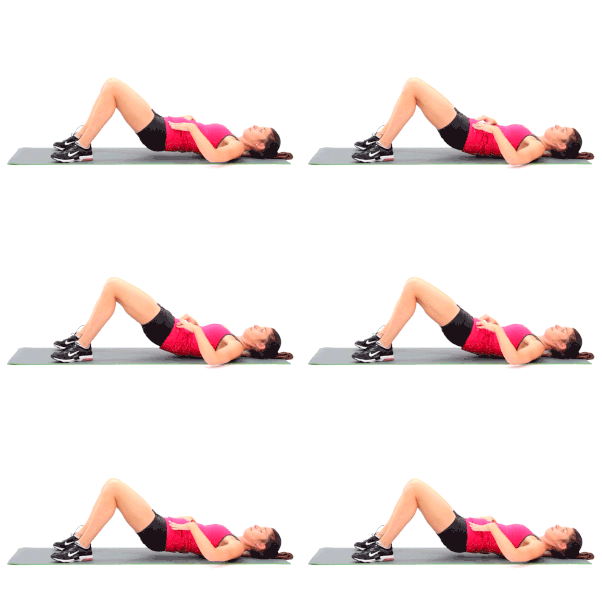
Move 2: Bridges
- Lie on your back with your knees bent and feet on the floor. Rest your arms by your sides. 2. Perform the abdominal maneuver and maintain this tightness throughout the movement.
- Squeeze your buttocks together and lift you hips up off the floor, as high as possible.
- Hold 3 to 5 seconds, then slowly lower down.
When this exercise gets easy, try one-legged bridges.
Move 3: Clamshells
- Lie on your side with your knees bent and legs stacked on top of each other. 2. Lift your top knee up toward the ceiling while keeping your feet together — as if your legs are a clam's shell that is opening. 3. Hold for 2 to 3 seconds, then lower back down. 4. Repeat on the opposite side.
Related Articles
Exercising With Sore Knees After Pregnancy
Learn More
Exercises to Help the Belly Button After Pregnancy
Learn More
Slimming Arm Exercises for Pregnancy
Learn More
How to Tone Up a C-Section Belly
Learn More
Pregnancy Stretches for Rib Pain and Muscle Spasms
Learn More
The Safest Time to Do Sit-Ups After a C-Section
Learn More
Pelvic Tilt Exercises During Pregnancy
Learn More
Stretches for Hip Pain During Pregnancy
Learn More
Best Exercises by Trimester
Learn More

Exercises to Do When 37 Weeks Pregnant
Learn More
- Journal of the Canadian Chiropractic Association: "Pregnancy-Related Symphysis Pubis Dysfunction Management and Postpartum Rehabilitation: Two Case Reports"
- Orthopedics: "Management of Postpartum Diastasis of the Pubic Symphysis"
- Journal of Clinical & Diagnostic Research: "Post-Partum Diastasis of the Pubic Symphysis: Report of a Rare Case"
- Princeton University Athletic Medicine: "Pelvic Stabilization, Lateral Hip and Gluteal Strengthening Program"
- Mayo Clinic: "Kegel Exercises: A How-To Guide for Women"

Aubrey Bailey has been writing health-related articles since 2009. Her articles have appeared in ADVANCE for Physical Therapy & Rehab Medicine. She holds a Bachelor of Science in physical therapy and Bachelor of Arts in psychology from the University at Buffalo, as well as a post-professional Doctor of Physical Therapy from Utica College. Dr. Bailey is also a certified hand therapist.
