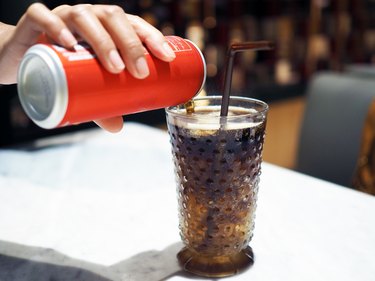
The science is black and white when it comes to the ill effects of too much added sugar in our diets — which is likely why people flock to diet soda. But ongoing health research on the sugar alternatives used to sweeten diet beverages has muddied the waters, leaving us all wondering whether or not diet soda is doing us any favors.
We dug into the science to share five reasons why you might want to rethink your diet soda habit.
Video of the Day
Video of the Day
1. It Confuses Our Bodies and Brain
Whether you gulp down a glass of regular soda or the calorie-free version, your body doesn't know the difference — initially, that is. "Artificial sweeteners confuse our brains and bodies to some extent," says Nicole Avena, PhD, neuroscientist, an expert in sugar and food addiction and the author of Why Diets Fail (Because You're Addicted to Sugar).
"When we taste something sweet, our body and brain react by releasing insulin in expectation of the glucose that circulates in our blood as a result of eating something with sugar. But when we consume an artificial sweetener, we end up releasing insulin when it isn't necessary, since the sweeteners don't impact blood glucose in the way that caloric sweeteners can."
Why is this a problem? Over time, this can lead to insulin resistance or difficulty managing blood sugar, which may potentially lead to diabetes.
Read more: Which Sodas Do Not Contain Aspartame?
2. Diet Soda Is Linked to Diabetes
Diet soda seems like it should be innocuous — it is sugar- and fat-free after all! But the truth is, studies have linked it to type 2 diabetes.
One study that observed over 60,000 women found that drinking both sugar-sweetened beverages and artificially sweetened beverages is associated with an increased risk of developing type 2 diabetes, according to March 2013 research published in The American Journal of Clinical Nutrition. However, researchers found that the sugar-sweetened group was at a greater risk. More studies have confirmed these findings including a May 2018 study published in Current Developments in Nutrition which also looked at sugar- and artificially sweetened beverages. Both groups were observed to have an increased risk for diabetes, although this time, other potential factors like BMI were controlled for in the artificially sweetened group.
But a December 2016 cohort study published in The Journal of Nutrition concluded that drinking sugar-sweetened beverages — not artificially sweetened beverages — is a risk factor for type 2 diabetes. Note that, since these are observational studies, they can't prove cause and effect.
3. It’s Associated With Heart Disease
Cracking open a can of the diet stuff is linked to an increase in blood pressure and other risk factors for heart disease. In fact, researchers observed that women who drank two or more artificially sweetened beverages every day were 29 percent more likely to develop heart disease and 23 percent more likely to have a stroke, according to a large February 2019 study published in Stroke, a journal of the American Heart Association.
Again, like the studies on diabetes risk, these were observational studies so they only show an association. More clinical research needs to be done to determine cause and effect.
4. Diet Soda Might Mess With Our Gut Microbiome
We're still figuring out how our gut microbiome is responsible for staving off certain diseases, according to Harvard Health. But a February 2019 review found that some non-nutritive sweeteners (which includes everything from aspartame to stevia to sugar alcohols) can alter our gut microbiota — and not in a good way, the study in Advances in Nutrition states. The researchers specifically called out saccharin and sucralose, reporting that they negatively affected the good bacteria in our gut. Saccharin led to inflammation while stevia slightly altered the bacteria in our guts as well.
"The gut microbiome is a hot topic in health and recent studies indicate that some artificial sweeteners such as saccharin could disrupt the gut microbiome and further affect health," Jim White, RD and certified exercise physiologist, tells LIVESTRONG.com.
"In one study, scientists looked at the relative toxicity of artificial sweeteners on E. coli bacteria and found that all artificial sweeteners damaged the bacteria in some way," he says, citing September 2018 research in Molecules. "While more research is needed, this does call into question the risks associated with artificial sweeteners in diet soda on the microbiome."
5. Can It Make It Harder to Kick Sugar?
Sometimes people use diet soda as a crutch to manage their sweet tooth or to wean off regular soda — but that might not be the right approach.
"I believe that the artificial sweeteners found in diet sodas can make breaking a sugar addiction a lot harder, says Avena. "Many people are under the impression that switching to an artificial sweetener will be the way to get off sugar, but when you consume artificial sweeteners, your brain still thinks it's [real] sugar. As a result, dopamine is released, and the neurochemical cascade of events that perpetuates the craving and withdrawal will continue."
That's why Avena recommends cutting back on all sweeteners including those with zero calories.
Healthier Drink Options — That Aren’t Plain Water
- Water infused with herbs, fruit or vegetables
- Spindrift (contains sparkling water and real squeezed fruit)
- Unsweetened iced tea
- Green juice
- Kombucha
- Low-sodium tomato juice
- Current Developments in Nutrition: "Diet Soda and Sugar-Sweetened Soda Consumption in Relation to Incident Diabetes in the Northern Manhattan Study"
- The Journal of Nutrition: "Sugar-Sweetened Beverage but Not Diet Soda Consumption Is Positively Associated with Progression of Insulin Resistance and Prediabetes"
- Stroke: "Artificially Sweetened Beverages and Stroke, Coronary Heart Disease, and All-Cause Mortality in the Women’s Health Initiative"
- Advances in Nutrition: "Effects of Sweeteners on the Gut Microbiota: A Review of Experimental Studies and Clinical Trials"
- The American Journal of Clinical Nutrition: "Consumption of Artificially and Sugar-Sweetened Beverages and Incident Type 2 Eiabetes in the Etude Epidemiologique Aupres des Femmes de la Mutuelle Generale de l Education Nationale–European Prospective Investigation into Cancer and Nutrition Cohort"
- Harvard Health: "Can Gut Bacteria Improve Your Health?"
- Molecules: "Measuring Artificial Sweeteners Toxicity Using a Bioluminescent Bacterial Panel"