
What does fact checked mean?
At SportsRec, we strive to deliver objective content that is accurate and up-to-date. Our team periodically reviews articles in order to ensure content quality. The sources cited below consist of evidence from peer-reviewed journals, prominent medical organizations, academic associations, and government data.
- American Council on Exercise: Selecting and Effectively Using a HomeTreadmill
- American Council on Exercise: Selecting and Effectively Using a HomeTreadmill
- American Council on Exercise: What You Need to Know Before You Purchase a Treadmill
The information contained on this site is for informational purposes only, and should not be used as a substitute for the advice of a professional health care provider. Please check with the appropriate physician regarding health questions and concerns. Although we strive to deliver accurate and up-to-date information, no guarantee to that effect is made.
What Is the Purpose of a Treadmill?
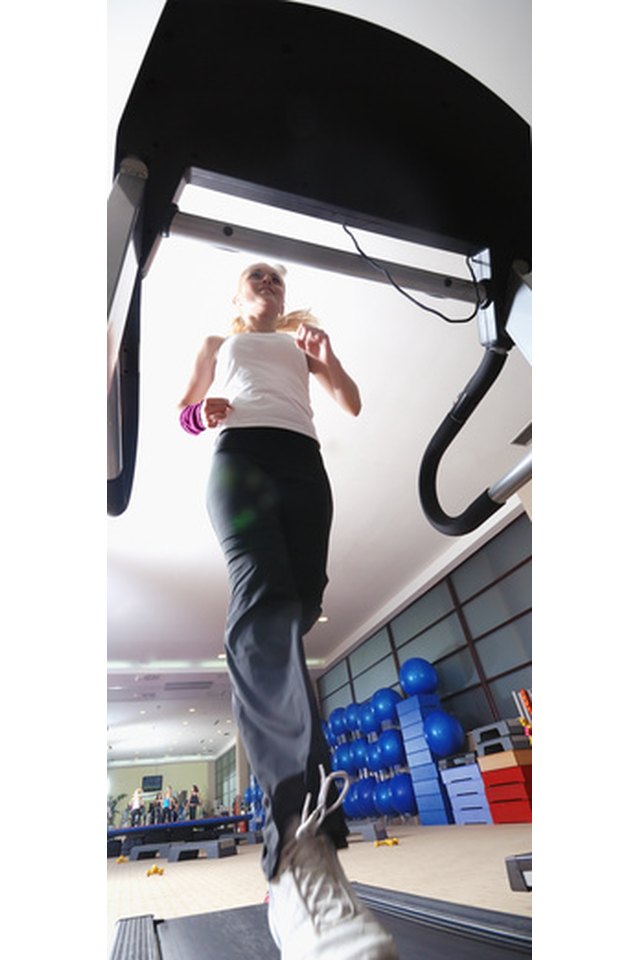
One of the greatest appeals of running is that it can be done outdoors. Running outdoors can seem to make time go faster, exposes you to fresh air and gets you in touch with nature. With all these benefits, you might wonder why someone would want to use a treadmill. However, the treadmill has an all-weather advantage and allows you to customize your speed and slope to get precisely the workout you desire.
Features
Treadmills are stationary cardio machines on which you can walk, jog or run indoors. Treadmills usually feature adjustable speeds and inclines to vary your workout, allowing you to simulate a hill with the push of a button. Most commercial treadmills go as fast as 12 mph and reach inclines of 10 percent or higher. Home-models features vary according to price; lighter, manual treadmills are generally less expensive while heavier, motorized versions cost more.
Uses
Treadmills are often used by people who are committed to their running workout, but are unable to go outside because of excessive heat or ice. If you live in an urban environment, running outdoors may not be pleasant because of traffic and air quality. Treadmills can also help you simulate specific race courses. For example, if you live in a flat area but are traveling to race on a hilly 10K, a treadmill can help you train effectively for those hills.
Benefits
The belt of a treadmill is a softer surface than asphalt or concrete and thus can discourage some injuries, notes Rick Morris, author of "Treadmill Training for Runners." Beginners who are apprehensive about outdoor routes may find comfort in being able to control the duration and intensity of their workout on a treadmill. If you own your own treadmill, it is exceptionally convenient to fit in your workout quickly, without having to drive to a trail or wait for sunrise. If you base your runs on distance traveled, a treadmill helps you keep accurate count of your miles.
Misconceptions
Some people believe treadmill training is inferior to outdoor running. Treadmills can help elite athletes train more precisely. Marathoner and running coach Jeffrey Horowitz notes in an April article published in the "Washington Post" that treadmills help runners better perform specific types of training drills like tempo and interval runs. With the technology of a treadmill, you can set your speed and ensure you are maintaining it for the duration you desire.
Considerations
If your goal is to improve cardiovascular fitness and burn calories, a treadmill will satisfy your needs. If you are a competitive runner, a treadmill can help prepare you for marathons and other events. Setting the incline on a treadmill at 1 percent for your runs will help make up for the lack of wind resistance and terrain changes, simulating an outdoor run.
Explore In Depth
References
- American Council on Exercise: Selecting and Effectively Using a HomeTreadmill
- American Council on Exercise: What You Need to Know Before You Purchase a Treadmill
- The Washington Post: Before You Run Down Treadmills
- Barnes KR, Hopkins WG, Mcguigan MR, Kilding AE. Effects of Different Uphill Interval-Training Programs on Running Economy and Performance. International Journal of Sports Physiology and Performance. 2013;8(6):639-647. doi:10.1123/ijspp.8.6.639
Writer Bio
Andrea Boldt has been in the fitness industry for more than 20 years. A personal trainer, run coach, group fitness instructor and master yoga teacher, she also holds certifications in holistic and fitness nutrition.