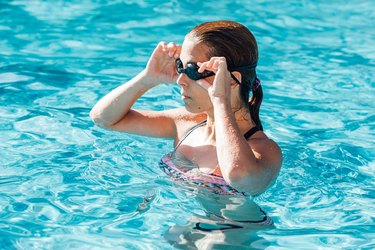
Let's say you decide to take a swim. In the early morning light, armed with fresh new goggles, you hit the pool. Images of Michael Phelps and Katie Ledecky run through your head. But before you finish the first lap, you can hardly breathe.
Don't sweat it: It's an all-too-common scenario for beginners. "Swimming takes longer to adapt to than any other sport," says Gerry Rodrigues, a Los Angeles-based swim instructor who's been coaching for more than 30 years. "We're used to moving our bodies on land. But we have very little practice moving in the water."
Video of the Day
Video of the Day
Even if you're a marathon runner or have logged endless hours in the weight room, learning how to swim takes time. You have to acclimate to a new breathing pattern, feeling of weightlessness and way of moving your body. But this guide will help you get there.
3 Form Tips to Help You Get Started
Eager to learn how to start swimming for exercise?
First things first: Adult swimming lessons are essential for beginners who are just learning how to swim. Even if your stroke just feels rusty or it's been a while since you swam laps, work with an instructor. Your local pool will likely offer adult group or private options.
You can also find a program near you through U.S. Masters Swimming, a national group that provides organized workouts and clinics for anyone who is 18 or older.
But if you decide to go solo, first check up on these tips for swimming laps for beginners:
1. Stay 'Athletically Relaxed'
Unnecessary tension can zap your energy, but you also don't want to be too relaxed and just float in the water. Instead, Rodrigues says to think of having some tautness to your body to keep it aligned.
Think about gently engaging your core muscles rather than actively squeezing them.
2. Go Long
An elongated posture will help you move faster and easier in the water. So think about stretching out in the direction you're headed.
When your hand and arm enter and move through the water, they should not cross the midline of your body. Even elite-level swimmers work on technique frequently, so give it time.
3. Stick With Small, Steady Kicks
The biggest mistake beginners make is kicking too much, according to Rodrigues. Kicking provides little propulsion but sucks up huge amounts of energy and sends your heart rate skyrocketing because you're moving big muscle groups like the quads. You want to kick just enough to keep the legs ups. A light, gentle tapping should do the trick.
3 Beginner Swimming Strokes to Try
Sure, you could just jump in the pool and doggy paddle. (And if that feels like the best place for you to start, go for it!) But good swimming form can make a world of difference.
To help you get started swimming for exercise, here's a quick breakdown of some of the most popular swimming strokes for beginners.
1. Freestyle
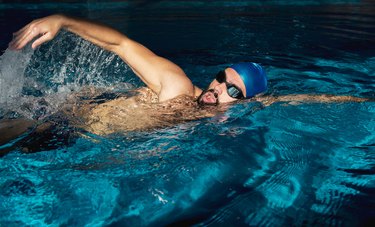
This is the fastest swimming stroke you can do when swimming laps. And fortunately it's not incredibly complicated.
To do the freestyle stroke, you want your head, hips and feet to form one long line. If your middle sags or your feet ride low, you increase drag, slowing you down and wasting energy.
If your midsection tends to sink, try doing some core exercises when back on dry land. If your feet flirt with the pool floor, try pushing your head down a bit farther into the water. Your upper body will act as a counterbalance to help your lower body float.
2. Backstroke
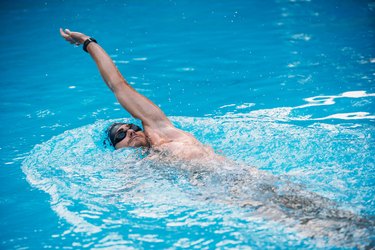
If you're swimming laps in the pool, adding the backstroke into your routine can help work your arms and shoulders in a different way from all of the forward-facing strokes. Bonus: Because it has you lie face-up, you don't have to worry about turning your head to the side to breathe.
The key to doing the backstroke is to think of reaching your arms forward instead of back. Stick with strong, powerful flutter kicks.
3. Breaststroke
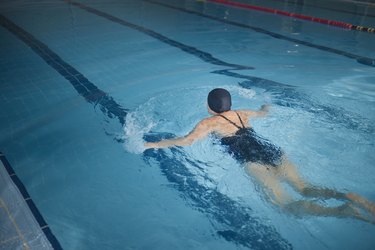
The breaststroke is a great way to work your lower body more than you do with other strokes.
Begin with your palms together in front of you and your legs behind you. Extend your arms forward, then turn your palms out as you sweep your arms back in a semi-circle. Return your arms to the front and repeat.
At the same time, bend your knees and bring your feet toward your hips. Then kick your legs out and back forcefully like you're a frog.
As you get a hang for the coordination, you can play with dipping into the water and coming back up with each stroke.
What Beginners Should Know About Lap Pools
Most lap pools are usually 25 or 50 meters long. One "lap" is out and back; a "length" is one direction. So, a 50-meter swim in a workout would mean you swim one lap in a 25-meter pool or one length in a 50-meter pool.
Try This Beginner Swim Workout
Consistency is key to learning anything, so start with regular sessions of steady swimming.
1. Pool-Walk Warm-Up
The natural resistance of the water is a great way to warm up before any swimming exercises, similar to the idea behind water aerobics. With the water at chest-height, walk across the pool for 100 meters to warm up. With each step, pump your arms.
2. 50-Meter Swim Intervals
Choose one of the beginner swim strokes listed above, and try swimming 50 meters. At the end of the distance, take a rest and check in with yourself and how you feel. Try to stay at a rate of perceived exertion (RPE) of 6 to 7 (on a scale from 1 to 10). At this intensity, you should feel like you're working but not feel out of breath.
Once you feel ready, repeat. Continue this pattern for at least 15 minutes. Work up to 30 minutes as you grow more comfortable swimming.
Everyone is different, Rodrigues says, so don't get discouraged if the person in the next lane over is cranking out laps two at a time, and you're winded after 30 seconds. Swim, rest, repeat. Stamina will come.
Keep Progressing
Once steady-state swims feel easy, Rodrigues recommends progressing to this beginner-intermediate swimming workout. Its short-distance intervals improve power, and the long-distance intervals increase endurance.
1. Warm-Up: Swim one or two lengths at an easy pace, rest for 10 to 15 seconds, then repeat for 10 minutes.
2. Short-Distance Intervals: Swim 100 meters at a speed that feels hard but manageable (an RPE of 8 out of 10). Rest for 20 seconds. Repeat 15 times.
3. Long-Distance Intervals: Swim 300 meters, 200 meters and then 100 meters, resting 20 seconds in between each set. If you're not comfortable with these distances, try swimming 100 meters, then 75 and 50, again resting for 20 seconds in between each set.
Tip
If you're looking for a way to balance your swimming workouts on land, consider using the elliptical. Ellipticals usually have moveable arms so that you work your upper body and lower body, which is a great opportunity to hone your arm and leg coordination skills for the water. You can alter the intensity of your workout by adjusting the resistance, pace or incline.
4 Benefits of Swimming for Beginners
Swimming statistics show that picking up the sport is worth the effort — with big benefits for your overall health and fitness levels.
"Commit to doing a block of 10 swims over the course of three weeks and you'll be amazed at the body's uncanny ability to adapt," Rodrigues says.
Keep these great health benefits in mind when you're doing the hard work of learning how to swim laps.
1. Improved Cardio Health
Swimming is a full-body workout that focuses on your heart and lung health, according to Harvard Health Publishing.
2. Stronger Muscles
Swimming also builds muscle from head to toe. The lats and back muscles in swimmers tend to be among the most developed. That bodes well for your posture.
3. No Joint Impact
Low-impact cardio workouts support your health without stressing sensitive joints and bones. But swimming isn't just low in impact, it involves zero impact.
4. Big Calorie Burns
A 185-pound person swimming laps in a pool at a vigorous clip can burn around 420 calories in 30 minutes, per Harvard Health Publishing. Swimming at a more leisurely pace can still burn up to 252 calories in 30 minutes.
Keep in mind that swimming is just part of the equation. In order to lose weight with swimming, you also need to maintain a calorie deficit (aka burn more calories than you take in).
4 Pieces of Essential Swimming Gear
After you've found the best swimsuit for you, it's worth stocking up on a few other swimming tools.
1. Goggles
Swimmers' most prized possession is their goggles. You'll want a set of clear lenses for indoor swimming and tinted ones for outdoors.
Goggles We Love
- Nike Vapor Goggle (Amazon.com, $21)
- Speedo Adult Hydro Comfort Swim Goggle (Amazon.com, $21.99)
2. Nosepiece
There's nothing quite like sucking water up your nose. So buy yourself an adjustable nosepiece for the best fit possible.
Nosepieces We Love
- Speedo Swim Nose Clip Liquid Comfort (Amazon.com, $6.49)
- Speedo Swim Training Nose Clip (Amazon.com, $4.99)
3. Cap
If you need a swimming cap to keep your hair under control, go with a silicon version. It'll last much longer than latex will.
Caps We Love
- Speedo Silicone Swim Cap (Amazon.com, $12)
- TYR Silicone Comfort Swim Cap (Amazon.com, $14.99)
4. Pool Floats
Kickboards let your upper body rest while you work your legs. Meanwhile, pull buoys (figure-8 shaped foam devices that you place between your legs above your knees) support your lower body so you can concentrate on your stroke.
Pool Floats We Love
- VIAHART Swimming Kickboard (Amazon.com, $12.49)
- Speedo Adult Swim Training Pull Buoy (Amazon.com, $14.99)
Was this article helpful?
150 Characters Max
0/150
Thank you for sharing!
Thank you for your feedback!