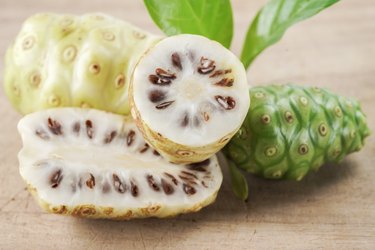
Noni fruit can be off-putting with its odd appearance and pungent scent, but it's revered in many Polynesian and Asian cultures as both food and medicine. Globally, it's become popular for treating a range of conditions, including diabetes and cancer; however, its efficacy hasn't been proven.
What Is Noni Fruit?
Video of the Day
Noni is the small fruit of the noni tree, Morinda citrifolia_,_ a small, evergreen tree that grows from Southeastern Asia to Australia. It is especially abundant in Polynesia, where it is hardy enough to thrive rooted among lava flows.
Video of the Day
Historically, the leaves and fruit of the noni tree were consumed and used as medicine to treat numerous conditions including inflammation, abscesses, angina, diabetes, osteoarthritis, rheumatism, backache, joint issues, hemorrhoids, skin allergies, burns and warts.
Recently, noni has attracted attention as a dietary supplement. It is sold commercially in capsules, powders, tablets and teas. Perhaps most popular is its juice; according to a research review published in the journal Foods in April 2018, over 108 million gallons of just one brand of the juice were consumed in more than 80 countries during the first 12 years it was available commercially.
Nutritional Profile of Whole Noni
Most people in the West rarely consume the whole noni fruit due to lack of availability and a smell and flavor that is repellant to unaccustomed taste buds. It has been described as having a flavor similar to bad cheese and a smell akin to vomit.
But if you happen to have access to the fruit and have a taste for it, eating it will add a range of nutrients to your diet not unlike many other fruits. According to a review published in Nutrients in May 2017, water makes up 90 percent of noni fruit, and the remainder is dry matter comprised of fiber, protein, minerals and vitamins. Protein constitutes a little over 11 percent of the dry matter, and the primary amino acids present are glutamic acid, aspartic acid and isoleucine.
Ten to 12 percent of the dry matter is composed of minerals, including calcium, sulfur, potassium, magnesium, sodium, phosphorus and selenium. The most abundant vitamin in noni is vitamin C, of which there are 250 milligrams per 100 grams, or 3.5 ounces. That's more than four times the daily value for the nutrient, according to the National Institutes of Health.
Vitamin C is a crucial nutrient that humans are not able to synthesize, unlike most animals. Its main function is to support the production of collagen, which is a part of the connective tissue that basically holds the body together. Collagen is also vital for wound healing. Vitamin C has other important roles in the body, including acting as an antioxidant that can potentially protect against disease.
Nutrition in Noni Juice
Noni juice is by far the more commonly consumed part of the fruit in the Western world. Juice lacks the dietary fiber of whole fruit, and it's a concentrated source of the natural sugars found in fruit.
Noni is sold either in pure juice form or in a pre-mixed combination of other juices, such as apple juice. It may also be combined with fruit purees. This means the nutritional value of each product can vary widely.
A serving of noni juice is not a full 8 ounces, as it is with other juices. One brand of 100 percent noni juice lists one serving as 1 fluid ounce. In this size serving, there are 5 calories, less than 1 gram of carbs and less than 1 gram of sugar. The only other nutrient listed is vitamin C, of which one serving provides 9 grams, or 10 percent of the daily value.
Another branded product contains noni juice mixed with other juices and fruit purees. In a 1-ounce serving, there are 15 calories, 4 grams of carbs, less than 1 gram of dietary fiber and 1 gram of added sugar. There is no information provided about its vitamin C content.
Noni Benefits From Antioxidants
Noni is often called a superfruit, or superfood, denoting its classification as a functional food that may confer greater health benefits than other foods. But according to Harvard T.H. Chan School of Public Health, this is nothing more than a marketing tool used by manufacturers to drive sales.
One of the main claims that supplement manufacturers make about noni benefits is that it is an antioxidant powerhouse. Antioxidants are naturally occurring compounds in foods that may be able to prevent disease by scavenging free radicals that damage healthy cells. According to the NIH, research corroborates the important role antioxidants play in human health.
However, while noni is high in antioxidants, it may not be a more abundant source than other more conventional foods. For example, a study published in Micronesica in April 2011 found that mature noni fruit had the same antioxidant capacity as oranges and tangerines — which are not considered superfruits.
Another study published in the October-Dececember 2010 issue of the Brazilian Journal of Pharmaceutical Sciences measured the antioxidant content of noni juice versus blueberry and grape juices and found that concentrated blueberry juice exhibited antioxidant activity six times greater than commercially available noni juice and four-and-a-half times more than grape juice.
Say "No" to Noni?
Therefore, the researchers of the Brazilian Journal of Pharmaceutical Sciences study concluded that, although there are potential noni benefits for health, they may not be any more than those of other widely available juices. Furthermore, its higher cost may make it a less favorable option than other, less expensive products.
It's tempting to believe supplement manufacturers' claims and anecdotal evidence from consumers. But, realistically, there's only so much that a couple tablespoons of juice once or twice a day can do for you.
Any therapeutic benefits of noni juice haven't been proven by scientific research. What has been proven, however, is the effectiveness of a healthy, balanced diet rich in a variety of fruits and vegetables. Eating whole fruits and vegetables is usually a better option than drinking their juices. Whole fruits are a good source of vitamins, minerals and antioxidants, and they also provide dietary fiber, which is critical for digestive and heart health.
Rather than shelling out a lot of money on noni juice supplements that make dubious health claims, seek out an Asian market that may sell the whole fruit. Give it a try and see if you like it. If not, pick up a variety of fruits, like some fresh oranges, tangerines and blueberries, which will give you just as much nutritional bang for your buck — and will taste great too.
- NIH: "Noni"
- Foods: "The Potential Health Benefits of Noni Juice: A Review of Human Intervention Studies"
- Vassar: "Noni: A Super-Fruit? (Or Just a Super Smelly Fruit?)"
- Nutrients: "Morinda citrifolia Linn. (Noni) and Its Potential in Obesity-Related Metabolic Dysfunction"
- NIH: "Vitamin C"
- Harvard T.H. Chan School of Public Health: "Superfoods or Superhype?"
- NIH: "Antioxidants: In Depth"
- Micronesica: "Antioxidant Capacity, Total Phenols, and Ascorbic Acid Content of Noni (Morinda Citrifolia) Fruits and Leaves at Various Stages of Maturity"
- Brazilian Journal of Pharmaceutical Sciences: "Total Polyphenol Content and Antioxidant Activity of Commercial Noni (Morinda Citrifolia L.) Juice and Its Components"
- Lakewood: "Organic PURE Noni, (32 oz, 6 pack) Fresh Pressed"
- Now: "Noni SuperFruit Juice Liquid"