
Rhythmic Breathing in Swimming
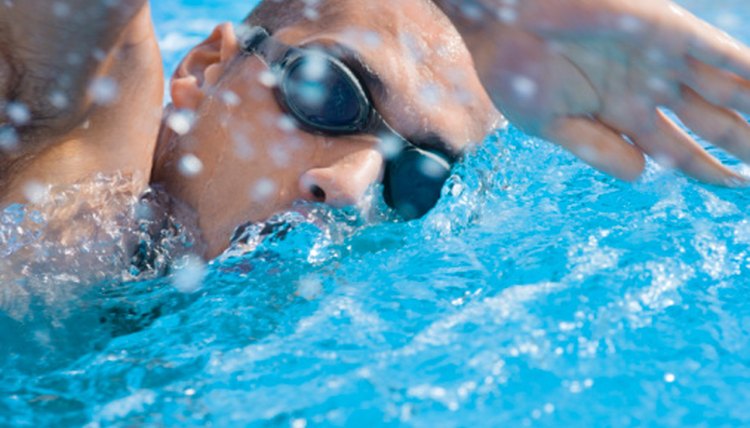
How you breathe while swimming can make the difference between an invigorating workout and one that leaves you gasping for air. Swimming is a technique-intensive sport, and developing comfortable rhythmic breathing takes good timing, proper technique and a lot of practice.
Breathing Rate
As a beginner, you might try holding your breath during your freestyle stroke, and only breathe when you cannot go without air any longer. Because beginners typically lift their heads high so they can exhale and inhale above water, they interrupt their forward motion and cause turbulence. Instead, switch your breathing pattern so that you only inhale above the water. Start exhaling slowly as soon as you take a breath and blow out air when your face is still in the water. Coordinate how fast you exhale against the water's pressure with your stroke so that you take a breath as your "recovery" arm returns overhead.
Breathing Every Three Strokes
Breathing on both sides helps you build up strength evenly on both sides of your body. You naturally favor one side over the other, though, and sometimes forcing yourself to breathe on your weaker side can result in strained neck and shoulder muscles. Bilateral breathing usually involves breathing every three strokes. You alternate breathing on your left and on your right side. The rhythmic pattern should not leave you short of breath, though, so if you feel uncomfortable, breathe every other stroke. Practice swimming “even” laps breathing on your right side, and “odd” laps breathing on your left.
Patience
Rhythmic breathing in swimming is about relaxing and finding your own rhythm. You cannot rush the process of finding your comfort zone. Freestyle is particularly challenging, but proper breathing during breaststroke also takes practice and patience. In breaststroke, you take a breath and time your next breath so as not to interfere with your streamlined position in the water. As in freestyle, you blow out slowly underwater and take your next breath when you surface. Breathing slowly and rhythmically gradually builds your lung capacity and fitness as well.
Drills and Tips
Certain techniques and drills help you get in the breathing groove. You can breathe when you want swimming backstroke, but practicing breathing in through your mouth and then out through your nose helps assure you a steady flow of oxygen, according to Olympic champion Janet Evans, in "Janet Evans' Total Swimming." Practice your freestyle breathing by eliminating other distractions. Use a kickboard held in front of you while you face down in the water and flutter kick. Perform one lap doing an "every three" breathing pattern, and then switch to breathing every other stroke on the way back. Swimming butterfly with one arm helps you improve your body position and perfect your breath-timing during your stroke.
References
- Janet Evans' Total Swimming; Janet Evans
- The 100 Best Swimming Drills; Blythe Lucero
- Ramos-Jiménez, A., Hernández-Torres, R. P., Torres-Durán, P. V., Romero-Gonzalez, J., Mascher, D., Posadas-Romero, C., & Juárez-Oropeza, M. A. (2008). The Respiratory Exchange Ratio is Associated with Fitness Indicators Both in Trained and Untrained Men: A Possible Application for People with Reduced Exercise Tolerance. Clinical medicine. Circulatory, respiratory and pulmonary medicine, 2, 1–9. doi: doi.org/10.4137/ccrpm.s449
- Recinto C, Efthemeou T, Boffelli PT, Navalta JW. Effects of Nasal or Oral Breathing on Anaerobic Power Output and Metabolic Responses. Int J Exerc Sci. 2017;10(4):506-514.
- Cancelliero-gaiad KM, Ike D, Pantoni CB, Borghi-silva A, Costa D. Respiratory pattern of diaphragmatic breathing and pilates breathing in COPD subjects. Braz J Phys Ther. 2014;18(4):291-9. doi:10.1590/bjpt-rbf.2014.0042
- Cleveland Clinic. Diaphragmatic Breathing. 2019.
- Giuliodori MJ, Lujan HL, Briggs WS, Dicarlo SE. A model of locomotor-respiratory coupling in quadrupeds. Adv Physiol Educ. 2009;33(4):315-8. doi:10.1152/advan.00057.2009
- Daley MA, Bramble DM, Carrier DR. Impact loading and locomotor-respiratory coordination significantly influence breathing dynamics in running humans. PLoS ONE. 2013;8(8):e70752. doi:10.1371/journal.pone.0070752
- Schücker L, Parrington L. Thinking about your running movement makes you less efficient: attentional focus effects on running economy and kinematics. J Sports Sci. 2019;37(6):638-646. doi:10.1080/02640414.2018.1522697
- Stickford AS, Stickford JL, Tanner DA, Stager JM, Chapman RF. Runners maintain locomotor-respiratory coupling following isocapnic voluntary hyperpnea to task failure. Eur J Appl Physiol. 2015;115(11):2395-405. doi:10.1007/s00421-015-3220-y
- Bramble, D., & Carrier, D. (1983). Running and breathing in mammals. Science, 219(4582), 251–256. doi:10.1126/science.6849136
- Recinto, C., Efthemeou, T., Boffelli, P. T., & Navalta, J. W. (2017). Effects of Nasal or Oral Breathing on Anaerobic Power Output and Metabolic Responses. International journal of exercise science, 10(4), 506–514. PMID: 28674596
- Schücker, L., & Parrington, L. (2018). Thinking about your running movement makes you less efficient: attentional focus effects on running economy and kinematics. Journal of Sports Sciences, 37(6), 638–646. doi:10.1080/02640414.2018.1522697
- Stickford, A. S. L., Stickford, J. L., Tanner, D. A., Stager, J. M., & Chapman, R. F. (2015). Runners maintain locomotor–respiratory coupling following isocapnic voluntary hyperpnea to task failure. European Journal of Applied Physiology, 115(11), 2395–2405. doi:10.1007/s00421-015-3220-y
- TAKANO, N. (1995). Phase Relation and Breathing Pattern during Locomotor/Respiratory Coupling in Uphill and Downhill Running. The Japanese Journal of Physiology, 45(1), 47–58. doi:10.2170/jjphysiol.45.47
- Daley MA, Bramble DM, Carrier DR. Impact Loading and Locomotor-Respiratory Coordination Significantly Influence Breathing Dynamics in Running Humans. Hug F, ed. PLoS ONE. 2013;8(8):e70752. doi:10.1371/journal.pone.0070752.
- Morton D, Callister R. Exercise-Related Transient Abdominal Pain (ETAP). Sports Medicine (Auckland, N.z). 2015;45:23-35. doi:10.1007/s40279-014-0245-z.
Writer Bio
Barrett Barlowe is an award-winning writer and artist specializing in fitness, health, real estate, fine arts, and home and gardening. She is a former professional cook as well as a digital and traditional artist with many major film credits. Barlowe holds a Bachelor of Arts in English and French and a Master of Fine Arts in film animation.