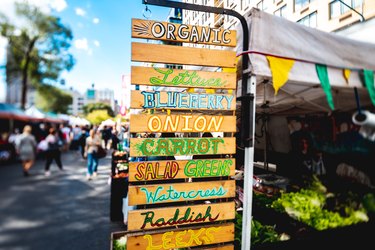
The organic industry is on the move: According to data from the Organic Trade Association, more than 82 percent of U.S. households buy organic, more than 75 percent of all categories on supermarket shelves offer organic options and half of organic operations are increasing their full-time employment.
However, according to an article published in Scientific American, organic production still makes up less than 1 percent of agricultural land around the globe — perhaps due in part to the complex interplay between the pros and cons of organic food and farming.
Video of the Day
Video of the Day
Disadvantage: The Cost Factor
Let's start with the most obvious disadvantage of organic food: It almost always costs more than conventionally grown food. That's a small wonder when you consider the long list of cost- and production-optimizing practices that are common on conventional farms but aren't allowed on organic farms.
These include genetically modified organisms, conventional pesticides, herbicides, petroleum-based and sewage-sludge-based fertilizers, antibiotics, growth hormones and irradiation. Depending on what's being produced, the scarcity of organic raw materials can ratchet costs up too.
For many consumers of organic food, the mandated absence of these practices is worth the extra cost. But the stark truth is that many people simply can't afford the difference in cost.
There's a different sort of cost factor for farmers: the learning curve they must undergo if they choose to transition from conventional to organic farming. Suddenly they must master a whole new set of agricultural principles, with both guidance and skilled labor less readily available than they are for conventional agriculture.
Advantage: Reduced Exposure to Pesticides
One of the greatest benefits of organic food is the reduced exposure to pesticides, due to the regulations imposed on organic farming operations.
There's been some back-and-forth over this issue, with some, like plant pathologist Steven Savage writing for Forbes, contending that pesticide residue on conventional foods falls within limits that have been deemed "safe."
But in a feature article for the Harvard School of Public Health, the editors point out that such limits are predicated on animal-based studies, and that several birth-cohort studies in the U.S. suggest that pesticides do in fact harm children's brains, demonstrating negative impacts on IQ, neurobehavioral development and ADHD diagnoses.
Ultimately, no matter what your feelings are about pesticide levels in conventional foods, it's difficult to assert that less pesticide exposure is in any way a negative aspect of organic foods.
Read more: 16 Foods You Don't Always Need to Buy Organic
Advantage: Reduced Exposure to Antibiotics
Even in conventional agriculture within the U.S., antibiotic use is on the decline: As of the FDA's 2017 annual summary report, the use of medically important antimicrobials in food-producing animals had dropped 43 percent from its peak in 2015, when about 80 percent of antibiotics sold in the United States were intended for use in animal agriculture.
Still, a December 2016 study for the European Parliamentary Research Service points out that antibiotic use in agriculture remains a key driver for the growing prevalence of antibiotic resistance, which can be spread from animals to humans.
That makes the very limited use of antibiotics in organic agriculture a definite benefit. Instead of turning to antibiotics to keep their animals healthy, organic farmers use more preventives, such as giving the animals appropriate space to roam, which in turn cuts down on the transmission of infections and other disease.
Possible Advantage: Reduced Allergies
A review of existing scientific evidence, published through the European Parliamentary Research Service in 2016, notes that some studies have indicated a link between organic food consumption and a lower risk of childhood allergies. The authors also note that adults who frequently eat organic food are less likely to have overweight or obesity.
That said, there have been no studies to establish definite cause between these factors. This is especially important because it's difficult to separate organic foods from other lifestyle factors present in the same population that might also affect these health factors.
Questionable Advantage: Better Treatment of Animals
According to a survey conducted in 2013 by the American Society for the Prevention of Cruelty to Animals, a majority of consumers who buy organic food believe that organic farms are required to treat animals more humanely than so-called factory farms. But vague requirements and regulatory loopholes mean that isn't necessarily the case.
If your primary concern in buying organic food is avoiding factory farms or encouraging animal welfare, consider shopping for products that are Certified Humane or bear a similar regulatory designation for the quality of care — and life — the animals receive.
Unclear Advantage: Better Sustainability
You could make the case that one of the biggest disadvantages of organic food is the label with its numerous assumptions and misapprehensions. In some cases, it's an undeniable case of consumers assuming that the organic label equates to ideal conditions for the animals involved.
Some consumers also assume that organic practices are more sustainable than conventional agriculture. And while that is certainly sometimes the case, it isn't always true.
For example, organic farmers are free to plant outside the natural season for crops, using heating systems and other practices that eat up a lot of natural resources. So if sustainability really matters to you, consider doing a little extra research to make sure the organic brand you're looking at is as eco-friendly as you think it is.
Possible Disadvantage: Too Costly and Restrictive
Some farms follow largely organic production practices but haven't actually pursued organic certification, either because they find the letter of the organic standards to be too restrictive (consider the previous point regarding sustainable farming), or because of the extra costs involved that they don't want to pass on to the consumer. (Becoming USDA Certified Organic can cost anywhere from a few hundred to several thousand dollars.)
While those might be considered disadvantages to the organic label, they're also a great reason to get to know your local farmers. If you stop by the farmer's market or farm stand during a time when it's not very busy, farmers are often happy to discuss their philosophies and farming practices.
Conditional Advantage: More Nutritional Value
Many consumers believe that organic foods have better nutritional value than conventionally grown foods, but there's only limited evidence that this is the case. For example, a 2017 study published in the Journal of Agricultural and Food Chemistry found that organic onions had about 20 percent higher antioxidant content than their conventionally grown cousins, and a pair of 2016 studies published in the British Journal of Nutrition found that organic milk and meat have greater concentrations of essential fatty acids than their nonorganic counterparts.
- European Parliamentary Research Service: Human Health Implications of Organic Food and Organic Agriculture
- Scientific American: Why People Aren't Buying Into Organic Food Products
- Organic Trade Association: Big Results From Small Seeds
- U.S. Department of Agriculture: Behind the USDA Organic Seal
- Organic Farming Research Foundation: Organic FAQs
- U.S. Food & Drug Administration: 2017 Summary Report on Antimicrobials Sold or Distributed for Use in Food-Producing Animals
- American Journal of Public Health: Antibiotics Overuse in Animal Agriculture
- National Geographic: We Don't Have Enough Organic Farms. Why Not?
- ASPCA: Research on Consumer Perceptions of Organic Food Standards
- Auguste Escoffier School of Culinary Arts: The Difference Between Organic and Sustainable Agriculture
- U.S. Department of Agriculture: Becoming a Certified Operation
- Journal of Agricultural and Food Chemistry: Higher Antioxidant Activity
- Science Daily: New Study Finds Clear Differences Between Organic and Non-Organic Milk and Meat
- Certified Humane: Our Standards