The Role of hCG in Pregnancy
The abbreviation hCG is short for human chorionic gonadotropin. It is a hormone produced by a developing embryo during pregnancy. The hormone has an important role in both the detection and the maintenance of pregnancy. Pregnant women have very high hCG levels, but nonpregnant women and men do not have the hormone in their bloodstreams.
Features
Once bound to the cells, it sends signals to cells across the cell membrane. The hormone isn't produced by all adults. Instead, embryonic cells begin producing hCG shortly after a woman conceives. Once the embryonic cells differentiate into tissue types, the tissues of the placenta take over hCG production.
Significance

The Medical Conditions That Cause a False Positive in Pregnancy Results
Learn More
The purpose of hCG is to maintain an important temporary maternal endocrine cell group called the corpus luteum. If an egg isn't fertilized, its corpus luteum dies within about 14 days. In the case of fertilization, hCG maintains the corpus luteum.
Function
By maintaining the corpus luteum that surrounds the egg, hCG also maintains the lining of the uterus, which is necessary to sustain a pregnancy if an egg is fertilized. When the corpus luteum surrounding an unfertilized egg dies, falling hormone levels cause the uterine lining to slough, which results in a menstrual period. By maintaining the uterine lining, hCG provides a place for embryonic development. The embryo is totally dependent on the uterine lining until the placenta is fully formed, usually during the fourth month of pregnancy.
Considerations

How Soon After Sex Can You Get Pregnant?
Learn More
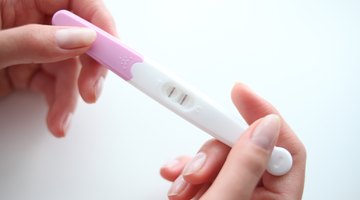
Although hCG's primary role in pregnancy relates to the developing embryo, it has a separate utility—physicians can test for hCG levels in blood to monitor the viability of an early pregnancy. Also, home pregnancy tests can detect hCG in urine to detect early pregnancies. Explain Heidi Murkoff and Sharon Mazel in their book "What To Expect When You're Expecting," because the embryo begins to produce hCG soon after conception, women can test positive for pregnancy owing to to hCG production several days before a missed period.
Potential
Because:
- of its similarity to another hormone
- luteinizing hormone or LH
- hCG mimics some of the effects of LH in the female body
- explains Dr
Miriam Stoppard in her book "Conception
Pregnancy
Birth." LH normally stimulates ovulation, but if LH levels are low, injections of hCG have similar stimulatory effects. In women whose ovaries ripen eggs but don't release them, doses of hCG can stimulate ovulation and help improve fertility.
Related Articles

The Medical Conditions That Cause a False Positive in Pregnancy Results
Learn More
How Soon After Sex Can You Get Pregnant?
Learn More

Pregnancy & Drop in hCG
Learn More

What Causes Raised HCG Levels?
Learn More
Medications That Will Affect HGC Testing for Pregnancy
Learn More

Causes of High Hormone Levels During Pregnancy
Learn More

7 Female Hormones and How They Affect Your Body
Learn More

Progesterone and Estrogen Levels in Early Pregnancy
Learn More

Progesterone Levels in the First Trimester of Pregnancy
Learn More

Symptoms of Hormone Imbalance & Unable to Get Pregnant
Learn More
- “Human Physiology”; Lauralee Sherwood, Ph.D.; 2004
- “Anatomy and Physiology”; Gary Thibodeau, Ph.D.; 2007
- “What to Expect When You’re Expecting”; Heidi Murkoff and Sharon Mazel; 2008
- “Conception, Pregnancy and Birth”; Miriam Stoppard, M.D.; 2008

Kirstin Hendrickson is a writer, teacher, coach, athlete and author of the textbook "Chemistry In The World." She's been teaching and writing about health, wellness and nutrition for more than 10 years. She has a Bachelor of Science in zoology, a Bachelor of Science in psychology, a Master of Science in chemistry and a doctoral degree in bioorganic chemistry.
