10 Steps to CPR
Performing CPR properly can mean the difference between life and death. CPR, which stands for cardiopulmonary resuscitation, is an emergency procedure done when someone’s breathing or heartbeat has stopped. CPR techniques vary depending on the age or size of the patient.
Those who are certified or trained in CPR are ideally the ones who should perform the procedure, notes MedlinePlus 1. People should not rely on reading information online or in books as adequate training to administer CPR.
Survey the area. Although it is best to begin CPR as quickly as possible, the person who is about to perform CPR needs to ensure that he will be safe while performing the procedure. This may include looking for traffic, fires or other potential dangers.
How to Use Ambu Bags
Learn More
Determine if CPR is necessary. Ask loudly if the person who looks to be in trouble is OK or gently shake the person to check responsiveness. Listen, look and feel for breathing. CPR is necessary only when a person is not breathing or circulating blood adequately, explains KidsHealth.org 2.
Call 911. If two people are present, one can begin CPR immediately while the other calls 911 for help. If only one person is present, however, that person should call 911 before beginning CPR if he has immediate access to a telephone or administer CPR for approximately 1 to 2 minutes and then call 911.
CPR Vs. Rescue Breathing
Learn More
Position the unresponsive person appropriately. Place the person on her back on a firm surface, such as the ground. Open her airway by lifting her chin and tilting her head upward.
Begin rescue breathing. Mouth-to-mouth resuscitation in adults requires pinching the nostrils and giving two breaths into the mouth, while mouth-to-nose rescue breathing in adults requires breaths delivered through the nostrils. Mouth-to-nose rescue breathing is useful when the mouth is injured or cannot be opened. If the victim is an infant, rescue breathing can also be administered through the mouth and nostrils simultaneously if the CPR performer’s mouth is large enough to cover both. Give one rescue breath and watch to see if the victim’s chest rises. If it does, give a second rescue breath. If the victim's chest doesn’t rise, reposition the head or check to see if something is blocking the air passage and try again. Only trained professionals should attempt rescue breathing. Those uncomfortable with their skills in this area may consider performing only chest compressions until emergency help arrives, suggests the Mayo Clinic 3.
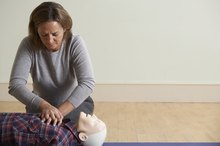
Begin chest compressions. This should be done only when the person is unconscious and does not have normal breathing, coughing or movement, explains MedlinePlus 1. For adult patients, the person performing the CPR should place the heel of her dominant hand between and slightly below the victim's nipples, and place the other hand on top of that hand. Position shoulders directly above the hands and keep arms straight. Use body weight to push the chest down about 2 inches, and continue pushing at a rate of 100 compressions a minute. For child patients, use a similar process but use one hand to compress the chest about 1/3 to 1/2 of the depth of the chest. For infants, two fingers should be used in lieu of hands and the infant’s chest should be pushed approximately 1/3 to 1/2 the depth of the chest, according to the University of Maryland Medical Center.
Return to rescue breathing after approximately 30 compressions. Give two more rescue breaths, then return to perform 30 additional chest compressions. Repeat as needed.
Administer a shock to adult or child patients using an automatic external defibrillator if possible. Those not trained to use a defibrillator may receive instructions and guidance from a 911 operator. After administering one shock, resume chest compressions for 2 minutes before administering a second shock. Automatic external defibrillators should not be used on children younger than 1, according to the Mayo Clinic 3.
Continue the CPR process until emergency medical personnel arrives or until the victim regains consciousness or movement.
Provide information to the appropriate health care professionals. Explain how the victim was found and how long the CPR was performed, as well as any other information that may be relevant to treatment.
Related Articles

How to Use Ambu Bags
Learn More
CPR Vs. Rescue Breathing
Learn More

How to Perform CPR on a Person With a Pacemaker
Learn More

How to Measure Someone's Pulse & Respiration
Learn More

How to Do the Heimlich Maneuver
Learn More

Conditions That Must Exist Before Using CPR
Learn More
How to Hypnotize People While They Sleep
Learn More

How to Get Kids to Project Their Voices
Learn More

Breathing Exercises After Heart Surgery
Learn More

Emergency Procedures in Sports
Learn More
References
Writer Bio
Elizabeth Wolfenden has been a professional freelance writer since 2005 with articles published on a variety of blogs and websites. She specializes in the areas of nutrition, health, psychology, mental health and education. Wolfenden holds a bachelor's degree in elementary education and a master's degree in counseling from Oakland University.