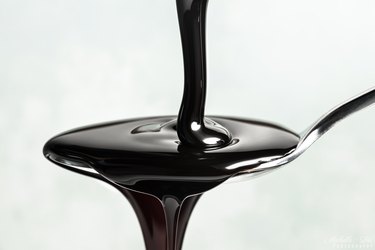
If you have diabetes, you know you have to watch your carbs to help keep your blood sugar levels in check. But when you're looking to have a sweetened treat, not all sugars — a type of carb — are the same, so you might be curious about white sugar alternatives like black strap molasses for diabetes.
The Centers for Disease Control and Prevention (CDC) says any type of sugar adds carbohydrates to your diet. When you have diabetes, counting your carbs can help you manage your blood sugar and prevent or delay complications of diabetes. But black strap molasses is a little different. While you still have to count carbs, you just might be able to enjoy black strap molasses in your diet.
Video of the Day
Video of the Day
Glycemic Index Explained
Harvard Health Publishing says that when you eat carbs, your blood sugar goes up, but the increase is not the same for every carb. The total amount of carbs is important, but so is the type of food. The glycemic index is a measure that tells you how fast a particular food raises your blood sugar. High glycemic foods can make it harder to control your blood sugar and your diabetes.
"The glycemic index ranks foods based on how they impact glucose levels, zero being least impactful and 100 being greatest increase," Joy Ashby Cornthwaite, RD, LD, certified diabetic care educator at UT Physicians, University of Texas Health Science Center at Houston, says. "Molasses ranks lower on the glycemic index than sugar, meaning that rises in glucose levels are lower when using molasses than with traditional sugar granules. It is for this reason that many people substitute molasses for sugar as a sweetener."
Harvard Health says that high glycemic foods have a glycemic index of 70 or higher. Low glycemic foods have a glycemic index of 55 or less; these include most fruits and vegetables. According to a glycemic index database based at the Boden Institute of Obesity, Nutrition, Exercise and Eating Disorders and Charles Perkins Centre at the University of Sydney, the glycemic index of black strap molasses is 55, which would put it in the same zone as safe foods like most fruits and vegetables.
Your Carb Load
Carbs are measured in grams, the CDC says. Although there is no one-size-fits-all for people with diabetes when it comes to total carbs, most people with diabetes should get about half their daily calories from carbs, the CDC says. That usually means about 200 to 225 grams of carbs per day.
According to the USDA, black strap molasses is almost all sugar. It has some protein but no fat. It also has 14 grams of carbs in 1 tablespoon, which is a lot for such a small amount. "Molasses will still need to be accounted for in terms of total carbohydrates consumed," Ashby Cornthwaite says.
Black Strap Molasses Benefits
The USDA says that black strap molasses has lots of important nutrients. These include calcium, iron, magnesium, potassium, sodium, zinc and vitamin B-6. It also has lots of calories. There are 60 calories in 1 tablespoon.
"Molasses contains nutrients that are lacking in traditional sugar. Molasses also has more flavor than sugar, making it easier to use less for sweetening. However, black strap molasses has a flavor that may not appeal to some people and may not be preferred in all cases where sugar is needed," Ashby Cornthwaite says.
Bottom Line on Black Strap Molasses
Black strap molasses is not a high glycemic food, but it still has a lot of carbohydrates. It has more nutritional benefits than sugar, but some people may not like the taste. When shopping, check nutrition labels, the CDC says.
Black strap molasses is neither good or bad for diabetes, but it is an option you can consider. "A person with diabetes should weigh the options on black strap molasses," Ashby Cornthwaite says.
Read more: Finding the Best Low-GI Diet for Diabetes
- Centers for Disease Control and Prevention: “Carb Counting”
- Harvard Health Publishing: “A Good Guide to Good Carbs: The Glycemic Index”
- Joy Ashby Cornthwaite, MS, RD, LD, CDE, certified diabetes educator, UT Physicians, University of Texas Health Science Center at Houston
- University of Sydney: “Search for the Glycemic Index”
- USDA: “Blackstrap Molasses”