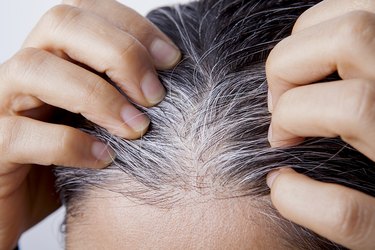
Many people consider their hair — and hair color — to be part of their identity.
So while it's not uncommon for your brown, red, blonde or black hair to turn gray, white or silver over time, the premature graying process is not always a welcome change.
Video of the Day
Video of the Day
There are plenty of reasons a person may go gray (or white or silver); one of the primary causes boils down to genetics, per September 2019 research in the International Journal of Trichology.
What causes hair to turn white, beyond genetics? Other factors, including smoking, certain autoimmune conditions and dietary deficiencies can also contribute to premature graying. We'll look into reasons why you might see some young people with white hair, black hair with white ends and possible treatments.
How Hair Loses Color
Melanin gives hair its color, whether the hue is black, red, blonde, brown — or any shade in between. This pigment, which is found in hair follicles, or the sheath of cells and tissue that surround the hair root, is an ingredient in the hair formation process, per the Library of Congress.
Over time, less melanin is available during hair growth, and this loss of pigment causes the hair to turn gray, silver and eventually white.
Gray or silver hair is either caused by low levels of pigment, or is an illusion created by the mix of white and dark hair on the scalp. White hair means there is a complete pigment loss.
Premature graying is defined as loss of hair pigment that occurs before the age of 20 in caucasian people, before the age of 25 in Asian people and before the age of 30 in African people, according to a June 2017 review in Pigment International.
The review also finds that approximately 50 percent of people have 50 percent gray hair by the age of 50.
5 Reasons Why Your Hair May Turn White or Gray at a Young Age
1. A Simple Case of Genetics
Although the underlying mechanisms are still not clearly defined, the most common explanation for the premature whitening or graying of hair is genetics. Your genes can lead to defects in the cells that produce melanin, or stop this melanin production at an early age, per the Library of Congress.
When it comes to going gray, genetics can be at play even for people of very young ages. If you're wondering, "Why do I have white hair at 15," well, it might just be the luck of the draw.
When your hair changes color due to genetics, there's not much you can do to reverse the change. That said, the modern beauty industry has endless options you can try on for semi-permanent and temporary hair color change. If you don't like the appearance of your graying hair, there are certainly many ways to mask it.
2. Autoimmune Conditions
Certain autoimmune disorders can cause the hair to whiten, or may create the illusion of whitened hair. Case reports reveal the hair that regrows after the scalp is affected by alopecia areata, a condition that may cause patches of hair loss, can be depigmented or white, per June 2014 research in the Journal of Pigmentary Disorders.
Alopecia totalis, a form of alopecia areata that leads to total loss of hair on the scalp, can sometimes selectively affect pigmented hair, leaving only the white hair in its place, per an early December 2008 study in the Journal of the Royal Society of Medicine.
Vitiligo is another autoimmune disorder which causes the pigment-making cells to be destroyed. While this condition often affects the skin, it can also lead to patches of white hair, per the American Academy of Dermatology Association.
3. Thyroid Disorder
While it's not very common, premature graying may be linked to other medical conditions.
Thyroid disorders, early aging syndromes or medication side effects can cause loss of hair pigment, per an August 2013 review in the Indian Journal of Dermatology, Venerology and Leprology.
Thyroid disorder, which is sometimes associated with hair loss, has also been linked with premature graying, though more research is needed, per early November 2008 research in the Journal of Clinical Endocrinology and Metabolism.
4. Vitamin Deficiencies
Some research findings suggests there may be a connection between certain nutrient deficiencies and premature graying.
Young people with early grays tend to have lower levels of ferritin, calcium and vitamin D, per one January 2013 study in the Journal of Trichology, while a separate October 2011 study, in Biological Trace Element Research, found a connection between premature graying and low levels of copper, zinc and iron.
Researchers point out that vitamin B12 deficiencies are often concurrent with folic acid and biotin deficiencies in people who experience early graying, according to a January 2017 study in the Journal of Trichology.
5. Smoking
If you need another reason to stop smoking, know that it's associated with premature aging, which includes going gray. There appears to be a connection between smoking and the onset of gray hair before the age of 30, per one April 2013 study in the Indian Dermatology Online Journal.
Can Certain Foods Prevent Gray Hair?
Some vitamin deficiencies, including vitamins D and B12, copper, zinc and iron, have been associated with premature graying. It makes sense, that some people may focus on eating certain foods with these nutrients to prevent gray hair.
While it's not possible to use vitamins to reverse gray hair, it may be possible to use certain vitamins to prevent future hairs from going gray.
More research is needed to understand whether eating specific nutrients can stop the graying process in its tracks, it doesn't hurt to focus on these particular vitamins to prevent gray hair, so long as you're not overdoing it.
When it comes to eating the best foods to prevent gray hair, you'll want to focus on those that are rich sources of vitamins D and B12, as well as copper, zinc and iron, since deficiencies in these are associated with premature graying.
Foods High in Vitamin D to Prevent Gray Hair
- Oily fish, including salmon, sardines, herring and mackerel
- Red meat
- Liver
- Egg yolks
- Fortified foods – such as some fat spreads and breakfast cereals
Foods High in Vitamin B12 to Prevent Gray Hair
- Meat
- Fish
- Milk
- Cheese
- Eggs
- Fortified breakfast cereals
Foods High in Copper to Prevent Gray Hair
- Oysters
- Shiitake mushrooms
- Firm tofu
- Sweet potatoes
- Sesame seeds
- Cashews
- Chickpeas
- Salmon
Foods High in Zinc to Prevent Gray Hair
- Red meat
- Legumes
- Shellfish
- Nuts and seeds
- Eggs
- Dairy
- Whole grains
Foods High in Iron to Prevent Gray Hair
- Chicken liver
- Oysters
- Clams
- Beef liver
- Beans
- Lentils
- Brown rice
Can Almonds Prevent Gray Hair?
Some people claim that almonds can be good for white or gray hair prevention. While there’s no specific research on the matter, almonds are a good source of copper, which may help prevent premature grays.
Other Gray and White Hair Phenomenons
Black and White Hair
People with dark hair may notice their black hair turning white at the root. The roots of your hair sometimes appear pale or white because some strands have finished their growing cycles, including receiving melanin injections, and are ready to shed by falling out, according to the Library of Congress.
Your hair is continuously growing and shedding on different cycles. The slowing of melanin directly corresponds to your genes.
It'd be less likely for the ends of your hair turning white before the rest of the strand does.
Hair Turning White Overnight
A centuries-old myth suggests that a person's hair can turn white over night. As the story goes, Marie Antoinette's hair did just that before her execution, which is why this is sometimes called "Marie Antoinette Syndrome."
Despite the convincing name, there's no scientific evidence that a head of hair could turn white so quickly. While there are a number of historical accounts of "Marie Antoinette Syndrome," December 2008 research in the Journal of the Royal Society of Medicine suggests that these historical accounts were most likely linked to alopecia areata or to the washing out of temporary hair dye.
A Final Word on Premature Graying
Premature graying or whitening of hair is usually related to genetics, and is rarely associated with a medical condition. If you are graying prematurely and the look doesn't run in your family, or if you have a sudden change in hair color or excessive hair loss, discuss your symptoms and concerns with your doctor.
- Indian Journal of Dermatology, Venerology and Leprology: "Premature Graying of Hair"
- American Academy of Dermatology: "Vitiligo"
- Pigment International: "Biology of Hair Pigmentation and Its Role in Premature Canities"
- Journal of the Royal Society of Medicine: "Sudden Whitening of the Hair: An Historical Fiction?"
- Dermatology and Dermatologic Diseases: "Overnight Graying? Phenomenon: A Case of Widespread Non-Pigmented Hair Regrowth in Diffuse Alopecia Areata"
- International Journal of Trichology: "Premature Graying of Hair: Review with Updates"
- Library of Congress: "Why does hair turn gray?"
- Journal of Pigmentary Disorders: "'Overnight Graying' Phenomenon: A case of Widespread Non-Pigmented Hair Regrowth in Diffuse Alopecia Areata"
- Journal of Clinical Endocrinology and Metabolism: "Thyroid Hormones Directly Alter Human Hair Follicle Functions: Anagen Prolongation and Stimulation of Both Hair Matrix Keratinocyte Proliferation and Hair Pigmentation"
- Biological Trace Element Research: "Serum iron, zinc, and copper concentration in premature graying of hair."
- Indian Dermatology Online Journal: "Smokers’ hair: Does smoking cause premature hair graying?"
- NIH: "Vitamin D"
- NIH: "Vitamin B12"
- USDA: "Top 10 Foods Highest in Copper"
- NIH: "Zinc"
- Mayo Clinic: "Iron Deficiency Anemia"
- American Academy of Dermatology: What Gives Hair Its Color?
- American Academy of Dermatology: Do You Have Hair Loss or Hair Shedding?
Is this an emergency? If you are experiencing serious medical symptoms, please see the National Library of Medicine’s list of signs you need emergency medical attention or call 911.