
Exercises to Strengthen the Abductor Pollicis Brevis Muscle
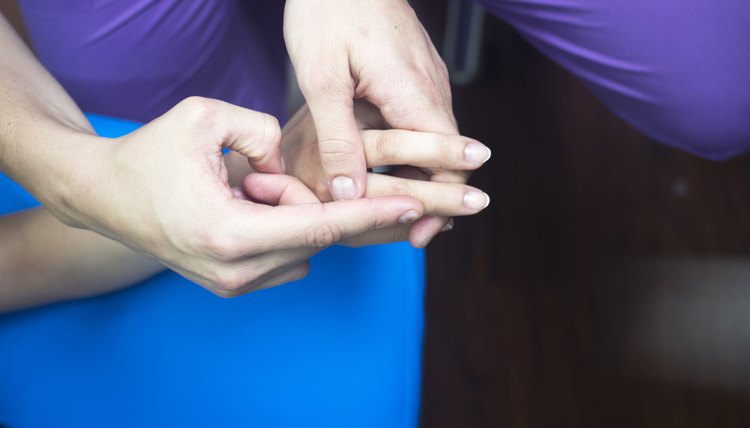
Throughout the forearm and hand are a number of muscles that control movement at the wrists, fingers and thumbs. Around the thumb is the abductor pollicis brevis, which allows you to move your thumb away from your hand. Therefore, exercises to strengthen the abductor pollicis brevis challenge you to abduct your thumb against resistance. It’s a small muscle, so the load doesn’t have to be much to build strength.
What Does it Do?
The abductor pollicis brevis is a flat, thin and triangular-shaped muscle located on the back and side of the thumb. It’s responsible for abducting the thumb, which means moving it out to the side and away from your hand. Carpal tunnel syndrome, which is when there is too much pressure on the median nerve in the wrist, causes the abductor pollicis brevis to weaken, which in turn prevents it from working appropriately.
Starting Out Slowly
To begin working your abductor pollicis brevis, perform thumb abduction movements against gravity. Hold your hand out in front of you with your hand turned to the side so your thumb is positioned on top. Keeping your hand in this position, lift your thumb up and away from your palm until your thumb is pointed toward the ceiling. Lower the thumb back, then repeat. Complete 15 repetitions for each thumb.
Holding the Contraction
You can work the abductor pollicis brevis with isometric exercises, which force your thumb muscle to hold a contraction over time. Position your hand with your fingers and thumb straight. With your free hand, hold your thumb firmly against your hand. Contract your abductor pollicis brevis by trying to move your thumb out and away from your thumb, but continue to hold it in position with your free hand. Hold the contraction for five to 15 seconds, then switch hands.
Adding a Rubber Band
To kick up the difficulty, use a rubber band to strengthen the abductor pollicis brevis. Hook a rubber band around your thumb with your palm facing you, and grab one end with your free hand. Pull the band across your palm and hold it so it’s taut. Open your thumb away from your palm against the resistance of the band. Control your thumb back until it’s resting against the side of your hand and then go into the next repetition. You can increase how hard your abductor pollicis brevis has to work by pulling harder on the rubber band. Complete 15 reps for each thumb.
References
Writer Bio
Kim Nunley has been screenwriting and working as an online health and fitness writer since 2005. She’s had multiple short screenplays produced and her feature scripts have placed at the Austin Film Festival. Prior to writing full-time, she worked as a strength coach, athletic coach and college instructor. She holds a master's degree in kinesiology from California State University, Fullerton.