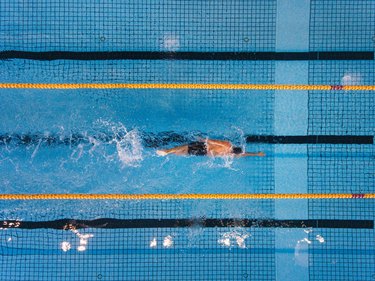
Sure, you can run or pedal your way to a fitter body, happier mood and better health. But if you have access to a pool or open-water swimming spot, you can freestyle, breaststroke or butterfly your way there instead.
That's right — swimming has many of the mental and physical health benefits of land-locked workouts — plus some added perks: You'll score the physical benefits of a heart-pumping cardio workout, along with the unique stress-relieving benefits of being in the water.
Not convinced? Read on if you still need some motivation to get into the pool.
Read more: What Your Favorite Swimming Style Says About You
You Might Live Longer
Swimming leads to overall improvements in health and well-being that could extend your lifespan. A study published in May 2017 in the British Journal of Sports Medicine tracked more than 80,000 adults for nearly 20 years. Those who swam had a 41 percent lower risk of dying of heart disease and a 28 percent lower risk of death from any cause compared to people who never suited up. If that's not motivation to dive straight into your next swimming workout, we're not sure what is.
You Can Swim for Life
Because water supports much of your body weight, reducing the pressure on bones and joints, swimming is an attractive option for nearly anyone, at any age. "Swimming can turn into a lifelong sport," says Jenny McCuiston, co-founder of Goldfish Swim School, a swim school for kids up to 12 years old, meaning you can score the benefits of swimming far into your senior years.
You'll Boost Your Body Strength
Whether you freestyle or do the backstroke or butterfly, swimming works just about every muscle, from your forearms to your feet. And unlike land-based workouts, you don't need to add weights for resistance because the resistance of the water is always pushing against your body, building muscle strength.
"Swimming tones your body in a way no land exercise can," says Stacy Caprio, a certified Red Cross water safety instructor, former competitive swimmer and coach.
And you can switch up your stroke to target certain areas of your body. Freestyle, for example, strengthens quads due to the intensity of flutter-kicking. Meanwhile, pulling through the backstroke works your shoulders and triceps, says Samantha Caballero, CEO of Swim With Sam in Miami.
Swimming Is Good for Your Heart
Any form of aerobic exercise — you know, the type that makes your heart pump harder — boosts your heart health over time, and pool-based workouts are no exception. In fact, women who swam for an hour three times a week for 12 weeks reduced both their total cholesterol and their triglycerides, according to an October 2015 study in the Journal of Exercise Rehabilitation. And in an April 2012 study in the American Journal of Cardiology, swimming reduced blood pressure in adults age 50 and older who were previously sedentary.
Read more: The Best Swimming Caps for Every Type of Swimmer
One thing to remember when it comes to swimming and the heart: When you exercise in water, several factors influence your body's normal response to exercise and your heart rate may be different than what you'd expect on land, according to the American Council on Exercise. If you have any history of a heart condition, check with your doctor about the best way to keep tabs on your effort.
You'll Burn Calories
All that kicking, pulling and splashing requires a considerable amount of energy, which means — you guessed it — you'll burn calories while in the water. The exact calorie burn depends on a number of variables, including your stroke (freestyle requires the least fuel, while butterfly torches the most calories, according to a September 2013 research review in the International Journal of Cardiology), but on average, a 154-pound person swimming slow, freestyle laps burns about 255 calories in half an hour, according to the Centers for Disease Control and Prevention.
That means swimming can also help you lose weight. In one November 2010 study of older women in the journal Metabolism, swimming beat walking for long-term weight loss. It even led to short-term improvements in body fat distribution: People who swam were less likely to pack fat around their midsections, where it's more dangerous to your health.
Swimming Is Super Accessible
Water supports about 90 percent of your body weight, according to the American Council on Exercise, making it a super low-impact sport. "People with physical limitations from strokes, accidents or arthritis find solace in swimming because of its low impact on the body," Caballero says. That's also why it's a good choice for so many older adults, too.
In some cases, swimming may even ease your symptoms. A March 2016 study in the Journal of Rheumatology found that swimming reduced pain and stiffness in people with arthritis. What's more, it boosted strength and improved participants' ability to perform daily activities.
Swimming also works well if your condition is more temporary. If you're injured due to another sport or physical activity, swimming can serve as part of your rehab, says Mike Lucero, head swim coach and president at Golden Road Aquatics in Burbank, California. You'll be able to get in just as good of a workout, but without the pressure or pounding you'd endure on dry land, which is why many runners turn to swimming when working through an injury.
Working out in the water is usually safe for pregnant people, too, according to the American College of Obstetricians and Gynecologists.
Swimming Relieves Stress
The rest of your day might include deadlines, arguments or other pressures, but all that mental clutter melts away the minute you submerge, Caballero says. "The water gives you a personal thinking chamber where you can escape reality," she says. "No outside noises or problems. It's just you in the water."
Besides the soothing nature of the aquatic environment, this effect occurs due to swimming's focus on breathing, she points out. To swim well, you'll inhale and exhale slowly and consistently, matching your breath to your motion. This type of focus on respiration calms your body's stress response, much like meditative breathing.
You'll Boost Your Energy and Feel Better Overall
A heart-pumping exercise like swimming releases the same feel-good chemicals that cause a so-called "runner's high." These endorphins have the power to ward off bad moods, leaving you with a feeling of energy and happiness that lingers even after you step out of the water, Caprio says. (Consider swimming in the morning so the feel-good vibes last throughout the day.)
That positivity brings a momentum that can build throughout the rest of your life, even outside of the pool. Not long after swimmers begin training with Lucero, they often come up to thank him for jump-starting remarkable changes.
Some express gratitude for reduced levels of anxiety, whether they feared the water or something bigger in their lives. Others say that now that they see what they can accomplish lap by lap, they can cope better with the demands of parenting or ascend to new levels in their career. Pretty major stuff, right?
"They say, 'I have goals now because I see what this program has done for me and for other people,'" he says. "Swimming is very rewarding."