Poisonous Wood Spiders
While there is not an actual species of spider called a "wood" spider, various types of spider are known to inhabit woodpiles and other hidden places found outdoors. Some people refer to these types as wood spiders. Some of these types are poisonous. A bite is rarely known to cause death, but should surely be avoided.
Read more about the signs and symptoms of an infected spider bite.
Brown Recluse
The Loxosceles reculsa, more commonly known as the brown recluse spider, is most common in southern and central locations of the United States. It can be found both indoors and outdoors and prefers dark damp spaces, such as a closet, garage or woodpile. It is very small in size and brown in color. The recluse has an identifying mark on the top of its back shaped like a violin. The violin is a darker brown shade than the rest of the spider's body. The bite causes a necrotic reaction, which means the tissue around the bite deteriorates. Initially, the bite is painless, but within the days that follow, a blister forms as the flesh is compromised. In rare untreated cases, liver or kidney damage can result.
- The Loxosceles reculsa, more commonly known as the brown recluse spider, is most common in southern and central locations of the United States.
- The bite causes a necrotic reaction, which means the tissue around the bite deteriorates.
Huntsman spider
Common Spiders in Nevada
Learn More
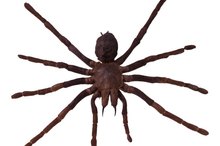
The huntsman spider, or Heteropoda maxima, can be found in the southern regions of the United States, as well as several other countries 2. It is primarily found in Australia. Sometimes referred to as wood or cane spiders, they prefer to live in trees, woodpiles and mine shafts. Their color is generally brown or gray. With a long, crablike leg span, they can grow to very large sizes. Normally, they are not known as being aggressive, but when provoked can move very fast and will cling to their attacker.
- The huntsman spider, or Heteropoda maxima, can be found in the southern regions of the United States, as well as several other countries 2.
- Normally, they are not known as being aggressive, but when provoked can move very fast and will cling to their attacker.
Black Widow
There are actually three different species of black widow: northern, western and southern. All can be found within the United States. They have been divided due to their adaption to the individual region they reside in. Black widows are black, with a distinctive red hourglass shape on their belly. They are smaller in size than other wood spiders, usually measuring under half an inch. Their bite causes a red welt and is accompanied by nausea, difficulty breathing, pain and sweating. A small child or elderly person could die from the bite if it is left untreated.
Read more about side effects of a black widow spider bite.
- There are actually three different species of black widow: northern, western and southern.
- Black widows are black, with a distinctive red hourglass shape on their belly.
Related Articles
Common Spiders in Nevada
Learn More
Poisonous Spiders in Ontario
Learn More
Which Insect Bites Cause Blisters?
Learn More
Common House Bugs That Bite
Learn More
Chiggers Vs. Tick
Learn More
Differences Between Bedbugs & Chiggers
Learn More
Bugs That Eat Human Flesh
Learn More

Side Effects of a Bedbug Bite
Learn More
Carpenter Bee Sting Reaction
Learn More
Various Stages of Spider Bites
Learn More
References
- Dangerous spiders
- Huntsman spider
- Illinois Department of Public Health. Brown Recluse and Black Widow Spiders.
- Cedars Sinai Medical Center. Brown Recluse and Black Widow Spider Bites in Children.
- Sotelo-cruz N, Gómez-rivera N. [Neurotoxic manifestations of black widow spider envenomation in paediatric patients]. Neurologia. 2016;31(4):215-22. doi:10.1016/j.nrl.2015.05.007
- Williams M, Nappe TM. Black Widow Spider Toxicity. StatPearls Publishing. Updated March 8, 2019.
- Stoecker WV, Vetter RS, Dyer JA. NOT RECLUSE-A Mnemonic Device to Avoid False Diagnoses of Brown Recluse Spider Bites. JAMA Dermatol. 2017;153(5):377-378. doi:10.1001/jamadermatol.2016.5665
- Vetter RS. The distribution of brown recluse spiders in the southeastern quadrant of the United States in relation to loxoscelism diagnoses. South Med J. 2009;102(5):518-22. doi:10.1097/SMJ.0b013e3181a0abb3
- Illinois Department of Public Health. Brown Recluse and Black Widow Spiders.
- Rahmani F, Banan Khojasteh SM, et al. Poisonous Spiders: Bites, Symptoms, and Treatment; an Educational Review. Emerg (Tehran). 2014;2(2):54-8.
- Gaver-wainwright MM, Zack RS, Foradori MJ, Lavine LC. Misdiagnosis of spider bites: bacterial associates, mechanical pathogen transfer, and hemolytic potential of venom from the hobo spider, Tegenaria agrestis (Araneae: Agelenidae). J Med Entomol. 2011;48(2):382-8. doi:10.1603/ME09224
- Livshits Z, Bernstein B, Sorkin LN, Smith SW, Hoffman RS. Wolf spider envenomation. Wilderness Environ Med. 2012;23(1):49-50. doi:10.1016/j.wem.2011.11.010
- Meires J, Louden B. Bite of the Brown Recluse Spider. Clinical Review. 2010(12):14-17.
- Pagac BB, Reiland RW, Bolesh DT, Swanson DL. Skin lesions in barracks: consider community-acquired methicillin-resistant Staphylococcus aureus infection instead of spider bites. Mil Med. 2006;171(9):830-2. doi:10.7205/milmed.171.9.830
- Mikals K, Beakes D, Banks TA. Stinging the Conscience: A Case of Severe Hymenoptera Anaphylaxis and the Need for Provider Awareness. Mil Med. 2016;181(10):e1400-e1403. doi:10.7205/MILMED-D-15-00536
- Gaver-Wainwright MM, Zack RS, Foradori MJ, Lavine LC. Misdiagnosis of spider bites: bacterial associates, mechanical pathogen transfer, and hemolytic potential of venom from the hobo spider, Tegenaria agrestis (Araneae: Agelenidae). J Med Entomol. 2011 Mar;48(2):382-8.
- Isbister GK, Framenau VW. Australian wolf spider bites (Lycosidae): clinical effects and influence of species on bite circumstances. J Toxicol Clin Toxicol. 2004;42(2):153-61.
- Livshits, Z., Bernstein, B., Sorkin, L., Smith, S., & Hoffman, R. (2012). Wolf Spider Envenomation. Wilderness & Environmental Medicine, 23(1), 49-50. doi:10.1016/j.wem.2011.11.010
- Pagac BB, Reiland RW, Bolesh DT, Swanson DL. Skin lesions in barracks: consider community-acquired methicillin-resistant Staphylococcus aureus infection instead of spider bites. Mil Med. 2006 Sep;171(9):830-2.
- Payne, K., Schilli, K., Meier, K., Rader, R., Dyer, J., & Mold, J. et al. (2014). Extreme Pain From Brown Recluse Spider Bites. JAMA Dermatology, 150(11), 1205. doi:10.1001/jamadermatol.2014.605
- Robinson, J., Kennedy, V., Doss, Y., Bastarache, L., Denny, J., & Warner, J. (2017). Defining the complex phenotype of severe systemic loxoscelism using a large electronic health record cohort. PLOS ONE, 12(4), e0174941. doi:10.1371/journal.pone.0174941
- Stoecker, W., Vetter, R., & Dyer, J. (2017). NOT RECLUSE—A Mnemonic Device to Avoid False Diagnoses of Brown Recluse Spider Bites. JAMA Dermatology. doi:10.1001/jamadermatol.2016.5665
Writer Bio
Eva David is a freelance writer and graphic designer based in Chicago. She has received several awards for her short stories. David holds a Bachelor of Arts in Mass Communications and Advertising from the University of South Florida.