
Splenius Capitis Exercise
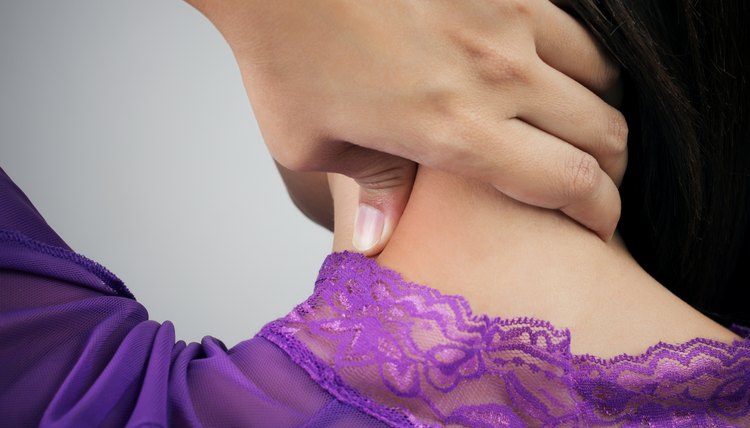
Your splenius capitis muscle is comprised of several muscular fibers that insert themselves into the skull and are responsible for proper neck extension. Strengthening this muscle can help you keep a stable spine while preventing unwanted upper back and neck pain. Consult your health care professional before you attempt any exercise to strengthen or rehabilitate your splenius capitis.
Chin-to-Chest
The chin-to-chest exercise stretches your splenius capitis while using your upper back muscles and posterior deltoids as muscle stabilizers. Sit on a chair and let your head drop forward as far as possible. Place one or both hands on your head, so that your fingertips touch your skull bone. Exhale and gradually apply pressure to deepen the stretch in the back of your neck. Hold this position for one to two minutes, and then perform one to four repetitions with your head rotated to the left, and then rotated to the right, holding each position for one to two minutes.
Neck Retraction
The neck retraction exercise counteracts the poor posture movement you perform when you slump your neck and poke your head forward. Sit on a chair or soft surface and engage your core to stabilize your spine. Brace the posterior muscles of your neck to bring your head back in a stable position, with your chin slightly dropped. Hold this backward position briefly, relax, repeat, and perform one set of five to 10 repetitions.
Lateral Neck Flexion Stretch
The lateral neck flexion stretch can help relieve stiff upper back and posterior neck muscles from excessive sitting. Stand up straight with your feet hip-width apart and place your left hand on top of your head, pointing your fingers to the right. Engage your core to stabilize your spine and gradually pull your neck to the left and drop your left ear to your left shoulder, feeling the stretch on the right side of your neck. Avoid lifting your shoulder up, hold for 10 to 30 seconds, and repeat on the other side.
Neck Rotation
The neck rotation exercise works your posterior neck muscles while using your anterior neck muscles as stabilizers. Start with your head in a neutral position and extend your neck upward. Keep your mouth closed and teeth together, and place your index, middle and ring fingers of your left hand on the left side of your cheek. Push on your cheek as turn your head to one side until you feel a slight tightness. Inhale and hold this position for 10 to 15 seconds. Repeat on the other side and perform two to four rotations on each side.
References
- SportsInjuryClinic.net: Splenius
- SportsInjuryClinic.net: Lateral Neck Flexion Stretch
- Geneen, L., Moore, R., Clarke, C. et al. Physical Activity and Exercise for Chronic Pain in Adults: An Overview of Cochrane Reviews. Cochrane Database of Systematic Reviews. 2017. 4:CD011279.
- Shin, Y., Kim, W., and S. Kim. Correlations Among Visual Analogue Scale, Neck Disability Index, Shoulder Joint Range of Motion, and Muscle Strength in Young Women With Forward Head Posture. Journal of Exercise Rehabilitation. 2017. 13(4):413-417.
Writer Bio
Fabio Giorno began writing professionally in 2010 for various websites. Giorno attends McMaster University and will be receiving his Bachelor of Arts with Honours in communications studies in 2013. He has a passion for professional sports with an expertise in soccer. Giorno was also a goalkeeper for McMaster's varsity soccer team for two years.