What does fact checked mean?
At Healthfully, we strive to deliver objective content that is accurate and up-to-date. Our team periodically reviews articles in order to ensure content quality. The sources cited below consist of evidence from peer-reviewed journals, prominent medical organizations, academic associations, and government data.
- The Journal of Pain: Ginger (Zingiber officinale) Reduces Muscle Pain Caused by Eccentric Exercise
- The Journal of Pain: Ginger (Zingiber officinale) Reduces Muscle Pain Caused by Eccentric Exercise
The information contained on this site is for informational purposes only, and should not be used as a substitute for the advice of a professional health care provider. Please check with the appropriate physician regarding health questions and concerns. Although we strive to deliver accurate and up-to-date information, no guarantee to that effect is made.
Health Benefits of Crystallized Ginger
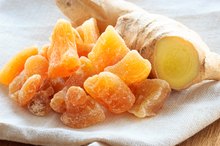
Ginger, with its spicy, warm aroma and taste, is most frequently associated with South East Asian cuisines, although it is now more widely consumed than ever. Rich in a number of essential nutrients, ginger also has several health benefits, especially for your digestive system. Crystallized ginger, also known as candied ginger, is made by boiling ginger in a simple syrup and then letting the candy dry out. While the health benefits of ginger are preserved, the sugar content is greatly increased. Pay attention to your consumption of candied ginger to avoid getting too much sugar.
Treating Motion Sickness
If you get motion sickness, eating crystallized ginger, or eating some ginger chews can help alleviate the symptoms. Ginger naturally helps prevent nausea, especially when it results from dizziness or motion sickness. If you have motion sickness regularly, try one or two small to medium-sized pieces of crystallized ginger before or during travel.
Treating Morning Sickness
Ginger as an Appetite Suppressant
Learn More
In addition to nausea from motion sickness, crystallized ginger can also help with nausea and upset stomachs resulting from morning sickness. Morning sickness is no fun to deal with, and the same amount of ginger per day, one to two small to medium-sized pieces, may help reduce the vomiting or nausea that comes with pregnancy. If you have extreme morning sickness, or experience it over a prolonged period of time, speak with a medical professional as there may be other factors at play.
Helping with Muscle Pain and Inflammation
Consuming ginger every day or on a regular basis can help reduce muscle pain from exercise related effort or injury. In a 2010 study published in the "Journal of Pain," ginger was shown to help relieve some muscle pain due to exercise 3. A daily dose of 2 grams of ginger reduced pain and inflammation due to exercising. Ginger can also help reduce inflammation of the joints, which may be helpful also in treating conditions such as arthritis, according to the University of Maryland Medical Center 1.
Alternative Medicine
Crystallized Ginger Nutrition
Learn More
For over 5,000 years, ginger has been prized and used for its "warming" properties. In Asian medical practice, historically and in the current-day, ginger is used to treat a number of conditions, from arthritis and migraines, to sore throats. It is also used as a general health tonic, thought to help reduce overall body fat and improve circulation. In Ayurvedic medicine, the traditional medical practice of India, ginger has been used in the treatment of anorexia and cholera.
- For over 5,000 years, ginger has been prized and used for its "warming" properties.
- In Asian medical practice, historically and in the current-day, ginger is used to treat a number of conditions, from arthritis and migraines, to sore throats.
Related Articles

Ginger as an Appetite Suppressant
Learn More
Crystallized Ginger Nutrition
Learn More
How to Make Ginger Preserve
Learn More
How to Take Ginger Pills for Motion Sickness
Learn More
What Is Good to Drink to Break-Up Phlegm?
Learn More
Can You Eat Too Much Ginger?
Learn More
Ginger for Chest Congestion
Learn More
What Foods Have the Herb Ginger in Them?
Learn More
Gastroparesis & Ginger
Learn More
Ginger Root for the Lungs
Learn More
References
- University of Maryland Medical Center: Ginger
- Herbal Medicine: Biomolecular and Clinical Aspects, 2nd edition; by Ann M. Bode and Zigang Dong (book)
- The Journal of Pain: Ginger (Zingiber officinale) Reduces Muscle Pain Caused by Eccentric Exercise
- Better Nutrition: Travel Gingerly
- From Fatigued to Fantastic!; by Jacob Teitlebaum (book)
- Ryan JL. Treatment of chemotherapy-induced nausea in cancer patients. Eur Oncol. 2010;6(2):14-16.
- Marx W, Ried K, McCarthy AL, et al. Ginger-mechanism of action in chemotherapy-induced nausea and vomiting: A review. Crit Rev Food Sci Nutr. 2017;57(1):141–146. doi:10.1080/10408398.2013.865590
- Panahi Y, Saadat A, Sahebkar A, Hashemian F, Taghikhani M, Abolhasani E. Effect of ginger on acute and delayed chemotherapy-induced nausea and vomiting: a pilot, randomized, open-label clinical trial. Integr Cancer Ther. 2012;11(3):204–211. doi:10.1177/1534735411433201
- Haniadka R, Rajeev AG, Palatty PL, Arora R, Baliga MS. Zingiber officinale (ginger) as an anti-emetic in cancer chemotherapy: a review. J Altern Complement Med. 2012;18(5):440–444. doi:10.1089/acm.2010.0737
- Arslan M, Ozdemir L. Oral intake of ginger for chemotherapy-induced nausea and vomiting among women with breast cancer. Clin J Oncol Nurs. 2015;19(5):E92–E97. doi:10.1188/15.CJON.E92-E97
- Bossi P, Cortinovis D, Fatigoni S, et al. A randomized, double-blind, placebo-controlled, multicenter study of a ginger extract in the management of chemotherapy-induced nausea and vomiting (CINV) in patients receiving high-dose cisplatin. Ann Oncol. 2017;28(10):2547–2551. doi:10.1093/annonc/mdx315
- Palatty PL, Haniadka R, Valder B, Arora R, Baliga MS. Ginger in the prevention of nausea and vomiting: a review. Crit Rev Food Sci Nutr. 2013;53(7):659-69. doi:10.1080/10408398.2011.553751
- WholeHealth Chicago. Ginger. Updated May 12, 2009.
- Oncology Nutrition: a Dietetic Practice Group of the Academy of Nutrition and Dietetics. Dietary supplements.
- Marx W, Mckavanagh D, Mccarthy AL, et al. The effect of ginger (Zingiber officinale) on platelet aggregation: a systematic literature review. PLoS ONE. 2015;10(11):e0143675. doi:10.1371/journal.pone.0141119
- Chuah SK, Wu KL, Tai WC, Changchien CS. The effects of ginger on gallbladder motility in healthy male humans. J Neurogastroenterol Motil. 2011;17(4):411-5. doi:10.5056/jnm.2011.17.4.411
- National Center for Complementary and integrative Health. Ginger. Updated November 30, 2016.
- Bossi, P., Cortinovis, D., Fatigoni, et al. A Randomized, Double Blind, Placebo-Controlled, Multicenter Study of a Ginger Extract in the Management of Chemotherapy Induced Nausea and Vomiting (CINV) in Patients Receiving High Dose Cisplatin. Annals of Oncology. 2017. 28(10):2547-2551.
- Haniadka, R. et al. Zingiber officinale (Ginger) as an Anti-Emetic in Cancer Chemotherapy: A Review. Journal of Complementary and Alternative Medicine. 2012.18(5):440-4.
- Jordan, K., Jahn, F., and M. Aapro. Recent developments in the prevention of chemotherapy-induced nausea and vomiting (CINV): a comprehensive review. Annals of Oncology. 2015.26(6):1081-90.
- Pillai, A. et al. Anti-emetic effect of ginger powder versus placebo as an add-on therapy in children and young adults receiving high emetogenic chemotherapy. Pediatric Blood and Cancer.2011.56(2):234-8.
Writer Bio
Bethany Lalonde has been a professional writer since 1997. She has published for CBS Health Watch, WebMD, the "Ann Arbor Daily News" and "Entertainment Weekly." She holds two masters degrees from the University of Michigan, in dietetics and nutrition as well as journalism.