Symptoms of Head Shingles
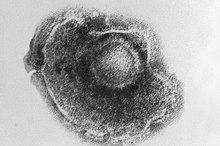
The Centers for Disease Control and Prevention (CDC) estimates that 1 in 3 people will develop shingles at some time during their life 2. The disease is caused by varicella-zoster virus, the same virus that causes chickenpox. As a person recovers from the chickenpox, the virus travels to clusters of nerves -- called ganglia -- near the spinal cord or in the brain. It then becomes dormant, hiding in the ganglia without causing any problems.
If you are experiencing serious medical symptoms, seek emergency treatment immediately.
But sometime later in life, the virus may become reactivated, leave the ganglia and cause shingles. Although the trunk and back are the most commonly involved areas, shingles can also occur on the head.
Rash
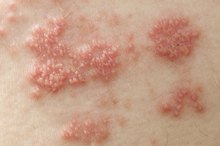
Shingles causes a rash that begins as red, swollen areas of skin that evolve over a few hours into fluid-filled blisters. The blisters are about the size of an eraser at the top of a pencil. New blisters develop in groups for about 3 to 5 days. The blisters then break open and crust over in about a week to 10 days. Because the blisters contain the varicella-zoster virus, the person can pass on the virus until all blisters crust over.
Complete healing of the skin lesions may take up to 4 weeks after the rash first appears. With head shingles, the rash can occur on the scalp, face, mouth, ears or eyelids. It typically appears in a distinct strip of skin on just one side of the head.
- Shingles causes a rash that begins as red, swollen areas of skin that evolve over a few hours into fluid-filled blisters.
- The blisters then break open and crust over in about a week to 10 days.
Flu-Like Symptoms
Early Signs and Symptoms of Eye Shingles
Learn More
Many people with head shingles have flu-like symptoms for a few days or so before the rash appears. **These may include a fever, headache, decreased appetite and general sense of feeling tired and unwell.
** Since the rash has not yet appeared, people usually think they are coming down with the flu or a cold. However, respiratory symptoms such as a cough or runny nose never appear.
With a fever due to head shingles, the temperature is usually only slightly higher than normal. Flu-like symptoms resolve when the blisters crust over.
- Many people with head shingles have flu-like symptoms for a few days or so before the rash appears.
- However, respiratory symptoms such as a cough or runny nose never appear.
Pain
Pain due to head shingles typically begins as a mild tingling, burning, itching, stinging or soreness a few days to a week before the rash appears. These sensations occur in the same area as the rash.
When the rash eventually does appear, the pain often becomes worse. It can be severe and increase with even a light touch, such as a faint breeze.
**For most people, the pain improves gradually as the skin lesions disappear, and resolves completely within 1 to 2 months.
** But for some people, the pain persists, producing a condition known as post-herpetic neuralgia, which can last for a year or more.
Post-herpetic neuralgia is more common and tends to last longer and be more severe in people over the age of 60. Neuralgia pain is often worse at night, which can interfere with sleep.
- Pain due to head shingles typically begins as a mild tingling, burning, itching, stinging or soreness a few days to a week before the rash appears.
- But for some people, the pain persists, producing a condition known as post-herpetic neuralgia, which can last for a year or more.
Other Symptoms
On What Parts of Your Body Are Shingles Found?
Learn More
Shingles of the head may sometimes affect the eye, a condition called herpes zoster ophthalmicus. This produces inflammation in and around the eye, which can lead to pain, sensitivity to light, increased pressure within the eye and vision changes or loss of vision.
Head shingles may also affect the ear. The condition called herpes zoster oticus, or Ramsay Hunt syndrome, produces severe ear pain, hearing loss, paralysis of part of the face and sometimes dizziness.
Occasionally, head shingles leads to symptoms of inflammation within the brain, called encephalitis.
High fever, severe headache, extreme sensitivity to light and vomiting are typical early symptoms of encephalitis.
Later symptoms can include muscle weakness, poor coordination, confusion, seizures and even coma. Although rare, encephalitis is more common in people with an impaired immune system, such as those with HIV or receiving medications for cancer.
- Shingles of the head may sometimes affect the eye, a condition called herpes zoster ophthalmicus.
- The condition called herpes zoster oticus, or Ramsay Hunt syndrome, produces severe ear pain, hearing loss, paralysis of part of the face and sometimes dizziness.
Additional Considerations
The shingles vaccine (Zostavax) can reduce the risk of developing shingles. The CDC recommends that everyone 60 and older receive the shingles vaccination, which only has to be given once in a lifetime.
If you think you have shingles, see your doctor.
Antiviral medications are available that may help shorten the duration of the disease and make it less severe.
They are more effective when started as soon as possible, ideally before the rash appears. Seek immediate medical attention if you have an impaired immune system or have any eye or ear symptoms, paralysis of the face or any symptoms suggestive of encephalitis.
Reviewed by: Mary D. Daley, M.D.
- The shingles vaccine (Zostavax) can reduce the risk of developing shingles.
- The CDC recommends that everyone 60 and older receive the shingles vaccination, which only has to be given once in a lifetime.
Related Articles

Early Signs and Symptoms of Eye Shingles
Learn More
On What Parts of Your Body Are Shingles Found?
Learn More
The Stages of Shingles Rash
Learn More

Back Pain From Shingles
Learn More

What Is the Incubation Period for Shingles?
Learn More

Early Stages of Shingles
Learn More
Shingles & Chest Pain
Learn More

Facial Herpes Symptoms
Learn More

Knee Pain From Shingles
Learn More
Shingles & Chest Pain
Learn More
References
- Neuropathology and Applied Neurobiology: The Neurobiology of Varicella Zoster Virus Infection
- Centers for Disease Control and Prevention: Shingles (Herpes Zoster) -- Clinical Overview
- Clinical and Experimental Optometry: Herpes Zoster Opthalmicus
- Merck Manual Consumer Version: Shingles (Herpes Zoster)
- Merck Manual Professional Version: Herpes Zoster (Shingles; Acute Posterior Ganglionitis)
- Centers for Disease Control and Prevention. Shingles (Herpes Zoster) Signs & Symptoms.
- Centers for Disease Control and Prevention. Shingles (Herpes Zoster) Signs & Symptoms.
- John AR, Canaday DH. Herpes Zoster in the Older Adult. Infect Dis Clin North Am. 2017;31(4):811-826. doi: 10.1016/j.idc.2017.07.016
- Yun H, Xie F, Baddley JW, Winthrop K, Saag KG, Curtis JR. Longterm Effectiveness of Herpes Zoster Vaccine among Patients with Autoimmune and Inflammatory Diseases. J Rheumatol. 2017;44(7):1083-1087. doi: 10.3899/jrheum.160685
- Cohen KR, Salbu RL, Frank J, Israel I. Presentation and Management of Herpes Zoster (Shingles) in the Geriatric Population. P T. 2013;38(4): 217-224, 227.
- Galetta KM, Gilden D. Zeroing in on zoster: A tale of many disorders produced by one virus. J Neurol Sci. 2015;358(1-2):38-45. doi: 10.1016/j.jns.2015.10.004
- Blank LJ, Polydefkis MJ, Moore RD, Gebo KA. Herpes zoster among persons living with HIV in the current antiretroviral therapy era. J Acquir Immune Defic Syndr. 2012;61(2):203-7. doi: 10.1097/QAI.0b013e318266cd3c
- Mallick-searle T, Snodgrass B, Brant JM. Postherpetic neuralgia: epidemiology, pathophysiology, and pain management pharmacology. J Multidiscip Healthc. 2016;9:447-454. doi: 10.2147/JMDH.S106340
- Johnson RW, Bouhassira D, Kassianos G, Leplège A, Schmader KE, Weinke T. The impact of herpes zoster and post-herpetic neuralgia on quality-of-life. BMC Med. 2010;8:37. doi: 10.1186/1741-7015-8-37
- Sampathkumar P, Drage LA, Martin DP. Herpes zoster (shingles) and postherpetic neuralgia. Mayo Clin Proc. 2009;84(3):274-80.
- Pereira LB. Impetigo - review. An Bras Dermatol. 2014;89(2):293-9. doi: 10.1590/abd1806-4841.20142283
- Gershon AA, Breuer J, Cohen JI, et al. Varicella zoster virus infection. Nat Rev Dis Primers. 2015;1:15016. doi: 10.1038/nrdp.2015.16
- Naveen KN, Pradeep AV, Kumar JS, Hegde SP, Pai VV, Athanikar SB. Herpes zoster affecting all three divisions of trigeminal nerve in an immunocompetent male: a rare presentation. Indian J Dermatol. 2014;59(4):423. doi: 10.4103/0019-5154.135548
- Opstelten W, Zaal MJ. Managing ophthalmic herpes zoster in primary care. BMJ. 2005;331(7509):147-51. doi: 10.1136/bmj.331.7509.147
- Jeon Y, Lee H. Ramsay Hunt syndrome. J Dent Anesth Pain Med. 2018;18(6):333-337. doi: 10.17245/jdapm.2018.18.6.333
- Kim SH, Choi SM, Kim BC, et al. Risk Factors for Aseptic Meningitis in Herpes Zoster Patients. Ann Dermatol. 2017;29(3):283-287. doi: 10.5021/ad.2017.29.3.283
- Saxena A, Khiangte B, Tiewsoh I, Jajoo UN. Herpes zoster encephalitis presenting as multiple cerebral hemorrhages - a rare presentation: a case report. J Med Case Rep. 2013;7:155. doi: 10.1186/1752-1947-7-155
- Teo HK, Chawla M, Kaushik M. A Rare Complication of Herpes Zoster: Segmental Zoster Paresis. Case Rep Med. 2016;2016:7827140. doi: 10.1155/2016/7827140
- American Academy of Dermatology. Cellulitis: Overview.
- American Academy of Ophthalmology. Herpes Zoster Ophthalmicus.
- Centers for Disease Control and Prevention. Shingles (Herpes Zoster): Clinical Overview. Feb 21, 2018.
- Mayo Clinic. Postherpetic Neuralgia. Sept 16, 2015.
Writer Bio
Heather Gloria began writing professionally in 1990. Her work has appeared in several professional and peer-reviewed publications including "Nutrition in Clinical Practice." Gloria earned both a Bachelor of Science in food science and human nutrition from the University of Illinois. She also maintains the "registered dietitian" credential and her professional interests include therapeutic nutrition, preventive medicine and women's health.