How to Clean Germs Below the Gumline
When the germs and bacteria from your environment and the food you eat are not properly removed from your mouth, they begin to solidify, forming plaque and tartar. Over time, plaque and tartar buildup leads to inflammation of the gums, called gingivitis. If not treated, gingivitis leads to periodontal -- or gum -- disease. Home care can help clean just below the gumline; to get deep below the gumline, however, requires a visit to the dentist.
Brushing Your Teeth
Brush your teeth at least twice a day using a toothpaste containing fluoride, which reacts with your tooth's enamel to protect against cavities.
How to Use Dental Tools at Home to Remove Plaque
Learn More
Spend at least two minutes brushing your teeth each time you brush.
Avoid scrubbing your gums; rather than cleaning them, brushing your gums too hard leads to small cuts or scratches that leads to more bacteria growth.
How to Remove Tooth Tartar at Home
Learn More
Brush at a 45-degree angle to your teeth -- a slightly upward motion if you are brushing your top teeth and a slightly downward motion for your bottom teeth. An electric toothbrush -- which uses hundreds and in some cases thousands of small movements every second -- is even more effective at removing germs from your teeth and gums. Bristles help move germs away from the gumline, and prevents the formation of plaque, which is a cluster of hardened bacteria.
- Brush your teeth at least twice a day using a toothpaste containing fluoride, which reacts with your tooth's enamel to protect against cavities.
- Avoid scrubbing your gums; rather than cleaning them, brushing your gums too hard leads to small cuts or scratches that leads to more bacteria growth.
Flossing
Floss your teeth at least once a day, before or after you brush your teeth. Flosses come in coated and non-coated varieties; the coated varieties are coated with wax, which makes the flossing experience more comfortable for those with sensitive teeth or gums.
Insert the floss between all the teeth in your mouth, as well as at the ends of the molars in the back of your mouth. Flossing loosens and removes plaque that forms along and just below the gumline.
Rinse off the floss if you loosen or remove any chunks of food or plaque with the floss, to avoid spreading germs to different teeth.
Avoid applying too much pressure with the floss. The goal is to clean between your teeth and along the gumline; too much pressure makes your gums bleed, which leads to infection.
- Floss your teeth at least once a day, before or after you brush your teeth.
- Rinse off the floss if you loosen or remove any chunks of food or plaque with the floss, to avoid spreading germs to different teeth.
Mouthwash
Buy a mouthwash that is approved by the American Dental Association (ADA) 1. A good mouthwash does not necessarily have to sting to work.
Follow the instructions on your mouthwash's packaging, as the amount of mouthwash required varies by brand.
Rinse your mouth with the wash at least once a day, after brushing and flossing. Use your cheek and tongue muscles to move it around your mouth, further loosening and removing plaque along and just below the gums. Do this for 30 seconds at a time before spitting the mouthwash out. Do not rinse your mouth with water afterwards, as this diminishes the effect of the mouthwash.
Tips
Contact your dentist if you have swollen, bleeding or painful gums. This is a sign of serious infection. You'll need a doctor to clean far below your gumline at this point. In addition to routine cleanings, dentists also perform scaling and root planing to remove germs from below the gums. Surgery may also be required in severe cases to actually move the gums to clean underneath them.
- Buy a mouthwash that is approved by the American Dental Association (ADA) 1.
- Do not rinse your mouth with water afterwards, as this diminishes the effect of the mouthwash.
Related Articles
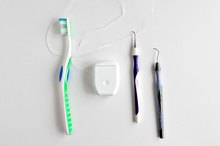
How to Use Dental Tools at Home to Remove Plaque
Learn More

How to Remove Tooth Tartar at Home
Learn More

How to Clean Clear Retainers
Learn More

How to Remove Gum Line Stains
Learn More

Tooth Pain After Eating
Learn More

How to Use a Dental Scaler
Learn More

How to Care for Your Flipper
Learn More
How to Make Your Own Tooth Caps
Learn More

The Best Ways to Water Clean Teeth
Learn More
How to Use Peroxide in My Waterpik
Learn More
References
- American Dental Association: Cleaning Your Teeth and Gums
- Dental Fear Central: How to Prevent Gum Problems
- American Dental Association. Floss/interdental cleaners. Updated March 25, 2019.
- Colgate. Flossing teeth properly, how to floss.
- Hunt I, Ryatt S. Aggressive flossing. Br Dent J. 2013;214(11):539. doi:10.1038/sj.bdj.2013.536
- Anoka Dental. Why you should not reuse dental floss. Updated May 31, 2017.
- Flossing. American Dental Association.
- 5 Steps to a Flawless Floss. American Dental Association.
Writer Bio
Elizabeth Falwell has been writing for the TV news industry since 2005. Her work has appeared on WXII 12 News, WMGT 41 News, NewParent.com and multiple parenting blogs. A graduate of the S.I. Newhouse School at Syracuse University, Falwell holds a Master of Science in broadcast journalism.