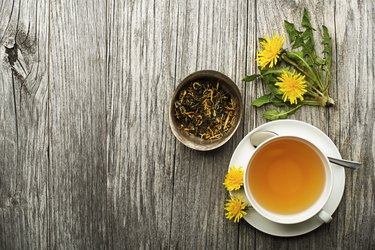
Dandelions are far more than just a backyard weed. These pretty yellow puff-tops that pop up in springtime have been used medicinally for centuries, in traditional Chinese medicine, in Europe and by Native Americans, per Mount Sinai.
The plant's botanical name is Taraxacum officinale, per PeaceHealth, and dandelion's roots or leaves (or both) can be used to brew a tea that's potentially good for you.
Video of the Day
Video of the Day
Warning
Check with your health care provider before drinking dandelion tea if you have kidney or gallbladder problems or if you have gallstones, per Mount Sinai.
What Is Dandelion Tea?
Dandelion tea has been traditionally used in alternative medicine, according to the National Center for Complementary & Integrative Health (NCCIH).
Dandelion tea is made using the root and/or the leaf. Typically, the root is used to treat liver and gallbladder issues while the leaves are used as a diuretic, per Mount Sinai.
Dandelion leaves are also commonly eaten as salad greens and cooked greens. Dandelion coffee, made from roasted dandelion root, is a "superfood" drink that's said to taste like coffee but has similar health benefits to dandelion tea.
Tip
Before you go drinking dandelion tea for medicinal purposes, consider discussing it with your health care provider. Keep in mind the drink's limitations: While there’s a rich history of dandelion being used medicinally, there’s “little scientific evidence on this herb,” per the NCCIH.
10 Health Benefits of Dandelion Tea
While there are some studies around the health benefits of dandelion, they're primarily done in animals, not people, per Mount Sinai. That means that while these studies point to dandelion's potential, more research is needed to confirm their purported benefits.
1. Eases Bloating
Dandelion tea has diuretic properties, and so it can help ease bloat.
Taking dandelion leaf extract led to more urination, per an August 2009 study in the Journal of Alternative and Complementary Medicine. Water weight, and bloat, decreased.
What about dandelion tea and weight loss? Sometimes, dandelion for weight loss is recommended because it can have a diuretic effect, causing a decrease in body fluid. Losing water can be beneficial if you're retaining water for some reason, but it can also be risky if you drink too much dandelion tea.
The problem with using diuretics for weight loss is that they result only in the loss of only water weight — not fat — and once you're properly hydrated again, all the weight usually comes back.
2. Full of Vitamins and Minerals
For a plant often considered a nuisance, dandelion packs a healthy punch. One ounce of dandelion greens contains the following, according to the USDA:
- Vitamin K: 184% Daily Value (DV)
- Vitamin C: 11% DV
- Vitamin E: 7% DV
- Vitamin A: 16% DV
- Calcium: 4% DV
- Iron: 5% DV
- Potassium: 2% DV
- Magnesium: 2% DV
- Zinc: 1% DV
3. Lowers Blood Sugar
Lab studies have shown dandelion to lower blood sugar levels, according to Memorial Sloan-Kettering Cancer Center (MSKCC).
Dandelions contain a substance called fructo-oligosaccharides that can stabilize blood sugar levels, per an August 2016 review published in The Review of Diabetic Studies. Dandelion also has anti-inflammatory properties.
More research — with clinical trials involving humans — is needed to more fully understand if dandelion (and specifically dandelion tea) can help people with type 2 diabetes.
4. Linked to Improved Liver Function
Dandelion tea may help your liver perform one of its main jobs — getting toxins out of your body better.
In animals, dandelion tea dramatically increased a detoxifying enzyme, per a February 2010 study in the Journal of Pharmacy and Pharmacology. And dandelions are listed as a plant with protective effects for the liver in a June 2015 article in Evidence Based Complementary and Alternative Medicine.
More research is needed to know if dandelions help improve liver function.
Related Reading
5. Full of Antioxidants
Dandelion is a particularly rich source of beta-carotene, on level with carrots, per the August 2016 review in The Review of Diabetic Studies. Beta-carotene helps your body make vitamin A, per the University of Rochester Health — it's also an antioxidant.
The plant's flowers are a source of antioxidants as well, per Mount Sinai. Antioxidants fight free radicals and help maintain cell health, per the Harvard T.H. Chan School of Public Health.
6. Has Potential Anti-Cancer Properties
Here's the most promising news: Dandelions might have anti-cancer properties, per MSKCC.
For instance, dandelion root extract blocked the invasion of breast cancer cells and dandelion leaf extract blocked prostate cancer cells in a May 2008 study conducted in a lab, published in the International Journal of Oncology. This gives some indication that dandelion root might play a role in preventing prostate or breast cancer cell growth.
But, it's important to note that these studies were not done in humans, and there's no scientific proof that dandelions can treat or prevent cancer, according to MSKCC. Once again, this is an area that requires more research.
7. May Aid Digestion
Like other bitter herbs, dandelions may help with your digestion, per PeaceHealth. Eating them spurs your body to produce more saliva, stomach acid and digestive enzymes.
It may also act as a laxative, which is helpful if you're experiencing constipation.
8. Possibly Reduces UTI Frequency
There's some potential that dandelions may help cut down on urinary tract infections (UTIs).
There is limited evidence, for example, that taking Uva-ursi (an herbal product that contains dandelion root), may help reduce recurrent UTIs, per a September 2017 study published in Trials.
9. Linked to Helping Regulate Cholesterol
Animal studies show that dandelion may help with cholesterol, per Mount Sinai. In some studies, dandelion helped lower total cholesterol while increasing HDL (the "good") cholesterol.
That's a positive sign, but without additional studies, we can't know if we'll see the same effect in people.
10. Potentially Fights Inflammation
Inflammation is not all bad: It helps your body heal, whether from an infection or a cut, per Harvard Health Publishing. But chronic inflammation — aka persistent, low-grade inflammation — is more problematic, and associated with heart disease, diabetes, dementia, depression, cancer and arthritis, per Harvard Health Publishing.
Dandelions may boast anti-inflammatory activity, per a September 2012 review in Nutrition Reviews.
Related Reading
How to Make Dandelion Tea
In his book Integrative Medicine, David Rakel offers a good ratio of dandelion to water. This tea can be enjoyed up to 3 times each day.
- Add 1 to 2.5 teaspoons (4 to 10 grams) of dried dandelion leaves or 0.5 to 2 teaspoons (2 to 8 grams) of dandelion root to a cup.
- Pour over 1/2 to 1 cup water.
- Steep for 10 to 15 minutes.
- Strain out the dandelion.
Dandelion Tea Side Effects
Allergies
Dandelion is generally safe to consume, per the NCCIH. But as with any herbal supplement, it can potentially lead to side effects.
Some people are allergic to dandelion and may not know it — so be particularly cautious if you're allergic to ragweed, chrysanthemums, marigolds and daisies, as you may be more likely to have an allergic reaction to dandelion, according to the NCCIH.
Dandelion Medication Interactions
Dandelion can interact with some medications, per Mount Sinai, including:
- antacids
- lithium
- blood thinners
- Ciproflaxin
- hypoglycemic drugs
You should avoid dandelion if you have hormone-sensitive cancers, chronic kidney disease or are taking immunosuppressive agents, according to MSKCC.
Before drinking dandelion tea as a part of your regular routine, speak to your health care provider. And keep in mind that this tea is not a replacement for any prescribed medications you're taking.
Related Reading
- Mount Sinai: "Dandelion"
- PeaceHealth: "Dandelion"
- National Center for Complementary & Integrative Health: "Dandelion"
- Journal of Alternative and Complementary Medicine: "The Diuretic Effect in Human Subjects of an Extract of Taraxacum officinale Folium over a Single Day"
- USDA: "Dandelion Greens"
- Memorial Sloan-Kettering Cancer Center: "Dandelion"
- The Review of Diabetic Studies: "The Physiological Effects of Dandelion (Taraxacum Officinale) in Type 2 Diabetes"
- Mayo Clinic: "Liver Disease"
- Journal of Pharmacy and Pharmacology: "Effect of herbal teas on hepatic drug metabolizing enzymes in rats"
- Evidence Based Complementary and Alternative Medicine: "Plants Consumption and Liver Health"
- University of Rochester Health: "Beta-Carotene"
- Harvard T.H. Chan School of Public Health: "Antioxidants"
- International Journal of Oncology: "Evaluation of aqueous extracts of Taraxacum officinale on growth and invasion of breast and prostate cancer cells"
- Frontiers in Pharmacology: "Effect of Methanolic Extract of Dandelion Roots on Cancer Cell Lines and AMP-Activated Protein Kinase Pathway"
- Trials: "Uva-ursi extract and ibuprofen as alternative treatments of adult female urinary tract infection (ATAFUTI): study protocol for a randomised controlled trial"
- Harvard Health Publishing: "Understanding acute and chronic inflammation"
- Nutrition Reviews: "Diverse biological activities of dandelion "
- Integrative Medicine
- PubMed.gov: Amelioration of oxidative stress by dandelion extract through ... acute liver injury