
How to Keep Your Arms In Front of Your Chest on a Golf Backswing
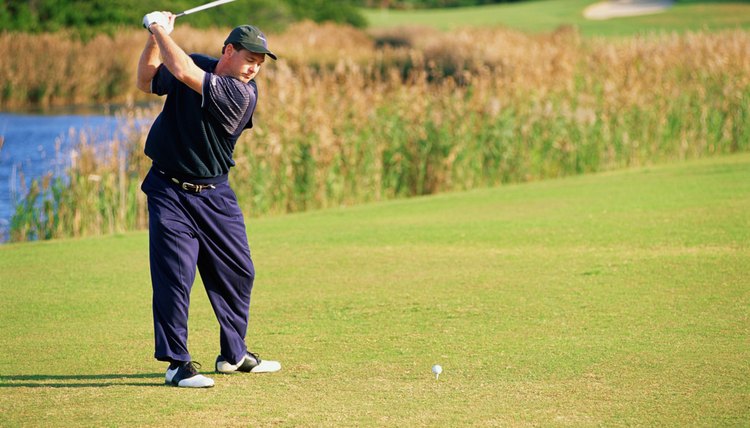
If your arms don’t remain in front of your chest during the backswing it likely means that you’re not rotating your body sufficiently.
To put your golf club in position for a powerful, repeatable downswing, you need link your arm swing and body turn on the backswing. Swinging the club too far around your body or picking it up too steeply forces you to compensate somehow on the downswing to get on a path for solid contact.
If you keep your arms in front of your chest on the backswing, you will have a much easier time returning the club on the proper downswing path.
Backswing Positions
Set up with your upper arms on top of your chest at address. Legendary ball-striker Ben Hogan felt like his arms started close together at address and stayed close together throughout the swing. His classic instruction book “The Five Lessons: The Modern Fundamentals of Golf” includes an illustration of Hogan’s arms bound together from the wrists to the elbows to emphasize this position.
Start the club back keeping the handle pointing at your belt line and the clubshaft pointing at the target line. If you pull the club too far inside going back, the handle will quickly start to point away down the target line almost immediately. If you pick the club up too abruptly, the handle will point at the ground and you will have to compensate to get the club on plane.
Hinge the club up with your wrists as you continue to swing back. Golf instructor Mitchell Spearman recommends imagining your golf club is a tube filled with water. As you turn your body and swing the arms in front of your chest, picture your left arm rotating and your wrists setting so the water will leak out gradually on a line between your feet and the ball.
Check the midpoint position of your backswing in front of a mirror from the down-the-line view. At this point, your left arm should be parallel to the ground, the clubshaft should bisect your right biceps and your hands should be in front of your chest.
Extend your arms away from your chest as you reach the top of the backswing. The back of your left wrist should be flat and the clubface should match that angle. Your shoulders should have turned about 90 degrees and your hips should have turned 45 degrees or less, depending on your flexibility. Viewed from down the line your hands will appear to be just above your right shoulder.
Swing Drills
Make practice swings standing a few feet in front of a wall to correct your swing path if you pull the club to far to the inside going back.
Check your takeaway, midpoint and top of positions in a mirror from the down the line angle. Memorize the feel of the proper positions.
Address a golf ball and cock your wrists so the club rises straight up in front of you. Turn your body and gradually rotate your left arm about a quarter turn as you reach the top of your backswing. Instructor Hank Haney uses this drill to reinforce the backswing position.
Bonus Tip:
It’s a golf axiom that your left arm (for a right-handed golfer) should remain straight throughout the backswing.
Golf instructor Jim McLean advises golfers not to take the rule 100 percent literally. He says “a little give at the elbow” is permissible and promotes “a more connected swing” in which arms and body turn together smoothly, which is the key to keeping your arms in front of your chest.
Writer Bio
David Raudenbush has more than 20 years of experience as a literacy teacher, staff developer and literacy coach. He has written for newspapers, magazines and online publications, and served as the editor of "Golfstyles New Jersey Magazine." Raudenbush holds a bachelor's degree in journalism and a master's degree in education.