How Early Can You Tell the Gender of a Baby?
How early you can tell the gender of your baby depends on the method of detection you use. You might want to know your baby's gender so that you can choose an appropriate name, or you might need to know if your baby is at increased risk for gender-linked genetic abnormalities. Only a medical test can tell gender; you can't tell from things like how you carry your pregnancy.
Traditional Ultrasound
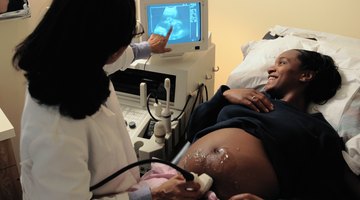
An ultrasound scan sends high-frequency sound waves into the uterus. As these sound waves bounce around, they encounter internal surfaces, bouncing back and generating on a computer monitor as an image of the fetus. The ultrasound image can help detect fetal developmental abnormalities, the baby’s size and growth, as well as the gender of the baby.Most mothers-to-be have an ultrasound around 18 to 20 weeks that shows the gender of the baby, but ultrasounds are sometimes done at 16 weeks. While the position of the baby and the skill of the technician are important in determining the baby’s sex, this visual method is approximately 95 percent to 100 percent accurate at detecting the gender at 20 weeks. Maternal body weight and fetal positioning can affect an ultrasonographer's ability to determine your baby's sex.
3D Ultrasound

At How Many Weeks Pregnant Can You Find Out a Baby's Gender?
Learn More
The use of 3D ultrasound can detect the gender of a baby even earlier than with traditional 2D ultrasound. According to a study published in the British Journal of Radiology, among 150 women who had 3D ultrasounds in their first trimester, 128--or 85.3 percent--received correct gender predictions. These predictions were made between weeks 11 and 14 weeks, demonstrating that 3D ultrasound can be an effective way of identifying the gender of a baby in the first trimester.
Amniocentesis
Amniocentesis is an option if there is a medical need, such as an increased risk for genetic diseases or birth defects, or if the mother is older. This procedure is not done just to determine fetal sex. Physicians perform amniocentesis between 18 and 20 weeks of pregnancy, so you won't get an answer on the sex of your baby any earlier than you would with ultrasound procedures. The procedure involves taking a sample of amniotic fluid and analyzing the cells, identifying potential genetic problems as well as the gender of your baby.
Chorionic Villus Sampling (CVS)

Can You Get a Paternity Test Before a Baby Is Born?
Learn More
Chorionic villus sampling, or CVS, is another test used in pregnancies that are at high risk for genetic or chromosomal defects. CVS is usually done at around 10 to 12 weeks. Your doctor will remove a small area of placental tissue and examine the chromosomes to determine whether you're having a boy or girl. This procedure can be done by going through the cervix or transabdominally. The transcervicial method has a slightly higher risk of miscarriage, according to the Royal College of Obstetricians and Gynaecologists.
Preimplantation Genetic Testing
If you undergo in vitro fertilization utilizing preimplantation genetic testing or PGD, you can know whether you're having a boy or girl even before you have a positive pregnancy test. While many medical professionals don't support the use of PGD for sex selection, unless it's used to prevent sex-linked genetic defects such as hemophilia. Removal of a cell from an embryo before the embryo is implanted in the uterus allows microscopic evaluation of chromosomes that show whether a baby will be a boy or a girl. Only embryos of the desired sex are implanted.
Related Articles

At How Many Weeks Pregnant Can You Find Out a Baby's Gender?
Learn More

Can You Get a Paternity Test Before a Baby Is Born?
Learn More

How Early Can You Hear a Baby's Heartbeat?
Learn More

How Precise is an Ultrasound for Determining the Exact Age of a Baby?
Learn More

When Do You Have Pap Smear After Having a Baby?
Learn More

Signs That a Fetus Is Not Growing
Learn More

What to Expect With a Baby's Heartbeat When You're Expecting
Learn More

When Does a Baby Develop Gender?
Learn More

Can Heart Rate Predict a Baby's Gender?
Learn More
Blood Clot in the Uterus in Early Pregnancy
Learn More

Christina McDonald-Legg has been writing about health, wellness and travel since 1999. Her articles have appeared in "Colures Magazine" (London), "The Sunday Times" (Dublin), "The Connacht Tribune" (Galway) and "The Seattle Post-Intelligencer," and been featured online by the U.K. Department of Health. McDonald-Legg holds a Master of Arts in journalism from the National University of Ireland.
