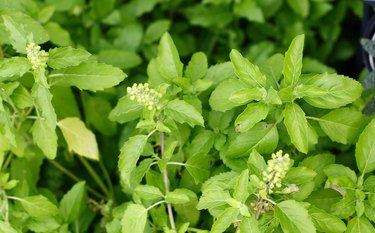
Tulsi is the Sanskrit word for holy basil. This medicinal herb has a long history as part of the Ayervedic tradition, according to Drugs.com, a drug information site that provides peer-reviewed information to consumers. The herb grows wild in tropical and sub-tropical regions, according to MedicinalHerbInfo.org. It's also widely cultivated for its reputed spiritual and medicinal properties. Before using tulsi, or any other medicinal herb, consult your health care provider.
Traditional Tulsi Uses
Video of the Day
Tulsi has many traditional health uses, including treatment of eczema, psoriasis and aging effects. It is also used as an antibiotic, an immune system booster, an anti-inflammatory and a stress reducer. In its native India, tulsi is considered a sacred plant and no household would dare be without the plant, according to an article at Acadamia.edu.
Video of the Day
Possible Side Effects
The use of tulsi while pregnant or breast-feeding could potentially be harmful to your unborn child. Use of tulsi is discouraged while pregnant or nursing, and tulsi has also been reported to cause lack of fertility in animal studies, according to The Chopra Center. Avoid tulsi when even considering getting pregnant. Men and women trying to procreate are also warned to avoid tulsi because of possible problems with fertility.
Potential Interactions
According to Drugs.com, using tulsi while also using acetaminophen can cause harmful interactions. The site also cautions against using tulsi while also taking barbiturates or other sedatives. If you have questions about whether taking tulsi will interact negatively with other herbs or medications you are taking, talk with your pharmacist or health care provider.
Forms of Tulsi
According to an article in "Natural Product Radiance," the tulsi herb is available fresh, in capsules, tea and in a tincture. The best way to get fresh tulsi leaves whenever needed is to keep a pot of the herb growing in a kitchen window or on a sunny porch.
Considerations
It is possible to experience an allergic reaction to tulsi, according to Drugs.com. Taking any medicinal herb can cause an allergic reaction, even if it's been taken before with no reaction. Be aware of rashes, hives and signs of swelling of the tongue, lips, face or throat from taking tulsi and if these occur, stop using it and contact your health care provider.
Related Reading
More commonly known as holy basil, tulsi has been used medicinally for thousands of years. Holy basil, or Ocimum sanctum and O. tenuiflorum, is closely related to the common basil herb used in cooking. Tulsi has been used in Ayurvedic medicine as an adaptogenic herb to improve the body's ability to cope with stress and disease. The herb has been used to treat respiratory ailments, stomach problems and even heart disease. The University of Michigan Health System recommends taking 1,000 to 2,500 mg of the dried powdered leaf per day.
Treating Asthma
Tulsi may help in treating asthma-related symptoms. Medical studies have found that taking tulsi extract can improve breathing in people with shortness of breath and other respiratory ailments, according to the Herb Growing & Marketing Network. Traditionally, tulsi has been used to treat coughs, mild upper respiratory infections and bronchospasms, as well as bronchial asthma when combined with ginger and black pepper. Animal studies have found that tulsi extracts can stop constriction of the bronchial passages, and some preliminary clinical trials in humans revealed that the herb improved breathing function and reduced the frequency of attacks in people with asthma, states the University of Michigan Health System. The subjects in the clinical trials took 500 mg of tulsi three times daily for one month.
Treating Diabetes
Holy basil may help control blood sugar levels in type 2 diabetes patients. The University of Michigan cites preliminary clinical trials which found that taking 1,000 to 2,500 mg of tulsi per day can lower blood sugar levels. The Herb Growing & Marketing Network also points to a study conducted in 1997 at M.S. University of Baroda in India, where medical researchers gave 17 patients with non-insulin-dependent diabetes mellitus 1 g of holy basil leaf per day for 30 days and compared the effects to 10 other patients who were given no supplementation. Both groups of patients continued to take their anti-diabetic medications and follow their usual diets, but the participants who took the tulsi leaves experienced a 20.8 percent reduction in their fasting blood glucose levels. The test group experienced an 11.3 percent reduction in their total cholesterol levels as well.
Relieving Poison Oak and Poison Ivy Dermatitis
Tulsi is often used externally to treat inflammation and skin disorders, and it may be useful in resolving dermatitis from poison oak and poison ivy. Extracts of holy basil reduced pain sensitivity and improved wound healing in animal studies, states the University of Michigan Health System. Also, tulsi leaves contain an essential oil comprised of eugenol and other volatile compounds which have been shown to have anti-inflammatory and antioxidant effects in test tube studies.
Is this an emergency? If you are experiencing serious medical symptoms, please see the National Library of Medicine’s list of signs you need emergency medical attention or call 911.