Deep Breathing Meditation Technique
Deep breathing is one of the most effective ways to start meditating and can be performed anywhere. The two key elements of any meditation practice are finding a focal point and letting go of any thoughts or emotions that arise. According to Yoga Instructor Mary Bruce of Phoenix, Arizona, focusing on your deep, rhythmic breath helps turn your mind inward and activates your parasympathetic nervous system, which promotes relaxation. “When the breath is made steady, the mind becomes calm like a still lake,” says Bruce. “This is the fertile ground for meditation to blossom. Breath is key.”
Sit down in a chair or on the floor on a folded blanket or cushion. Keep your back straight from the base of your spine to your neck. This creates a straight path for energy to flow up your spine.
How to Begin Shaolin Meditation
Learn More
Place your hands on your thighs with your palms face up or down. Rest your feet flat on the floor if you are sitting in a chair. Cross your ankles or legs if you are seated on the floor.
Close your eyes to prevent your mind from being distracted by outer objects.
How to Calm Down When Your Pulse Is Racing
Learn More
Breathe normally in and out through your nose for about one minute, observing your breath without judgment. Close your mouth and relax your facial muscles.
Allow your breath to slowly deepen as you inhale and fully inflate your lungs, counting silently to four. Feel your ribcage expand forward and to the sides as you breathe in.
Exhale to a slow count of four as you pull your navel point toward your spine. Make your in-breath and out-breath the same length. If thoughts or emotions arise, let them go and bring your attention back to your breath.
Continue deep breathing meditation for three to five minutes or for as long as you can sit comfortably with a calm, steady breath.
Tips
Empty your bowels and bladder before you begin. Shower or wash your face so you will feel more alert.
Roll out your yoga mat and do a physical practice before meditating. The yoga poses will help stretch and strengthen your body. Focus on poses that work your abdominals, to strengthen your spine, and hip openers to prepare your body to sit in stillness.
Set aside time each day to meditate. Choosing the same time and place for your practice will help you create a regular routine.
When you can sit comfortably in meditation for three to five minutes, increase your time to 10 to 15 minutes. As you gain more experience, gradually lengthen your meditation time to 30 minutes or longer.
Sit upright whenever meditating. Reclining on a couch or lying on your back make it more likely you will doze off.
The exhalation is the most important part of the breathing cycle. Breathing out completely will create more room for a deeper, fuller inhalation. Full exhalations help remove impurities that have accumulated in the lower part of your lungs.
Warnings
Avoid eating a big meal before meditating to prevent feeling tired or falling asleep.
Never force or strain your breath. Strive for steady, rhythmic breathing that flows easily.
If deep breathing causes dizziness or lightheadedness, slow down your breath or return to normal breathing.
Related Articles
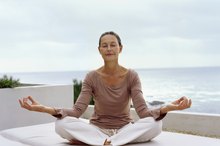
How to Begin Shaolin Meditation
Learn More
How to Calm Down When Your Pulse Is Racing
Learn More

Exercises for Stuttering
Learn More
Breathing Exercises to Increase Oxygen Rate
Learn More
How to Increase Your Body's Oxygen Intake
Learn More
Yoga Breathing Exercises for Anxiety
Learn More

Exercises to Elongate the Neck
Learn More
How to Correct Mouth Breathing
Learn More

Breathing Exercises to Fight Sinusitis
Learn More
How to Boost Your Alpha Brain Waves (and Why You Should Care)
Learn More
References
- How Meditation Heals; Eric Harrison
- Mary Bruce, RYT; Yoga Instructor, Urban Yoga; Phoenix, Arizona
Resources
- The Heart of Yoga; T.K.V. Desikachar
Writer Bio
Angela Ambrose began her writing career in 1987, producing videos and publications for Fortune 500 companies and the US Public Health Service. She is an American Council on Exercise-certified group fitness instructor specializing in yoga, indoor cycling and cardio classes for seniors. Ambrose holds a Bachelor of Arts from the University of Illinois.