Crib Age Safety
As your baby grows, it’s imperative that that her crib adjusts to her changing safety needs. Compared to all nursery products, cribs are responsible for the most infant deaths, warns KidsHealth 1. The right crib keeps your baby safe as she learns to turn over, sit up, and finally, stand.
Sleep Position
Until your baby can roll over on his own, usually around 5 to 6 months, he should sleep on his back to help prevent sudden infant death syndrome, or SIDS. The American Academy of Pediatrics, or AAP, believes infants may not have the brain function to rouse them in life-threatening situations, such as when they are suffocating. SIDS-related deaths have declined by over 40 percent since the AAP began recommending back sleeping in 1992.
Mattress
Crib Slat Safety
Learn More
Your baby’s mattress should be firm and fit snugly against the sides of the crib. If you can fit two fingers between the mattress and the crib, the mattress is too small. A full-size crib mattress should be at least 27 1/4 inches wide by 51 5/8 inches long and no more than 6 inches thick. Your crib should adjust so you can lower the mattress position as your baby grows. Put the mattress at the lowest position once your baby can stand, usually around 6 months, so she cannot climb out of her crib.
- Your baby’s mattress should be firm and fit snugly against the sides of the crib.
- Put the mattress at the lowest position once your baby can stand, usually around 6 months, so she cannot climb out of her crib.
Bedding
Cover your baby’s mattress with a fitted sheet designed specifically for the mattress. Remove any other blankets, pillows or toys from the crib when you put your baby to bed. Just as your baby can suffocate when sleeping on his stomach, he can suffocate on loose bedding. The AAP recommends against crib bumpers for this reason. If you must use a blanket before he can roll over, place your baby so his feet can touch the end of the crib. Then only pull the blanket up to your baby’s chest and tuck the blanket into the mattress to prevent it from coming loose as your baby moves in the night. Once your baby can push up to a standing position or when your baby turns 5 months, remove any mobiles.
- Cover your baby’s mattress with a fitted sheet designed specifically for the mattress.
- If you must use a blanket before he can roll over, place your baby so his feet can touch the end of the crib.
Railings
Can My 6-Month-Old Use Crib Bumpers?
Learn More
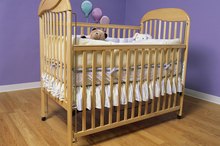
Both the space between the slate of the rails and the height of the crib railings are important. For any crib, the slats should be no wider than 2 3/8 inches. The U.S. Consumer Product Safety Commission warns against drop-side cribs, which can fall, trapping and strangling the baby inside. According to KidsHealth, if you have a drop-side crib rather than a crib with stationary rails, the top of the rail should be at least 9 inches above the mattress support when you lower the side rail. For older babies who can push up or stand, the top of the rail must be at least 26 inches above the mattress at its lowest position.
- Both the space between the slate of the rails and the height of the crib railings are important.
- For older babies who can push up or stand, the top of the rail must be at least 26 inches above the mattress at its lowest position.
Crib Location
Your baby should sleep in your room, but in her own crib or portable crib, bassinet or cradle, until she is at least 6 months old, recommends the AAP. After 6 months, your baby can sleep in her crib in her own room. Keep the crib away from windows as curtains and window cords can strangulate your baby. Additionally, keep the crib away from any wall hangings or anything baby can grab onto. Make sure the crib is locked into place, and never move the crib with the baby in it, regardless of the baby’s age.
- Your baby should sleep in your room, but in her own crib or portable crib, bassinet or cradle, until she is at least 6 months old, recommends the AAP.
- Keep the crib away from windows as curtains and window cords can strangulate your baby.
Related Articles

Crib Slat Safety
Learn More
Can My 6-Month-Old Use Crib Bumpers?
Learn More

How to Remove Lice From Helmets
Learn More

How to Wear a Back Support While You Sleep
Learn More

Sleeping & Tense Muscles
Learn More

Are Wooden High Chairs Safe?
Learn More
How to Sleep With a Hiatal Hernia
Learn More

How to Correct Pulled Forward Shoulders
Learn More

Staircase Railings & Child Safety
Learn More

How to Troubleshoot a Hospital Bed
Learn More
References
Writer Bio
Ivy Morris specializes in health, fitness, beauty, fashion and music. Her work has appeared in "Sacramento News and Review," "Prosper Magazine" and "Sacramento Parent Magazine," among other publications. Morris also writes for medical offices and legal practices. She holds a Bachelor of Arts in government-journalism from Sacramento State University.