
Why Should I Wear Dive Boots?
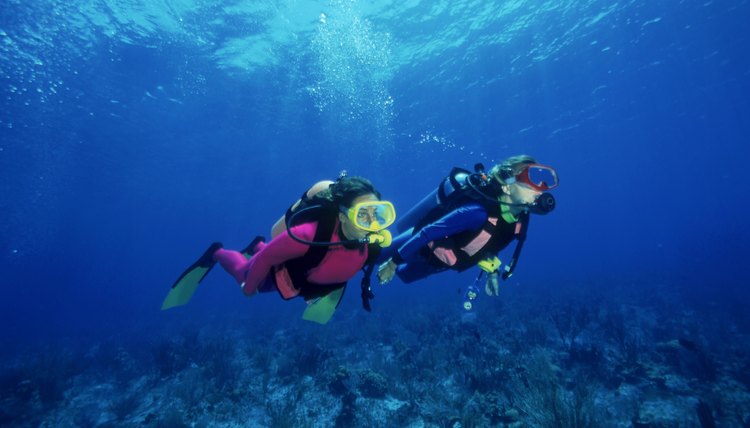
Scuba divers and snorkelers wear dive boots, also called wetsuit boots or booties, for warmth, comfort and protection. Dive boots are designed to be worn with open-heel dive fins, which feature an adjustable heel strap to hold the fin on the foot. If you use closed-heel fins, you do not need dive boots. Closed-heel fins are designed to fit closely to your foot. Dive boots are also used in surfing, kayaking, sailing and other water sports.
Construction
Dive boots are constructed from Neoprene polychloroprene, a synthetic rubber material popularly used for wetsuits. Material thickness ranges from 2 mm to 7 mm. Low-top booties start just below the ankle; high-top booties fully cover the ankle. Dive boot soles are available in a variety of thicknesses and feature ribbing or other textures for added traction. The boots may feature zippers, hook-and-loop fasteners or elastic tops to make putting them on easier.
Warmth
Neoprene traps water, serving as an insulating layer to keep your body heat next to your skin. Dive boots help keep your ankles, feet and toes warm in and out of the water. When you get cold, the blood flow to your skin and extremities is reduced to conserve body heat, making your fingers and toes feel cold. In warmer water, above 75 degrees F, thin 2 mm to 3 mm booties are usually sufficient to keep your toes cozy. In colder water, thicker 5 mm to 7 mm booties are necessary. Keeping your feet warm can also help prevent foot and leg cramps caused by cold water.
Comfort
Open-heel fins are not designed for bare feet. Wearing these types of fins without dive boots can strain your muscles, cause muscle cramps and chafe your skin. Booties provide padding to protect your toes, toenails and toe knuckles from the hard interior of the fin cup. Movement can cause the buckles, strap and sides of the cup to rub against your arch, heel and other parts of your foot, chafing your skin and causing discomfort, blisters or abrasions.
Protection
Not all beach entries are created equal. Soft sandy beaches can become quite hot, and many entry points are covered with sharp shells and rocks. Walking to the entry point with 40 lbs. or more of scuba gear on your back makes walking on rocks and shells even more painful. The rubber soles on your dive boots protect your feet from cuts, burns, bites and stings, and provide extra traction on slippery surfaces. Falling down on sharp rocks, particularly laden with heavy gear, can lead to serious injury and damage your expensive equipment.
Expert Insight
Visit a scuba gear shop to try on dive boots and fins together. If you are replacing your booties, take your fins in with you and vice versa. The booties should fit your feet tightly without squeezing and should fit snugly, but comfortably, inside the fin cups. Thin dive socks made of a variety of synthetic materials can be worn inside of your booties or with closed-heel fins.
References
Resources
Writer Bio
Deborah Lee Soltesz is a web developer who has been creating websites, promotional materials and information products since 1992. Soltesz has a Bachelor of Science in computer science and engineering. She worked in earth and space science research writing for scientific and general audiences for more than a decade.