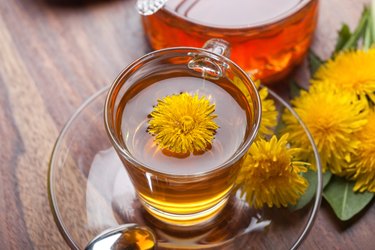
If you've come across dandelion root supplements and are wondering whether you should take them or whether dandelion has any side effects, here's what you need to know about dandelion and its benefits. These plants are more than just pesky weeds.
Read more: Benefits of Turmeric Powder
Video of the Day
Video of the Day
Tip
Dandelion is a nutritious plant that has been used as a natural remedy in many cultures for centuries, for a number of different ailments. While scientific evidence shows promise, there isn’t enough to conclusively prove its health benefits.
The Dandelion Plant
According to Bellarmine University, the name dandelion comes from the French phrase "dents de lion," meaning "teeth of the lion." Therefore, one of dandelion's nicknames is "lion's tooth," thanks to its spiky yellow petals. When the plant starts to seed, the flower turns into a white ball of puff that you can blow away, so it is also referred to as "blow ball" or "puff ball."
As the seeds blow away and take root, causing new plants to spring up, dandelions can become annoying weeds. Bellarmine University explains that they have a thick taproot system that stores enough energy for them to keep pushing up flowers even after they have been razed by lawnmowers multiple times.
However, dandelions are in fact eaten in many cultures. The whole plant is edible and it is used as a green in salads, added to soups and used to brew tea and wine.
Read more: What Are the Benefits of Eating Rose Petals?
Dandelion Benefits
Dandelions are also used as a natural remedy in traditional Chinese, Arabic and Native American cultures, according to the National Center for Complementary and Integrative Health (NCCIH).
Dandelion's benefits stem from its nutritive properties. According to Michigan State University Extension (MSU Extension), dandelions are rich sources of vitamin A, vitamin K, riboflavin (vitamin B2) and iron. In fact, MSU Extension states that 1 cup of dandelion greens has almost double the iron content of spinach and over 500 percent of your daily vitamin K requirement.
The NCCIH notes that dandelion has been used to treat liver, gallbladder and bile duct problems for centuries. It also widely used now as a diuretic and to treat digestive problems, among other issues.
However, the NCCIH states that there is little scientific evidence to support the health benefits of dandelion root, so it is hard to tell whether you should be taking any supplements or not, and whether they are effective.
Some in-vitro research studies have shown promising results, with the caveat that further investigation is required. For instance, an August 2016 study published in the Review of Diabetic Studies found that the bioactive compounds in dandelion have anti-diabetic properties that could help prevent and treat Type 2 diabetes.
Another study, published in the journal Oncotarget in November 2016, found that dandelion root extract could help combat cancer. Yet another study, published in the journal Oxidative Medicine and Cellular Longevity in October 2015, found that dandelion extract could help protect your skin against damage from ultraviolet rays.
If you happen to take dandelion root supplements while you wait for the scientific evidence to trickle in, the NCCIH recommends informing your health care provider so they have a full picture of your medical status and can ensure safe and coordinated treatment.
The NCCIH does not list any known dandelion side effects and states that dandelion is generally considered safe for consumption. The only dandelion side effects mentioned are for people who are allergic to the plant. The NCCIH notes that people who are allergic to other related plants, like daisies, chrysanthemums, marigolds and ragweed, are more likely to be allergic to dandelion as well.
- Bellarmine University: “Dandelion”
- National Center for Complementary and Integrative Health: “Dandelion”
- Michigan State University Extension: “Five Ways to Eat Dandelions”
- Review of Diabetic Studies: “The Physiological Effects of Dandelion (Taraxacum officinale) in Type 2 Diabetes”
- Oncotarget: “Dandelion Root Extract Affects Colorectal Cancer Proliferation and Survival Through the Activation of Multiple Death Signalling Pathways”
- Oxidative Medicine and Cellular Longevity: “Dandelion Extracts Protect Human Skin Fibroblasts From UVB Damage and Cellular Senescence”