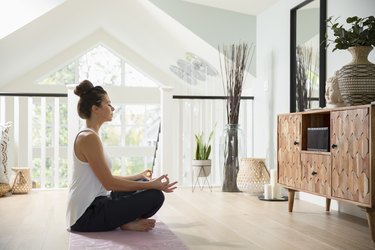
It wasn't too long ago that yoga was a relatively unknown activity practiced mainly by New Agers and people with hippie parents. But times have changed, and now it seems like everyone's doing yoga: your sister, your nephew, your grandma — even football players and prison inmates. And there are good reasons for that.
From an improved physique to a happier mood, the benefits of yoga are too plentiful to be ignored. So what are you waiting for? Read through the following expert-approved advice to find out how you, too, can reap the benefits of a regular yoga practice.
Benefits of Yoga to Convince You to Start
Regularly practicing yoga is a good way to improve your overall health and well-being. It's been linked to better brain health (according to November 2019 study from Brain Plasticity) and reduced anxiety (according to a November 2019 study from The Journal of Psychiatric Practice).
Yoga can also help reduce chronic pain from arthritis and headaches, help relieve insomnia, increase flexibility and muscle strength, help with weight loss, improve athletic performance, prevent injury, regulate metabolism and improve heart health, says osteopathic physician Natalie Nevins.
Plus, practicing yoga can help lower resting blood pressure in a group of adults with mild to moderate hypertension, according to an April 2013 statement from the American Heart Association.
Read more: What Are the Benefits of Practicing Yoga Daily?
Differentiating Between the Types of Yoga
Finding the style of yoga that appeals to you and helps you meet your goals is key to ensuring you stick with your program. Here's a rundown of the most popular types.
Vinyasa Yoga
This style of yoga is also referred to as "flow," since it involves smooth transitions from one pose to another. While it can be a challenging and fast-paced practice, beginners can modify pretty much anything. Expect multiple rounds of Sun Salutations, standing poses, arm balances and core exercises.
Bikram Yoga
Bikram yoga, which incorporates the same 26 poses into every practice, is practiced in a room heated to 105 degrees Fahrenheit with a humidity of 40 percent. Although it's quite challenging, Seattle-based yoga teacher Lauren McKee says postures are easy to learn and repeated in every class. Just make sure you stay hydrated and don't overdo it in your first class.
Ashtanga Yoga
If you're looking for a less vigorous — but still challenging — yoga experience, you can opt for Ashtanga yoga, a traditional style brought to the West from India. It's comprised of a series of sets of poses that get progressively more advanced as you move through them.
Power Yoga
If you're an athletic type or you're interested in losing weight, the power yoga might appeal to you. "Power yoga is a style of yoga that you can expect to be pretty vigorous," McKee says. "You're going to be moving, you're going to be sweating." It's sometimes practiced in a heated room, which ups the challenge even more.
Kundalini Yoga
Another traditional style, Kundalini, is also referred to as "yoga of awareness." Through a combination of meditation, mantras, physical poses and breathing techniques, this ancient style of yoga endeavors to "awaken the full potential of human awareness in each individual," according to the Kundalini Research Institute.
Iyengar Yoga
Focusing on alignment, precision and detail, this asana practice often includes the use of props, such as blocks, straps and bolsters, to help you achieve proper alignment in any pose. Try a class if you love precision or want to expand your knowledge of each pose.
Hatha Yoga
Literally meaning "forceful," Hatha refers to sequences of asanas meant to help you find balance between strength and flexibility. It emphasizes the importance of focusing on the breath. These classes may feel a bit slower than ones that you're used to, but you're guaranteed to leave feeling refreshed and energized.
Yin Yoga
If you're seeking out yoga as a way to relax or if you have an injury, try a Yin yoga class. Expect to hold poses for long periods — usually three to five minutes. Postures are mostly passive, aimed at stretching the connective tissue around joints to make it longer and stronger, says Yin yoga teacher Paul Grilley.
Restorative Yoga
For calming the mind and body, restorative yoga is another great option. This type of class uses props and long hold times in passive postures to help the body completely relax and open. According to restorative yoga teacher Judith Hanson Lasater, PhD, restorative yoga can also help relieve chronic stress.
At-Home Yoga vs. Studio Classes
Yoga can be practiced almost anywhere — at a studio, in your living room, in your office, in a park or wherever you feel you can move and breathe without being interrupted.
Still, most people choose to attend group classes in a studio or gym. Having a teacher to guide you, especially when you're a beginner, can help you more quickly and easily learn the poses while also avoiding injury.
When choosing a studio, there are a few things to take into consideration:
- Location: If the studio isn't nearby, it's less likely you'll make it to class regularly.
- Types of Classes: Does the studio offer the style of yoga you're interested in taking?
- Class Times: Are the classes you want to take offered at times that fit your schedule?
- Beginner-Friendly: "What I would recommend for a beginner is to find a studio that has a beginner series," says Washington-based yoga teacher Cara Maclean.
But cost can sometimes be prohibitive. If attending a yoga studio regularly isn't in your budget, practice at home. Identify a space (whether a whole room or a corner of a room) where you can practice uninterrupted and without running into anything.
Close the door or ask your family members to avoid your yoga space during your practice. If you're using online classes, set up your laptop or hook up your TV to the internet. Commit to your practice and worry about other things — like what you'll make for dinner — after your session is over.
Related Reading
Best Yoga Poses for Beginners
Though any good beginner class — whether online or off — will walk you through the various poses you'll be doing, it can help to know what to expect. Here are a few of the most common ones (Sanskrit words, a.k.a. official yoga names, are in parentheses).
1. Forward Fold (Uttanasana)
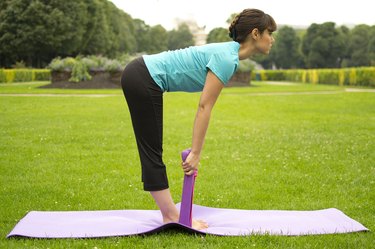
- Start standing. Inhale as you reach your arms overhead.
- As you exhale, fold forward, hinging at the hips.
- Place your hands on the floor beside your feet or on blocks depending on your flexibility.
- Keep a slight bend in your knees and stack your hips over your knees and your knees over your ankles.
2. Cat Cow (Marjaiasana Bitilasana)
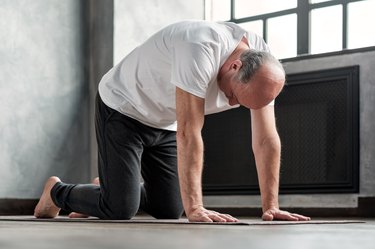
- Start on all fours with your knees under your hips and your hands under your shoulders.
- Draw your navel in toward your spine and arch your back like a cat.
- Starting at your tailbone, begin to extend your spine, vertebrae by vertebrae, until you are in a swayback position.
- Continue slowly alternating between the two.
3. Downward Facing Dog (Adho Mukha Svanasana)
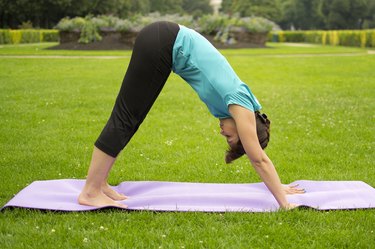
- Starting on all fours, curl your toes under and lift your hips up, straightening your legs.
- Draw your shoulders down your spine away from your ears. Elongate your spine and extend the backs of the legs only as far as the hamstrings allow.
- Depending on your flexibility, bring your heels down toward the mat or stay on the balls of your feet with knees bent.
- If your heels do not touch the ground, put a bolster under your heels or pressing the heels into a wall.
4. Cobra Pose (Bhujangasana)
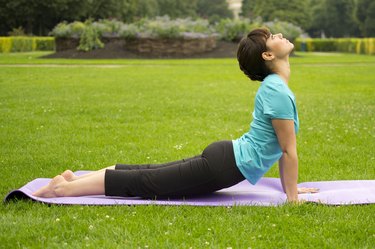
- Lie on your stomach with legs together, tops of the feet down and hands under your shoulders.
- With an inhale, peel the chest away from the floor.
- Roll your shoulders back and down your spine as you begin to straighten the arms as your flexibility allows. Be cautious not to go too far too soon.
- Breathe deeply and maintain awareness of the feedback your body is providing to avoid stress or strain.
5. Corpse Pose (Savasana)
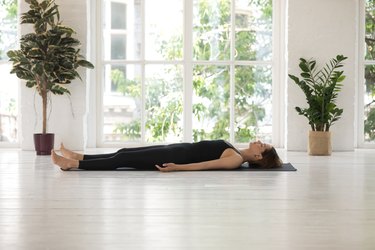
- Lie on your back. Place a small pillow or rolled-up blanket under your head and/or a bolster under your knees if you want.
- Find length through your lower back and relax the pelvis and hips. Let your arms rest by your sides with your palms facing up.
- Breathe with ease and relax every part of your body.
Read more: 10 Best Yoga Poses for Beginners
Equip Yourself for Success
As with most activities, starting a yoga practice is an investment, but it can be as little or as much as you want. Essentially, all you'll really need is light, comfortable clothing that allows you to move freely. A yoga mat is also good for providing cushion on hard studio floors and grip for your hands and feet, says Maclean.
Bolsters, blocks and straps are other useful props that are usually provided by studios, but you can also purchase them for your home practice. Bolsters provide extra support and take pressure off limbs in challenging and restorative postures. Blocks and straps can make certain poses easier for less-flexible practitioners, helping them achieve the correct shape of the pose without overextending.
If you're practicing at home, you'll can either buy these items or get creative, using a pillow as a bolster, a hardcover book as a block or a towel as a strap.
Read more: The 5 Best Eco-Friendly Yoga Mats
Best Tips for New Yogis
1. Cultivate a Beginner's Mindset
When starting a yoga practice, whether at home or at a studio, maintain an attitude of open-mindedness, a lack of preconceptions and an eagerness to learn. Allow yourself to notice the discomfort in your first class or in a pose you find challenging, then let it go and resume your breathing. Don't compare yourself to others in the room, McKee says. "Realize that everyone was new at one point. Give yourself the time to get there."
2. Be an Early Bird
When you head to your first class, McKee recommends arriving a little early and talking to the teacher. "Most teachers want to make you grow as a student, so if they're a good teacher, they should be able to give you some helpful hints before you delve in."
3. Practice Patience and Persistence
"I can't do yoga because I'm not flexible enough," is a common complaint McKee hears from new students. But it's also wrong. "That's the reason you would come to yoga. Most of us aren't inherently flexible or inherently able to balance on our hands, but with time and patience, it's like anything else — you can develop flexibility just like you can develop strength."
4. Don't Get Discouraged
Maclean says it's easy for beginners to compare themselves to people on social media doing complex poses and feel like you're not a "real yogi." But, she says, yoga is for everyone. "Whether you're flexible or not, just go into a yoga class and stick with it," she says. "You'll see progress immediately, if you allow it."
Instead of focusing on all the physical ways you think you don't measure up, allow yourself to let go and reap the mental and emotional benefits of your practice.