
What does fact checked mean?
At SportsRec, we strive to deliver objective content that is accurate and up-to-date. Our team periodically reviews articles in order to ensure content quality. The sources cited below consist of evidence from peer-reviewed journals, prominent medical organizations, academic associations, and government data.
- Sports Health: Examination and Treatment of Hamstring Related Injuries
- Sports Health: Examination and Treatment of Hamstring Related Injuries
- ACE: Hamstring Curl
The information contained on this site is for informational purposes only, and should not be used as a substitute for the advice of a professional health care provider. Please check with the appropriate physician regarding health questions and concerns. Although we strive to deliver accurate and up-to-date information, no guarantee to that effect is made.
Exercises for Hamstring Syndrome

A particular problem for runners, jumpers and anyone else who puts their best foot forward with great force, hamstring syndrome — also known as proximal hamstring tendinopathy — affects one or both of the sciatic nerves, causing pain, tingling or numbness in one or both legs.
More than just a case of chronic tightness of the leg muscles, hamstring syndrome occurs when tissues bunch up and form hard, fibrous bands where both the hamstring muscles and the sciatic nerve insert into the "sit bones."
Symptoms, which include pain in the buttocks, can overlap with piriformis syndrome. Because the sciatic nerves extend from the upper pelvis through the buttocks, down the back of the legs and finally to the foot, symptoms may radiate throughout the lower body.
Hamstring syndrome may require surgery in rare instances. In most cases it can be prevented, improved or cured with exercise, particularly strengthening and mobilizing of the hamstrings, hips and legs.
While you're trying these exercises to alleviate the pain of hamstring syndrome, switch to cardio exercise that's less stressful for the hips, such as swimming or cycling.
Hamstring Stretches
The hamstrings are a complex of three long muscles that run from the pelvis to the lower leg, and when they get tight they take the lower back with them. Practicing dynamic stretches for tight hamstrings, such as forward folds and standing leg swings, are a good first step to recovery from hamstring syndrome. Be sure to stretch both legs evenly to avoid future injury.
Progressive strengthening of the hamstring muscles and glutes is essential for recovery from and prevention of hamstring syndrome, according to the journal Physician and Sportsmedicine.
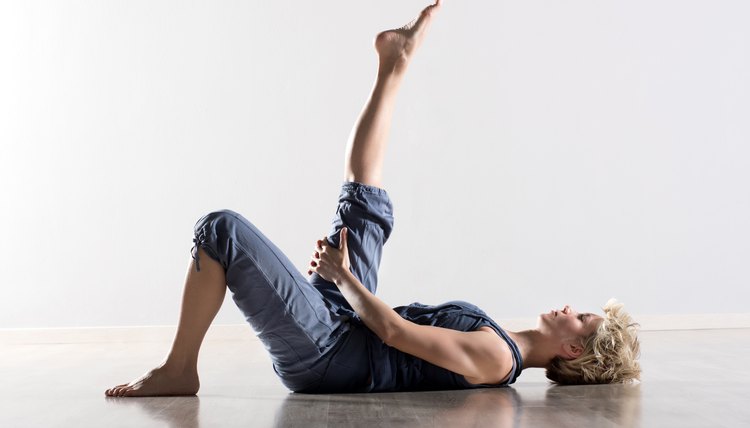
Double Leg Bridge Exercise
HOW TO DO IT: Lie on your back with your arms at your sides and your knees bent upward. Keeping your core stable, squeeze your butt muscles and lift your pelvis until your torso is in alignment with your upper legs. Slowly lower your body to the start position and repeat for three sets of 10 reps each. Perform twice a day.
Stability Ball Hamstring Curl
HOW TO DO IT: Lying on your back, place your ankles and lower calves on the stability ball. Brace your abdominals and raise your hips upward, pushing the ball slightly away from you with your legs until your torso, pelvis and legs form a straight line from the ball to the floor. Lower your pelvis to start position, pulling the ball in slightly closer to your body with your legs. Repeat 10 times.
Prone Plank with Hip Extension
HOW TO DO IT: Begin by lying face-down with your forearms resting palms-down and your elbows positioned directly under your shoulders. Clasp your hands together, flex your feet and curl your toes underneath them. Now press up from the floor as if you're doing a push-up using your forearms for stability instead of your hands.
To perform the hip extension, first raise the left leg off of the ground, flexing it at the knee and extend the hip by projecting the heel upward. Hold for 3 seconds or for as long as you can, and and then return to parallel for the same length of time. Repeat five to 10 times.
Explore In Depth
References
- British Journal of Sports Medicine: The Hamstring Syndrome in Endurance Athletes
- Sports Health: Examination and Treatment of Hamstring Related Injuries
- ACE: Hamstring Curl
- Physical Therapy. TeensHealth from Nemours. 2017.
- Ramos GA, Arliani GG, Astur DC, Pochini AC, Ejnisman B, Cohen M. Rehabilitation of hamstring muscle injuries: a literature review. Rev Bras Ortop. 2017;52(1):11-16. doi:10.1016/j.rboe.2016.12.002
- Erickson LN, Sherry MA. Rehabilitation and return to sport after hamstring strain injury. J Sport Health Sci. 2017;6(3):262-270. doi:10.1016/j.jshs.2017.04.001
- Raffensberger M. Orthopedic Interventions for the Physical Therapist Assistant. F.A. Davis Company (1st Ed.) 2019.
- Modified Hurdler’s Stretch. American Council on Exercise.
- Standing Hamstring Curls. American Council on Exercise.
- Van dyk N, Behan FP, Whiteley R. Including the Nordic hamstring exercise in injury prevention programmes halves the rate of hamstring injuries: a systematic review and meta-analysis of 8459 athletes. Br J Sports Med. 2019;53(21):1362-1370. doi:10.1136/bjsports-2018-100045
- Hody S, Croisier JL, Bury T, Rogister B, Leprince P. Eccentric Muscle Contractions: Risks and Benefits. Front Physiol. 2019;10:536. doi:10.3389/fphys.2019.00536
- Standing Calf Raises - Wall. American Council on Exercise.
- Van der plas A, De jonge S, De vos RJ, et al. A 5-year follow-up study of Alfredson's heel-drop exercise programme in chronic midportion Achilles tendinopathy. Br J Sports Med. 2012;46(3):214-8. doi:10.1136/bjsports-2011-090035
- Are your hamstrings working double duty?. Harvard Medical School. 2019.
- Narouei S, Imai A, Akuzawa H, Hasebe K, Kaneoka K. Hip and trunk muscles activity during nordic hamstring exercise. J Exerc Rehabil. 2018;14(2):231-238. doi:10.12965//jer.1835200.600
- Glute Bridge. American Council on Exercise.
- Front Plank. American Council on Exercise.
- Hansen T. Does Balance Training Improve Speed?. International Sports Sciences Association. 2015.
- Alfuth M, Gomoll M. Electromyographic analysis of balance exercises in single-leg stance using different instability modalities of the forefoot and rearfoot. Phys Ther Sport. 2018;31:75-82. doi:10.1016/j.ptsp.2018.01.002
- Pedley JS, Lloyd RS, et al. Drop Jump A Technical Model for Scientific Application. Strength & Conditioning Journal. 2017;39(5):36-44. doi:10.1519/SSC.0000000000000331
- Plyometric Training. National Council on Strength and Fitness.
- Goosens, EW et al. "Lower eccentric hamstring strength and single leg hop for distance predict hamstring injury in PETE students." Euro J of Sport Sci. 2015 15(5): 436-42.
- Sherry, MA and Best, TM. "A Comaprison of 2 rehabilitation programs for treating acute hamstring strains." JOSPT, 2004; 34(3):116-125.
Writer Bio
Martin Booe is a health, fitness and wellness writer who lives in Los Angeles. He is currently collaborating on a book about digital addiction to be published in the UK this December.