
What Is a Directional Twin Snowboard?
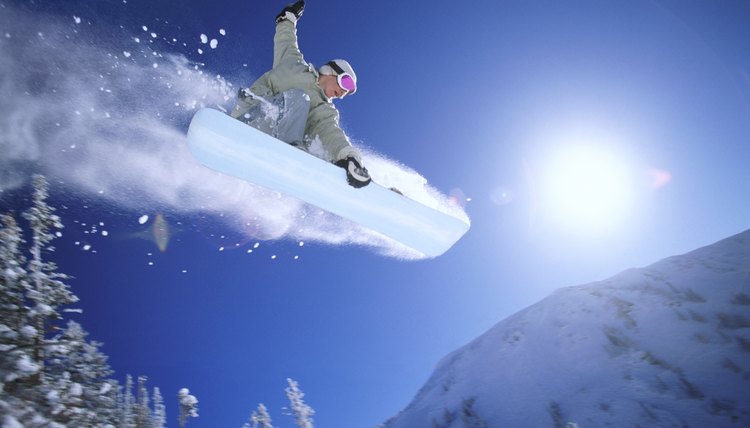
Snowboards and snowboarding have come a long way since the late 1970s, when they were initially being designed and produced in garages and home workshops from North America to Europe. Today's snowboards are designed for various uses, styles and functions, making many of them instruments of performance. Shape and flexibility greatly affects the way a snowboard will perform, resulting in the variety of shapes and flex patterns available.
A Freestyle Rider's Dream
A true twin tip, often shortened to " true twin," is a symmetrical board. It has exactly the same shape for the nose as it does for the tail of the snowboard. The flex pattern of a true twin is balanced as well, leaving the board to respond in the same manner forward as backward, and is preferred by many freestyle snowboarders. True twins also have centered stances, or a centered position for a rider's feet. This allows riders to keep their weight distributed equally across the length of the deck, enhancing control while maneuvering the board.
One Direction At a Time
Unlike true twins, directional snowboards generally have a longer nose and shorter tail. Directional snowboards have an asymmetrical flex pattern, with stiffer tails for carving better turns and keeping afloat through choppy snow and powder. They have softer noses than tails to further aid their ability to float. A directional snowboard has a stance that is set back from the center of the board. Keeping the rider's weight toward the tail reduces fatigue while snowboarding steeper and deeper terrain. You can ride directional boards in both directions, but their true strength is going forward through deep snow.
Best of Both Worlds
These are the do-everything, go-anywhere snowboards. Directional twins are a combination of true twins and directional snowboards, encompassing key elements of both designs to create one versatile deck that can do it all. Directional twins have a symmetrical flex pattern, but the shape of a directional board, with a longer nose and shorter tail. This design provides freestyle flexibility with the improved floatation qualities of a directional. Some directional twins may have a twin shape, better for riding in both directions, but matched with an asymmetrical flex pattern. The tail keeps stiff for turns and efficiency with the nose long and soft for powder and stability.
Choose the Right Board
With snowboarding growing rapidly and the quality equipment further enhancing the evolution of the sport, versatility may be the key factor when making choices. Many riders get comfortable on twin-tips or directional snowboards for general use, but the boards are tailored for a specific snowboarding style. If the entire mountain is in your sights, then a directional twin may be the board for you.
References
Writer Bio
Brandon Mathis has been freelance writing since 2007, covering health, mountain sports, lifestyle and travel. His work has appeared in "The Mountain Gazette," "The Durango Telegraph," "Inside/Outside Southwest Magazine," "Climbing Magazine" and more. With a Bachelor of Arts in humanities, he has a background in archeology, the winter sports industry and photography.