What does fact checked mean?
At Healthfully, we strive to deliver objective content that is accurate and up-to-date. Our team periodically reviews articles in order to ensure content quality. The sources cited below consist of evidence from peer-reviewed journals, prominent medical organizations, academic associations, and government data.
- Linus Pauling Institute: Iron
- Linus Pauling Institute: Seleneium
- Linus Pauling Institute: Folic Acid
The information contained on this site is for informational purposes only, and should not be used as a substitute for the advice of a professional health care provider. Please check with the appropriate physician regarding health questions and concerns. Although we strive to deliver accurate and up-to-date information, no guarantee to that effect is made.
The Health Benefits of Grits
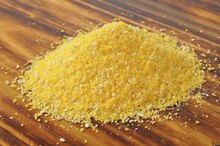
Corn has long been a staple in the American diet. In fact, Purdue University reports that it was cultivated more than 5,000 years ago. Corn grits, made by grinding whole-grain corn or hulled corn grains into a coarse powder, help to boost your grain intake, and each half-cup serving contributes 1 ounce of grains toward your daily recommended intake of 6 ounces for women and 7 for men, according to the U.S. Department of Agriculture. Cooked grits offer health benefits because they provide essential vitamins and minerals, and pairing them with healthy toppings makes for a nutrient-packed meal.
Nutrition Basics
Each half-cup serving of corn grits cooked in water contains 156 calories and provides 8 percent of the calories you need daily, based on a 2,000-calorie diet. Most of its calories -- 83 percent -- come from its carbohydrate content. Most of the carbs in grits provide energy, including fuel for your brain, while the 1.7 grams of dietary fiber it offers helps to lower your cholesterol and protect you from cardiovascular disease. Corn grits provide a small amount of protein, at 3 grams per serving, and contain less than a gram of fat.
- Each half-cup serving of corn grits cooked in water contains 156 calories and provides 8 percent of the calories you need daily, based on a 2,000-calorie diet.
Iron and Selenium
Cassava Benefits
Learn More
Corn grits also help you consume more iron and selenium. Each serving boasts 7 micrograms of selenium -- 13 percent of the recommended daily intake -- and 1.2 milligrams of iron. This provides 7 percent of the daily iron intake recommendation for women and 15 percent for men, set by the Institute of Medicine 3. Both iron and selenium activate proteins essential for good health. Iron-dependent proteins aid in blood circulation, help your cells produce energy and allow for DNA synthesis, while selenium-dependent proteins support muscle metabolism and aid in thyroid gland function.
- Corn grits also help you consume more iron and selenium.
- This provides 7 percent of the daily iron intake recommendation for women and 15 percent for men, set by the Institute of Medicine 3.
Vitamin B-9
Incorporate grits into your diet as a source of vitamin B-9, or folic acid. You need vitamin B-9 to metabolize amino acids and nucleic acids -- the building blocks used to make proteins and DNA, respectively. Vitamin B-9 might also play a role in DNA methylation, a process your cells use to regulate gene activity. Each serving of corn grits offers 93 micrograms of vitamin B-9 and provides 23 percent of your daily intake recommendation, set by the Institute of Medicine.
- Incorporate grits into your diet as a source of vitamin B-9, or folic acid.
Healthy Serving Tips
Rye Bread Vs. Multigrain Bread
Learn More
Keep your grits healthy by pairing them with healthful ingredients, such as fresh fruits and nuts. Add a handful of blueberries and an ounce of chopped raw almonds or top your grits with sliced strawberries and hazelnut butter. Alternatively, mix a mashed banana into your cooked grits, and then top with cinnamon and chopped walnuts for "banana bread" grits. Avoid toppings high in saturated fat, such as cheese or butter.
- Keep your grits healthy by pairing them with healthful ingredients, such as fresh fruits and nuts.
- Add a handful of blueberries and an ounce of chopped raw almonds or top your grits with sliced strawberries and hazelnut butter.
Related Articles

Cassava Benefits
Learn More
Rye Bread Vs. Multigrain Bread
Learn More

What Makes an English Muffin Healthy?
Learn More
The Nutrition in Lupine Seeds
Learn More

Wheat Chex Cereal Nutrition Information
Learn More
What Are the Benefits of Salmon Patties?
Learn More
How to Lose Weight With Spelt Bread
Learn More

The Carbohydrates in Glazed Doughnuts
Learn More

Are Cheerios Healthy?
Learn More
Grits Nutritional Value
Learn More
References
- Purdue University, Center for New Crops and Plant Products: Corn
- USDA National Nutrient Database: Cereals, Corn Grits, Yellow, Regular and Quick, Enriched, Dry
- Linus Pauling Institute: Iron
- Linus Pauling Institute: Seleneium
- Linus Pauling Institute: Folic Acid
- Celiac Disease Foundation. What Should I Eat? Fact Sheet.
Writer Bio
Sylvie Tremblay holds a Master of Science in molecular and cellular biology and has years of experience as a cancer researcher and neuroscientist.