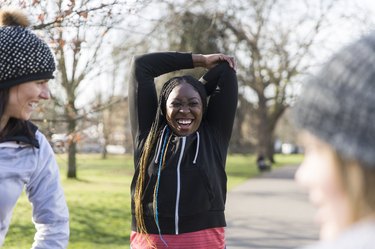
Swimsuit season is over, but don't let packing on the layers give you an excuse to pack up your workout gear. Fall is a time for turning inward, reflecting and getting cozy with a steaming mug of tea, a soft blanket and a book. But every Yin needs its Yang, and slow comfort should be balanced out with dynamic activity.
So while you're drawn to embrace the mindfulness that the season inspires, consider these exciting ways to lean into the adventure and energy that autumn has to offer to keep you active all season long.
Video of the Day
Video of the Day
1. Venture Into a National Park
"With some of the best terrain in the country, it's no surprise that many of our adventures are based in America's National Parks," says Viktor Marohnic, founder of 57Hours, a free app that connects adventurers with local guides. In fall, parks are less crowded, but the weather conditions are often better than in summer.
"Whether you're looking to take a beginner rock climbing course in Acadia National Park, a mountain bike tour in Moab, Utah, or guided hiking in the Grand Canyon, a local adventurer can show you the best spots and provide you with everything you need to tackle the activity to the fullest."
2. Get Creative With Outdoor Workouts
Spending time in nature can help reduce stress, according to a 2010 study from the International Journal of Environmental Research and Public Health. Even 20 minutes of outdoor exercise can make a big difference, and you can easily fit it in during lunchtime, on your walk home from work, or after dinner before sunset.
Here are some exercises Bonnie Micheli and Tracy Romer, co-founders and trainers at Shred415, recommend.
- Lunges in the grass: Grass is like a cushion, soft and gentle on your muscles, making it perfect for a warm-up lunge routine. Complete 10 reps of forward, sideways and backward lunges.
- Hill or stair sprints: Challenge yourself to five reps of hill or stair climbs, sprinting the incline and walking the decline.
- Squat jumps in the sand: Sand is a softer surface to complete high-impact exercises, like jumping. Try 10 squat jumps.
- Bench triceps dips and wall sits: Stop at a neighborhood or park bench and do some triceps dips, then hold a one-minute wall sit against the back of the bench.
- Park pull-ups and V-ups: Use the monkey bars or stand-alone bars at a playground to do pull-ups, and the nearby grass for V-ups.
- Trail running circuit: On a paved running trail, alternate two minutes running, one minute walking for 20 minutes, for a full-body workout.
3. Layer Up Against the Elements
Having the proper cold weather clothing and gear — extra layers, wind/waterproof shells, Smartwool socks, etc. — makes a huge difference in your comfort, which means you're more likely to stick to your exercise goals year-round.
While you don't need to drop a fortune on a shopping spree, certified trainer and MINDBODY wellness manager Kate Ligler recommends investing in one or two new pieces like a fuzzy fleece for warmth and comfort or reflective outerwear to help you stay safe as daylight hours wane.
4. Change Up Your Routine With "The Pumpkin Workout"
Pumpkin has been added to everything fall-related — why not add it to your fall workout? OK, maybe not really. But you can swap in a medicine ball or kettlebell in its place.
Elise Caira, trainer and owner of Sweat Fixx in Boston, Massachusetts, put together this creative lower-body workout. Set a 20-minute timer and get through as many rounds as you can, taking breaks and hydrating when you need it.
- Lunge Twist: Hold a medicine ball to your chest as you lunge forward and twist to one side. As you twist back to center, rise up and press the weight to the sky. Complete 10 reps, then switch sides.
- Step-Ups: Hold your medicine ball to your chest and step up onto a bench or chair one leg at a time. Complete 10 reps on one leg before switching.
- Squat Thrust: Start with your feet hip-width apart, medicine ball at your chest. Lower down into your squat, then straighten, pressing the ball overhead. Do 10 reps.
- Mountain Climbers: Start in a high plank, with your hands on a medicine ball. Keeping your hips down, drive one knee in toward your chest, then quickly switch legs. Do 20 reps total (10 on each leg).
5. Hit the Trails
Whether you're going for a hike or running the trails, a softer surface can reduce the impact on your joints and the uneven terrain can increase cognitive motor function and overall coordination, says Timothy Lyman, an American Council on Exercise-certified personal trainer and director of training programs at Fleet Feet in Pittsburgh.
While you're at it, Lyman suggests unplugging your ear buds and tuning into Mother Nature instead. "Running on a trail and listening to the sounds of nature is much more conducive to overall mental health than drowning out the sounds of sirens and car horns with loud music blasting through headphones."
Read more: The Top 10 Spectacular Fall Foliage Hikes
6. Connect Mind and Body
"In autumn, we all carry with us from childhood the 'back-to-school' rhythm of readiness for learning and a spirit of preparing for winter," says Sean Dennison, executive director of the Taoist Tai Chi Society of the USA.
This makes fall a perfect time to improve your mind-body connection with a restorative workout like Tai Chi or yoga. Not only can they help build strength and flexibility, but they can also help improve balance and relieve stress as a "moving meditation," working to focus your mind for clearer thinking.
7. Try a New Class
"If you have never tried a Pilates, barre or yoga class, find a local one and give it a
try," says Melissa Morris, a nutrition and applied kinesiology professor at the University of Tampa.
ClassPass, an app that lets you try classes at different locations, is a commitment-free way to test out what might just become your new favorite workout. Or try a streaming workout service at home for even more options to try something new every day.
8. Take Your Workout Indoors
"While there's nothing like running outdoors, fall can be a great time to embrace treadmill training. It's a perfect 'no-excuse' machine," says Leanne Pedante, Road Runners Club of America-certified run coach and head of training programs for STRIDE.
Or try indoor rowing, says Caley Crawford, certified personal trainer and director of education for Row House, which has taken its place beside indoor cycling and treadmill classes. If you have an indoor rowing machine at home or your gym, try this workout from Crawford:
- Warm up for three to five minutes.
- Start with 1250 meters at 85-percent effort.
- Take a break with strength-building floor work.
- Repeat for 5 rounds total, decreasing distance by 250 meters while increasing your intensity for each round.
- Cool down with a three-minute row at 40-percent effort, followed by two to three minutes of stretching.
Read more: Do Your Resolutions Need a Fall Reset?
9. Work Out With a Buddy
"Motivating yourself to work out can be hard when the seasons are changing, and the weather is unpredictable," says Caleb Backe, certified personal trainer and health expert for Maple Holistics. But with a workout buddy, you hold each other accountable rain or shine.
Start a lunchtime walking club at work or hold walk-and-talk meetings for a change of scenery. Check local coffee shops and community center boards for workout groups you can join. If you can't find one, start your own via Meetup, NextDoor or another local social media app.
- Viktor Marohnic, Founder of 57Hours
- Leanne Pedante, RRCA Certified Run Coach and Head of Training Program for STRIDE
- Bonni Micheli and Tracy Romer, co-founders and trainers at Shred415
- Caleb Backe, Certified Personal Trainer and Health Expert for Maple Holistics
- Certified Trainer and MINDBODY Wellness Manager Kate Ligler
- Dr. Melissa Morris, a nutrition and applied kinesiology professor at the University of Tampa
- Elise Caira, trainer and owner of Sweat Fixx in Boston, MA
- Timothy Lyman, an ACE certified personal trainer and Director of Training Programs at Fleet Feet in Pittsburgh
- Caley Crawford, NASM CPT and Director of Education for Row House
- Sean Dennison, Executive Director of the Taoist Tai Chi Society of the USA
Is this an emergency? If you are experiencing serious medical symptoms, please see the National Library of Medicine’s list of signs you need emergency medical attention or call 911.